National park in Rwanda
The drive north out of Kigali does most of the work of explaining Rwanda. Smooth tarmac, motorbike taxis, terraced hillsides stacked one above the next, and then, somewhere past the town of Musanze, a line of enormous cones lifts out of the farmland ahead of you and stops the conversation in the car. That is the Virunga chain, eight volcanoes strung along the borders of Rwanda, Uganda and the Democratic Republic of Congo, five of them standing inside this park. They rise straight from cultivated ground with no foothills to soften the transition, and on a clear morning you can see the whole row from the roadside, blue and steep and improbably large.
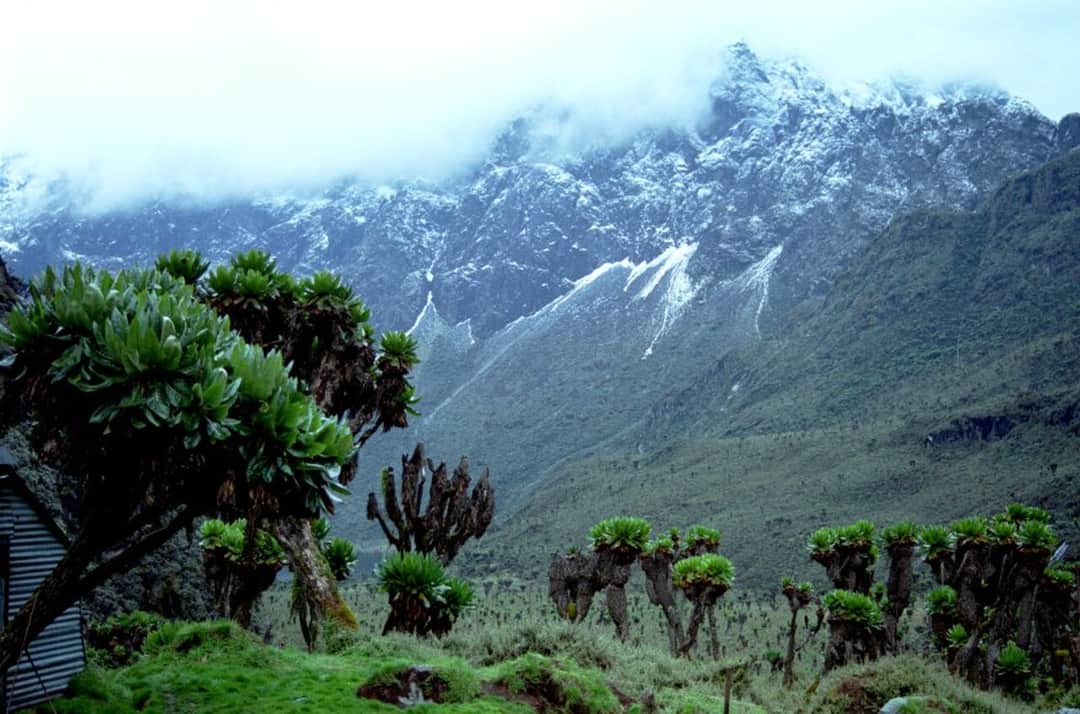
Volcanoes National Park protects around 160 square kilometres on the Rwandan side of that massif. Karisimbi is the giant at roughly 4,500 metres, snow dusted on rare mornings and usually wearing cloud. Bisoke holds a crater lake in its summit. Sabyinyo, whose name refers to old worn teeth, is the jagged one where three countries meet on the ridge. Muhabura and Gahinga complete the set. Between and below them the vegetation runs in bands you can watch change as you climb: bamboo first, then Hagenia and Hypericum woodland hung with lichen and old man's beard, then, high up, the strange afro-alpine world of giant lobelia and tree senecio that looks like it belongs on another continent.
Rwanda's real advantage is not the gorillas, which it shares with Uganda and Congo, but the two hours of good tarmac between Kigali airport and the park headquarters at Kinigi. That single fact reshapes what is possible. A gorilla visit here can be done in three days without anything feeling rushed: land, drive up, trek in the morning, drive back. In Uganda the equivalent trip is a week because Bwindi is eight to ten hours away on roads that punish you. Rwanda has built deliberately around that accessibility, positioning itself as the premium, low friction way into the Virungas, with lodges near Kinigi that are among the most expensive in Africa and an operation at the park gate that runs like a well drilled airport.
And the gorillas are only one of the reasons to be here. Golden monkeys, bright orange backed guenons found nowhere on earth except these volcanoes, are habituated and trekked in the bamboo zone, and a great many people rate that morning as highly as the gorilla one. This is where Dian Fossey built Karisoke and spent eighteen years, where she is buried among the gorillas she knew, and where the hike to her grave takes you into the story that made mountain gorillas famous. The volcanoes themselves are hikeable, from Bisoke as a hard day out to Karisimbi as a genuinely tough overnight. Each September the country holds Kwita Izina, a naming ceremony for the year's gorilla infants, which is unlike anything else in African conservation.
What you should not expect is solitude or a bargain. Permit numbers are strictly capped, the ones that exist are expensive by any measure and sell out for the dry months well ahead, and the terrain, while shorter and more open than Bwindi's, is still steep, wet and worked at altitude. Rwanda sells convenience and polish rather than wilderness. It delivers both, and it charges accordingly.
Best time to visit
The Virungas make their own weather and they make a lot of it. These are the first high ground that moist air hits, so cloud builds on the cones most afternoons regardless of season and rain is possible in every month. What changes is how much, and on these slopes the difference between damp and saturated is the difference between a firm climb and a four hour wrestle with mud.
June to mid September is the long dry season and the most reliable window. Trails hold together, the volcano hikes are actually enjoyable rather than an ordeal, and the mornings that reward you with the entire chain visible from Kinigi are far more common. This is also when Kwita Izina falls and when the park is at its fullest. Mid December to February is the shorter dry season and works nearly as well, with slightly more cloud and a Christmas peak in demand.
March to May is the long rains and the hardest time to be here. The bamboo drips constantly, the volcanic soil turns to a slick that takes your feet out from under you, and Bisoke or Karisimbi in that period is a serious undertaking rather than a hike. There is a counterargument and it is a decent one: the park is quiet, lodges are more available, the hillsides are impossibly green, and the gorillas tend to feed lower down when bamboo shoots are flushing, which can mean a shorter walk to reach them. October and November, the short rains, are gentler than March to May and represent the best value compromise most years.
One detail that matters more than the season: whatever month you come, trek in the first days of your stay rather than the last. If you are rained off, ill, or the family moves unusually far, having a spare day in the plan is the difference between a rescheduled morning and a lost permit. And pack for cold. You are at 2,400 metres and above before you take a single step, mornings at the briefing are genuinely chilly, and the summit camp on Karisimbi is close to freezing at night in every month of the year.
High season
June to September is the clear peak, followed by mid December to early January. Gorilla permits are capped at a small number per family per day and the dry season allocation is routinely gone months ahead, with the best lodges near Kinigi booking out further still. September carries the extra pull of Kwita Izina. April and May are by far the quietest, when permits and rooms can often be found at short notice.
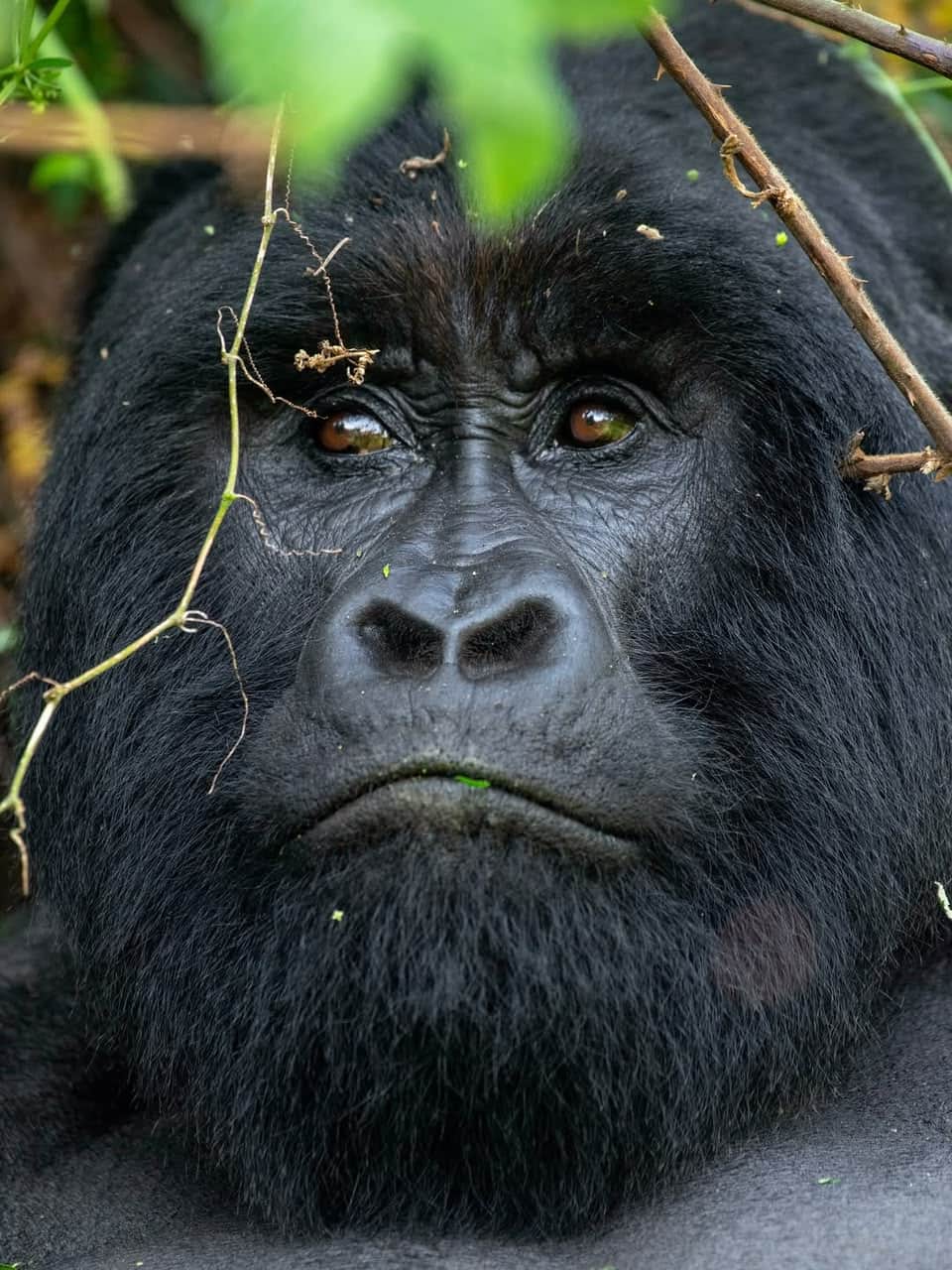
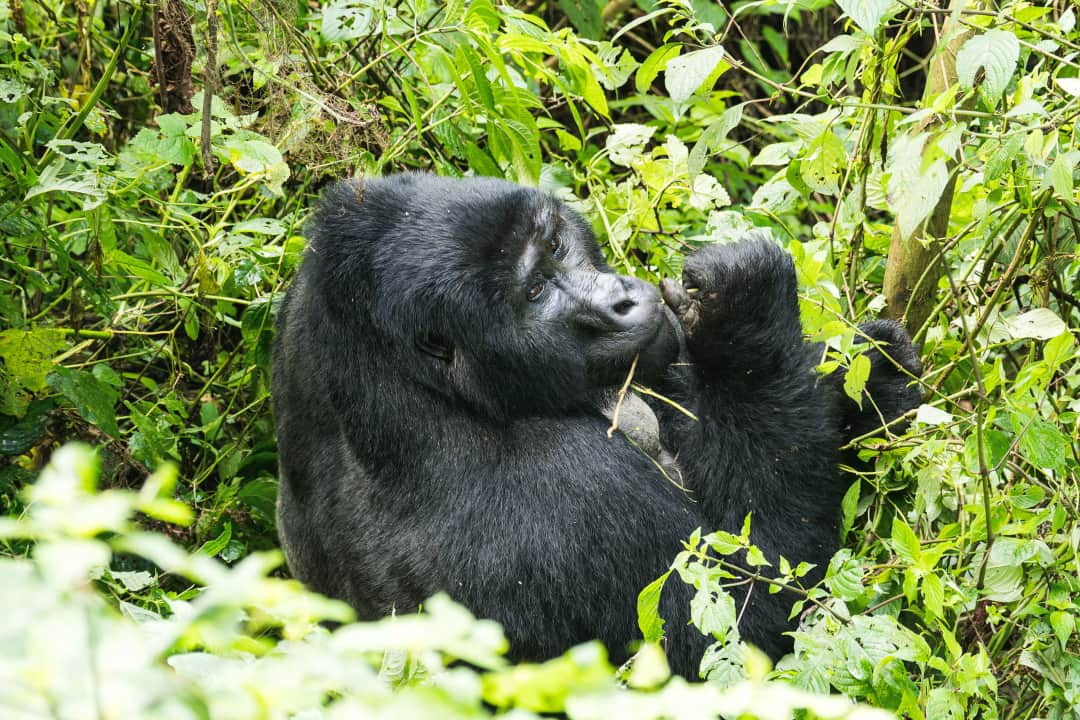
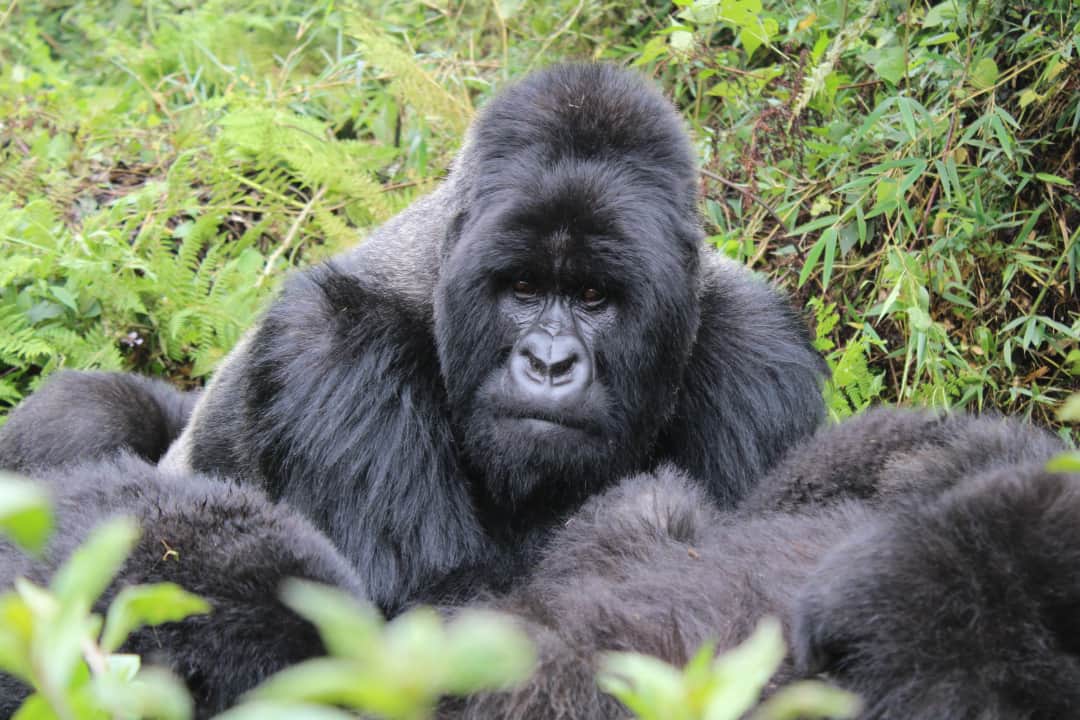
Mountain gorillas are why the permits sell out, and the experience here has a particular character shaped by the landscape. Because much of the park sits in bamboo and open Hagenia woodland rather than closed lowland forest, sightlines are frequently better than people expect, and photographs from Volcanoes tend to have more light in them than photographs from deeper forest. You get one hour, from the moment your guide starts the clock. A family at rest in a clearing, a silverback the size of a small car entirely unbothered by eight humans, infants using their mother as climbing apparatus, and the low rumbling contact calls that groups make constantly and that nobody warns you about beforehand.
The golden monkey deserves far more attention than it gets, and it is the strongest argument for adding a second day here. This is a Virunga endemic, a guenon with a blaze of burnt orange across its back and flanks, and it lives in troops that can run to well over a hundred animals in the bamboo belt. Trekking them is a shorter, lower and much easier walk than the gorillas, and the encounter is the opposite in tone: fast, noisy and chaotic, with animals crashing through bamboo stems, leaping between them and dropping shoots on your head while you try to keep a lens on something that will not stay still for two seconds. People arrive treating it as a filler activity and leave rating it among the best mornings of their trip.
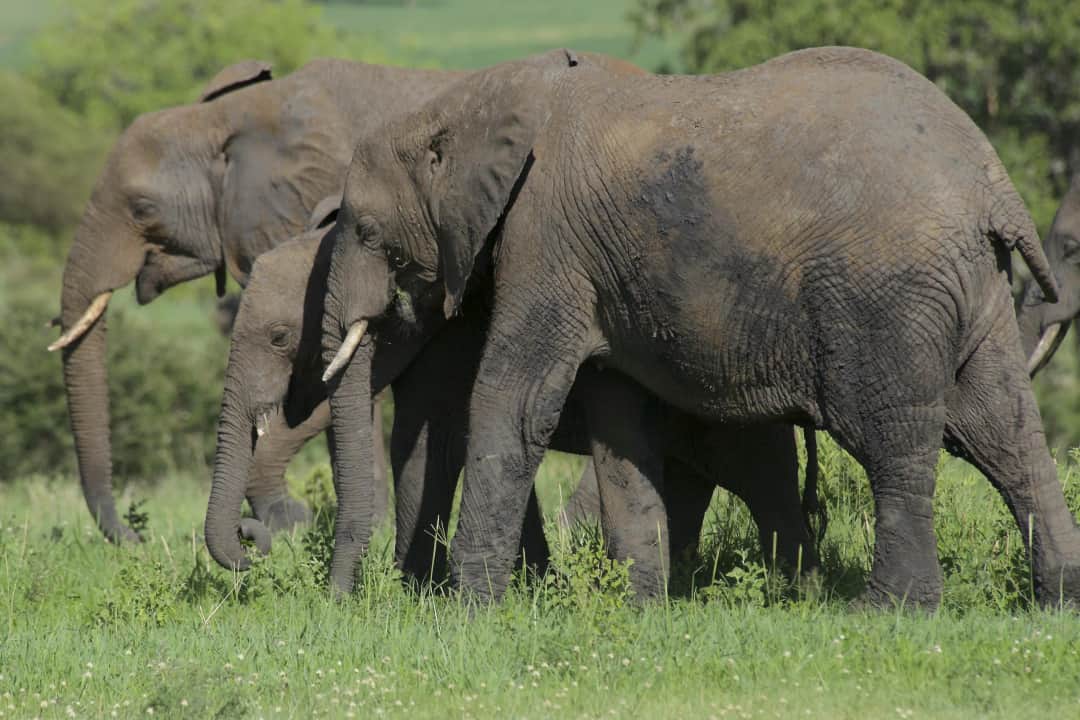
The rest of the mammal list is real but hard won, because dense bamboo and thick undergrowth hide a great deal. Buffalo are present and are the reason a dry stone wall runs along much of the park boundary and the reason your guide carries a rifle. Forest elephants exist in small numbers and are very seldom seen. Spotted hyena, bushbuck, black fronted duiker and golden cat are all on the list and almost none of it is on the itinerary. Treat every one of these as a bonus.
Birders should not overlook this park in favour of the gorillas. The Albertine Rift endemics are here, including the Rwenzori turaco with its crimson flight feathers, Rwenzori double collared sunbird, Rwenzori batis, handsome francolin and strange weaver, and the Hagenia zone on the way up Bisoke is a productive stretch if your guide is willing to slow down. The higher afro-alpine vegetation is worth attention in its own right: giant lobelias standing like green candelabra and tree groundsel three metres tall, a plant community found only on a handful of East African mountains.
Gorilla trekking from Kinigi
Everything starts at the park headquarters at Kinigi, where visitors gather from around seven in the morning for coffee, a briefing and, usually, a performance by Intore dancers while guides sort people into groups. The allocation is done on the day and takes account of fitness, so be candid rather than heroic. From the briefing you drive to a trailhead, often up a track through potato and pyrethrum fields, and then walk across farmland to the dry stone buffalo wall that marks the park boundary. Stepping over that wall is one of the sharpest transitions in African travel: cultivation on one side, bamboo forest on the other, with nothing in between. Trackers have been with the family since dawn and radio their position through. Walks range from around forty minutes to four hours each way depending on where the family has moved, and while the ground is steep and wet, the distances tend to be shorter than in Bwindi. You get an hour with them. Masks are commonly required and anyone with cold symptoms is asked to stand down, because human respiratory infections can kill gorillas.
Golden monkey trekking
Book this as well as the gorillas rather than instead of them, and treat it as a genuine second reason to be in Rwanda. Golden monkeys live only in the Virunga bamboo and are found nowhere else, and the habituated troops here are large, active and completely uninterested in your presence. The walk is short, mostly gentle and at lower altitude than a gorilla trek, which also makes it the sensible choice for anyone who wants a forest morning without the climb, or a second activity for legs that are already finished. Once you are among them the pace changes completely: animals moving fast through bamboo above and around you, stems whipping, shoots falling, constant chatter. Photographing them is properly difficult in low bamboo light with a subject that never stops, which is part of the fun. An hour with them costs a fraction of a gorilla permit and is one of the best value mornings in the country.
The Dian Fossey grave hike and the Karisoke story
In 1967 Dian Fossey established the Karisoke Research Center in the saddle between Karisimbi and Bisoke, and spent eighteen years there studying mountain gorillas and fighting poaching with methods that made her enemies. She was murdered at the camp in December 1985 and is buried in the graveyard she had made for gorillas she knew, next to Digit, the young male whose killing turned her campaign public. The hike up to the site takes roughly two to three hours each way through Hagenia woodland and a long unpleasant stretch of stinging nettles, and the original camp buildings are gone, so what you find is a clearing, a row of gorilla graves and her headstone. It is a quieter and more affecting morning than that description suggests, and a guide who tells the story properly makes it. Combine it with a visit to the Dian Fossey Gorilla Fund's research and visitor campus down at Kinigi, which explains the science that has continued since.
Climbing Bisoke to the crater lake
Bisoke is the day hike of the park and, at around 3,700 metres, the most popular non gorilla activity here. It is a straight up, straight down affair of roughly five to seven hours in total, and there is no gentle section: the trail climbs continuously through bamboo, then Hagenia woodland, then into low alpine scrub, and the volcanic soil is slick in a way that catches out even experienced hikers. Gaiters and a stick earn their place. At the top you reach the rim of a near perfect circular crater holding a lake, dark and still and usually curtained in and out by moving cloud, and if you get one of those windows when the cloud lifts, the view along the chain into Congo is the payoff for the entire climb. Start early, because afternoon weather here is dependable in the wrong way. Do not attempt it on the same day as a gorilla trek.
The Karisimbi overnight climb
Karisimbi, at roughly 4,500 metres, is the highest of the Virungas and a completely different proposition from Bisoke. It is a two day climb with a night in a very basic camp at around 3,700 metres, and the second day starts in the dark and works up through afro-alpine vegetation and then loose volcanic scree to a broad summit that is frequently in cloud and occasionally dusted with hail or snow. The camp is cold, genuinely cold, and there is no comfort in it. Altitude affects people at this height and the descent on the second afternoon is long and hard on the knees. Nobody should book this casually or as an add on. Book it if you are a hiker who wants a mountain rather than a viewpoint, if your knees are sound, and if you have a spare day in the plan for weather. Those who do it rate the sunrise from the upper slopes, above cloud with the whole chain below, as the best thing they did in Rwanda.
The other cones: Sabyinyo, Muhabura and Gahinga
Three more volcanoes are open to hikers and each attracts a fraction of the traffic Bisoke gets. Sabyinyo is the ragged, deeply eroded one, and its route climbs a long series of ridges and ladders to a summit where Rwanda, Uganda and the Democratic Republic of Congo meet, so you can stand in three countries at once. Muhabura is a relentless conical grind with a small crater lake at the top and, on a rare clear day, the widest view in the range, taking in Lake Kivu, the Bwindi hills and the smoking Nyiragongo away to the west. Gahinga is the shortest and gentlest of the three, a half day with a swampy crater at its summit, and it makes a good acclimatisation walk or a second activity for a rest day. All three are steep, all three are muddy after rain, and all three are worth considering if you would rather spend a second day walking than shopping for souvenirs in Musanze.
Musanze, the caves and the twin lakes
Musanze, the town at the foot of the volcanoes and formerly known as Ruhengeri, is where most non lodge life happens and it is a pleasant, busy place with good coffee and a genuinely useful market. Just outside it, the Musanze caves are lava tubes running for kilometres beneath the fields, with collapsed roof sections that throw shafts of light down into the dark and colonies of bats overhead. It is an easy, well managed hour and a good afternoon after an early trek. Twenty minutes further, the twin lakes of Burera and Ruhondo sit in deep volcanic basins with the cones behind them, and a canoe out on the water with fishermen working the shallows is about as calm as this country gets. Lake Kivu at Rubavu is roughly an hour and a half west and makes an easy soft landing at the end of a trip, with swimming that is safe from both bilharzia and crocodiles.
Kwita Izina and the communities around the park
Kwita Izina is Rwanda's annual gorilla naming ceremony, borrowed directly from the tradition of naming a newborn child, and it is held near the park with an enormous crowd, dancing, speeches and a namer for each infant born in the preceding year. It began in 2005 and has grown into the centrepiece of the country's conservation calendar, usually in September. Attending it, if your dates line up, gives you a very different picture of how Rwanda thinks about these animals, as national assets and a shared national story rather than as a tourist product. Around the same theme, the community villages near Kinigi run cultural visits with former poachers, traditional healers, brewing and archery, and a share of park revenue is directed by policy into local infrastructure. It is a deliberate answer to the hardest question in this landscape, which is why a farmer with two hectares should tolerate a protected forest full of buffalo next to the crops.
National park
Volcanoes National Park
Take it with you
Everything on this page in one document you can keep, print, or send to whoever you are travelling with. No email required.
Answer the question of how many days you have first, because it usually settles the rest. Rwanda is faster, more polished and considerably more expensive: Kigali to the park gate is about two hours on tarmac, the operation at Kinigi is slick, the lodges are excellent, and a three or four day trip works properly. Uganda's Bwindi is cheaper on the permit, but it is eight to ten hours from Entebbe on much harder roads, which means committing a week, and the forest there is denser, wilder and better for birds, with a four hour habituation option Rwanda does not offer. Neither has better gorillas. If your holiday is short or you are adding gorillas to a business trip or another East African itinerary, come to Rwanda. If you want an expedition and are watching the budget, go to Bwindi.
Moderately hard, and easier than Bwindi in general, though that is a low bar. Most of the difficulty comes from three things: the gradient, since these are volcanic cones with no gentle ground, the mud, which is slick and deep after rain, and the altitude, since you start at around 2,400 metres and climb from there. Distances are usually shorter than in Uganda, and walks tend to run from around forty minutes to three hours each way. Rangers assign visitors to gorilla families partly on stated fitness, so tell them honestly at the briefing what you can manage. Anyone who is reasonably mobile can do this with a porter's help. For those who genuinely cannot walk far, sedan chair carries can be arranged in advance through your operator, and they are used regularly.
Three nights is realistic and this is Rwanda's central selling point. Land in Kigali, drive up to Musanze or Kinigi the same afternoon, trek the following morning, and either drive back that afternoon or, better, stay a second night, do golden monkeys or the Fossey hike the next morning and return to Kigali after lunch. Four nights lets you add a volcano climb or Lake Kivu without hurrying. What you should not do is fly in and out on consecutive days with a single trek squeezed between, because weather, a family that has moved far overnight, or a stomach upset then costs you the entire reason for the trip. Build in one spare day and put the gorilla permit early in the stay rather than on your last morning.
Yes, and the people who skip them tend to regret it. Golden monkeys are found nowhere in the world except the Virunga volcanoes, the troops are large and lively, and the encounter is fast, loud and completely different in character from the stillness of an hour with gorillas. Practically, it is a shorter and much easier walk at lower altitude, which makes it a sensible second day when your legs are tired, and the permit costs a small fraction of a gorilla permit. It is also the best option for anyone in a group who is not trekking gorillas, and for photographers it is a genuine challenge given how quickly the animals move through dark bamboo. Book it alongside your gorilla permit rather than hoping to add it on arrival.
For a gorilla or golden monkey trek, almost certainly not, though you will notice you are breathing harder than the gradient seems to justify, and that is the altitude rather than your fitness. Trailheads sit around 2,400 to 2,600 metres and most treks stay below 3,000. The volcano climbs are a different matter. Bisoke tops out near 3,700 metres and Karisimbi around 4,500, where headaches, nausea and poor sleep are common, particularly if you have flown in from sea level a day or two before. If Karisimbi is on your list, arrive a few days early, do Bisoke or Gahinga first as acclimatisation, drink far more water than feels necessary, and be prepared to turn round. Altitude is the one thing on this mountain that willpower does not fix.
Waterproof boots with real ankle support and aggressive grip, because volcanic mud is slick and the descents are where people fall. Gaiters are more useful here than almost anywhere, both for mud and for the nettles, which are constant on the Fossey hike in particular. Long trousers, long sleeves, and cheap gardening gloves so you can grab stems and bamboo without shredding your hands. Add a waterproof jacket in every month, a warm layer for the cold briefing at Kinigi, two litres of water and a dry bag for camera gear. Bring gaiters and a stick even if you are only doing the gorillas. Hire a porter at the trailhead: it is inexpensive, the physical help is real, and it channels money directly into the communities living against the park boundary.
Not formally, but in practice sightings are close to routine, because trackers follow each habituated family every day and know roughly where they are before your group leaves the briefing. The genuine uncertainties are how far you will walk, whether the vegetation gives you a clean view or a partly screened one, and how active the family is when you arrive. Occasionally a group moves across the border into Congo and a trek is redirected. More often the disappointment is smaller and more personal: cloud, rain, and an hour that goes faster than anyone is ready for. What no operator can promise is a particular family, a silverback in the open, or good light, so treat those as luck rather than as the plan.
Comfortably, and it is one of the best reasons to give Rwanda four or five days rather than three. The sensible sequence is to trek gorillas first while you are fresh, take the golden monkeys or the Fossey grave hike as a middle day, and put Bisoke towards the end when your legs have adjusted to the altitude and the mud. Do not stack a gorilla trek and Bisoke on the same day, because either can run long and both are steep. Karisimbi needs its own two days and a spare one for weather, so if it is on your list, plan the trip around the mountain and treat the gorillas as the fixed appointment inside it. All of these start from the same headquarters at Kinigi, so nothing requires moving lodges.
Rwanda enforces a minimum age for gorilla trekking and does so strictly, so families with younger children need to plan around it rather than hope. That is less limiting than it sounds here, because the area gives non trekkers plenty to do: the Musanze caves, the twin lakes of Burera and Ruhondo, cultural villages near Kinigi, the Dian Fossey Gorilla Fund campus, and Lake Kivu an hour and a half away. Several lodges run childcare and shorter guided walks for exactly this reason. Health rules cut in the other direction and are taken seriously: anyone with a cold, flu or stomach illness will be asked not to trek, because human respiratory infections can pass to gorillas and kill them. Talk to your operator about permit terms in that situation before you travel, not on the morning.