Region in Morocco
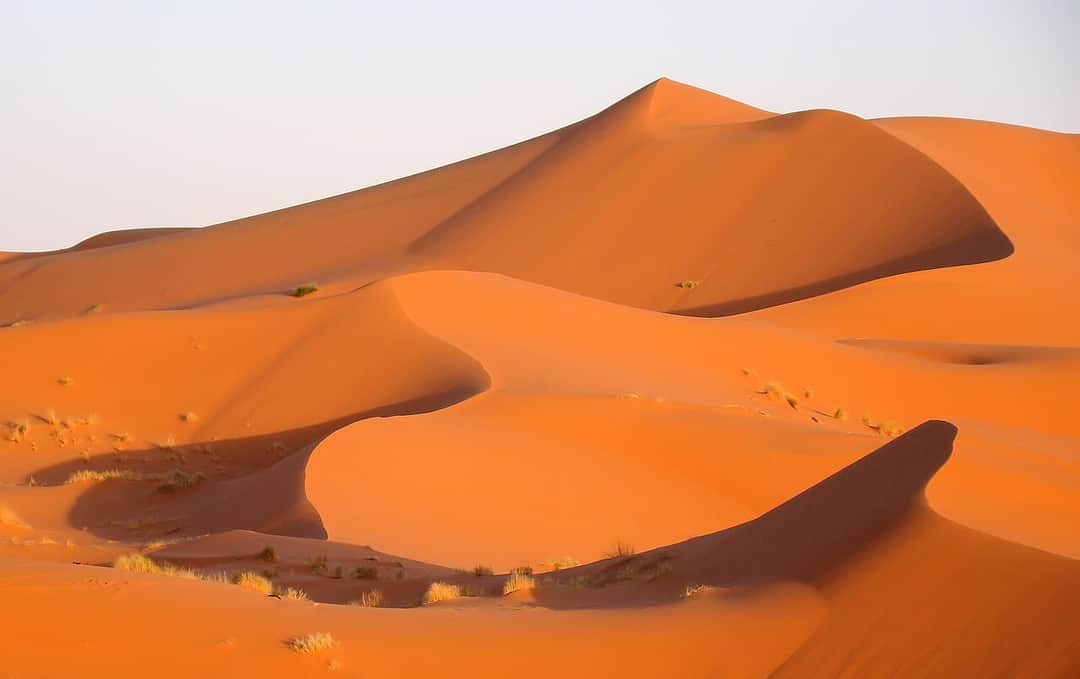
Merzouga is a small village on the edge of Erg Chebbi, the sand sea that supplies almost every photograph of the Moroccan Sahara you have ever seen. The erg runs roughly twenty kilometres north to south, a few kilometres wide, and its highest dunes rise well over a hundred metres above the flat stony ground around them. What makes it so photogenic is the abruptness. There is no gradual build up of sand. You drive across a hard, grey, gravelly plain that looks like nothing at all, come around a bend, and a wall of orange sand simply stands there against the sky.
The first thing anyone planning this trip needs to absorb is the distance. Merzouga is around 560 kilometres from Marrakech, most of it over the Tizi n'Tichka pass and along winding gorge roads, and it is not a day trip under any circumstances. The standard trip is three days and two nights: a long first day over the High Atlas with stops at Ait Ben Haddou and Ouarzazate, a night in the Dades valley, a second morning through the Todra gorge and the Ziz oases, arrival at Erg Chebbi in the afternoon, the camel trek and the camp, then a single very long drive back to Marrakech on day three. Judged as a Sahara trip, that itinerary gives you about eighteen hours in the desert and roughly twenty hours in a vehicle, so the only way to enjoy it is to decide in advance that the road is part of the holiday rather than the price of it.
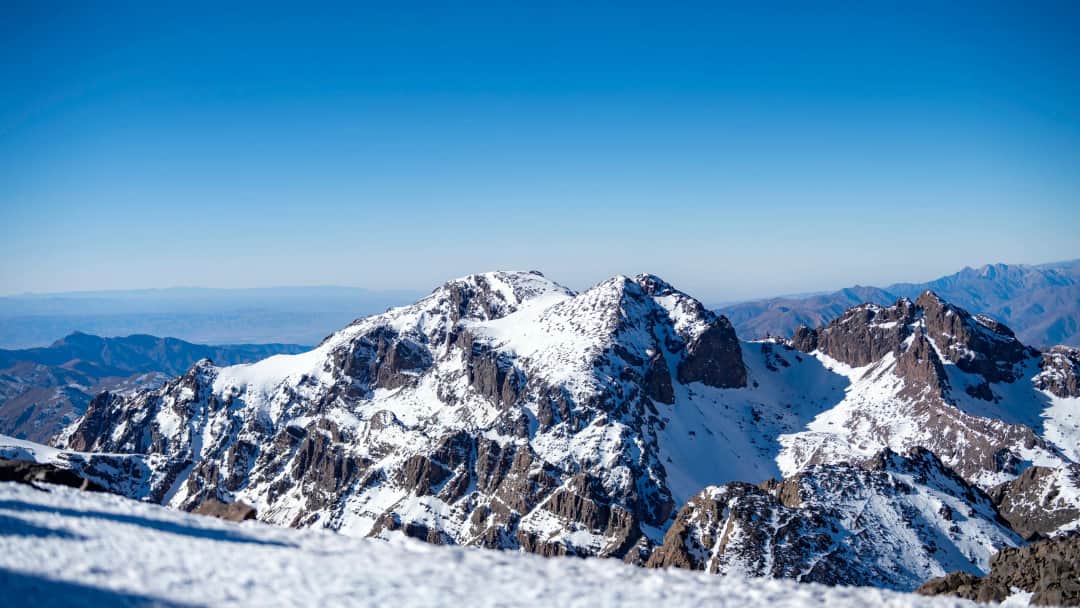
Fortunately the road genuinely earns that. The Tichka pass climbs into bare Atlas ridges with snow on them half the year. Ait Ben Haddou is a fortified earthen village stacked up a hillside that has stood in for half the ancient world on film. The Dades and Todra gorges cut vertical red walls hundreds of metres high with a river and a strip of palms at the bottom, and the run down the Ziz valley toward Erfoud drops you into a continuous green ribbon of date palms with mud brick ksour standing above it. That sequence, mountains to gorges to palmeries to sand, is a better description of southern Morocco than the dunes alone.
The desert night itself follows a pattern that has hardened into a formula, and the formula works. You arrive at a village on the sand's edge in mid afternoon, leave your main bag at a hotel and take an overnight bag, and mount a dromedary in a string of six or eight for the ride into the dunes, an hour to ninety minutes at the pace of a slow walk. You reach camp as the light goes orange, walk up the nearest big dune for sunset, eat tagine under a canvas awning, and listen to the camp staff play drums after dinner. Then people drift away from the fire, lie back on the sand, and find that the sky has more stars in it than they have ever seen. Someone always sets an alarm for sunrise, climbs a dune in the dark, and watches the shadows peel back off the ridges.
Be clear eyed about what this is. Erg Chebbi is the accessible, developed face of the Moroccan Sahara, with dozens of camps spread through the dunes and hotels lining the sand's edge at Merzouga and Hassilabied. It is not remote and you will not be alone. It is still, unmistakably, real desert: the silence at three in the morning, the cold that comes down after dark in winter, and the way the sand takes your footprints and erases them by morning are not staged for anyone. Go with the right expectations and it delivers everything it is supposed to.
Best time to visit
October and November are the best weeks of the year here, closely followed by March and April. Daytime temperatures are warm rather than hostile, the sand is comfortable to walk on barefoot in the evening, and the nights are cool enough for a jacket without being punishing. Those months also give you the most reliable light for photographs, with clear low sun in the mornings and evenings rather than the heat haze that flattens everything in summer.
Winter, from December to February, is underrated and the biggest surprise for most visitors. Days are usually pleasant and clear, often in the high teens or low twenties, and the light is excellent. What catches people out is the night. Temperatures in a desert camp in January can fall to freezing or below, and every year visitors arrive with a fleece and a thin jacket, having packed for their idea of the Sahara rather than for the actual place. Camps supply thick blankets and many have wood stoves or heaters, but you need proper warm clothing, a hat and socks for the night. Christmas and New Year are also the busiest dates of the year at Erg Chebbi.
Summer, roughly late May through August, is the season to avoid if you have any choice. Daytime temperatures regularly pass forty five degrees, the sand becomes too hot to walk on in bare feet by mid morning, and the afternoon camel trek is genuinely uncomfortable. It is also not merely unpleasant but a real health risk for older travellers and children, and heat exhaustion sends people to hospital from this area every summer. If your dates are fixed in summer, camps push everything later into the evening and many have air conditioned rooms at the sand's edge instead of tents, which is a sensible compromise. The long drive from Marrakech in a minibus in August is its own ordeal.
One seasonal detail worth planning around: spring brings the chergui, a hot dry wind out of the east that can raise dust and sand for a day or two at a time, most often between March and May. It does not usually cancel anything, but it can turn a promised horizon into a brown blur and it makes the dunes unpleasant while it blows. The same spring months are when Dayet Srji, the shallow seasonal lake outside Merzouga, is most likely to hold water and attract flamingos, so the trade off runs both ways.
High season
The two peaks are October to early November and March to April, when tour minibuses from Marrakech and Fes run at capacity and the better camps book out weeks ahead. Christmas and New Year is a short, very busy third peak with cold nights and full camps. July and August are quiet at the dunes because of the heat, which means lower prices and available beds if you can tolerate it. Late January and February are the calmest weeks with good conditions.
The stony plains and the erg look empty in the middle of the day and they largely are, because almost everything that lives here waits out the heat underground and comes out at night. Walk out from camp in the early morning and the story is written across the sand: the neat parallel prints of a jerboa that landed and bounded away, the drag line of a beetle, the wandering track of a lizard, and if you are lucky the small round prints of a fennec fox that circled the kitchen tent while everyone slept. Guides read these easily and will show you what passed by, which is a far better introduction to desert life than hoping to see the animals themselves.
Birds are the exception, and Merzouga is genuinely well known among birdwatchers, which surprises people who came only for sand. The desert sparrow, a pale bird found in very few accessible places, breeds around the villages and hotels at the edge of the erg. Brown necked ravens patrol the camps, desert wheatears and hoopoe larks work the gravel plains, and cream coloured coursers run rather than fly across the flats. In spring, migrants funnel through in numbers. The real draw is Dayet Srji, a shallow seasonal lake a few kilometres from Merzouga that fills after good winter rain and can hold flamingos, ducks and waders for a few weeks in a landscape where standing water seems impossible. In a dry year it is a cracked white pan with nothing on it, so treat it as a bonus rather than a plan.
The vegetation tells the same story of scarcity. Tamarisk grows where there is any moisture at all, thorny acacias stand alone on the plains with grazing lines cut flat underneath them by goats and dromedaries, and after rain a thin green haze of ephemeral plants appears across the gravel and is gone within weeks. The date palmeries around Rissani and along the Ziz are the opposite extreme, dense irrigated forests of palms fed by khettaras, underground channels dug by hand and marked on the surface by lines of spoil mounds running for kilometres across the desert.
The animal you will actually spend time with is the dromedary, the single humped camel that carries you into the dunes. Ask about the animals if it matters to you: reputable operators limit the number of trips a dromedary makes per day, keep the loads reasonable and rest them in the hottest months, while cheap operators do not. The other human presence worth knowing about is the nomadic and semi nomadic families who still move with goats and dromedaries across this country, living in low black tents and moving with the grazing. Some 4x4 excursions include a visit, and done respectfully with a guide who knows the family it is one of the more genuine encounters available here.
The road down: Ait Ben Haddou, Ouarzazate and the gorges
Treat the two days of driving as sightseeing and the whole trip improves. Leaving Marrakech you cross the High Atlas at the Tizi n'Tichka pass, a long climb through bare ridges with argan and walnut villages below, then drop to Ait Ben Haddou, a fortified ksar of packed earth towers stacked up a hillside above a river, best walked up through to the granary at the top for the view back over the valley. Ouarzazate follows, with its film studios and the Taourirt kasbah, then the Skoura palm grove and the Valley of Roses where the fields are harvested for rose water each May. The Dades gorge, where most tours spend the first night, has a famous set of hairpin switchbacks stacked up a red cliff, and the next morning the Todra gorge narrows to a slot with vertical walls three hundred metres high and a stream running through the bottom, popular with rock climbers. Push your operator on how long the stops actually are, because rushed tours reduce all of this to photo breaks.
The camel trek into Erg Chebbi
The classic arrival at camp is on a dromedary, in a string led on foot by a guide, setting off from the sand's edge in the late afternoon so you are in the dunes for sunset. It takes an hour to ninety minutes depending on which camp you are booked into, and the rhythm is a slow lurching sway that is charming for twenty minutes and hard work on the hips and lower back for the rest. Wear long trousers, cover your head, and take the offered scarf, because the low sun is stronger than it feels. The moment that justifies the whole thing comes when the string crests a ridge and the erg opens up in front, ridge after ridge of sand with nothing else in sight. If you have back problems, are heavily pregnant, or simply dislike the idea, every camp can transfer you by 4x4 instead, and there is no shame in it. Ask when you book rather than on the day.
A night at a desert camp, basic or luxury
Camps at Erg Chebbi fall into two broad categories and the difference is worth understanding before you book. A standard camp gives you a canvas or wool tent with a bed and blankets, shared toilets and washing facilities in a block at the edge of the camp, communal dinner of harira soup and tagine, and drumming around a fire afterwards. A luxury camp gives you a large tent with a proper bed, an en suite bathroom with hot water, rugs, lighting and often a private dining area, at several times the price. The desert is identical from both. What you are buying is a private toilet and a better mattress, which for some people is the difference between enjoying the night and enduring it, and for others is money better spent on an extra night. Whichever you choose, confirm the camp is actually inside the dunes rather than parked at the edge, because some cheap tours never leave the roadside.
Sunrise and sunset from the dunes
The dunes are only spectacular for about ninety minutes at each end of the day, and knowing that changes how you plan. When the sun is low the ridges split into a sharp orange face and a black shadowed face, the wind ripples on the sand throw their own tiny shadows, and the whole erg looks carved. At midday it is a flat, glaring, colourless place and photographs of it are disappointing. So climb a dune for sunset before dinner, and set an alarm for at least forty minutes before sunrise, because getting up a big dune in soft sand takes far longer than it looks: you step up and slide back, and the trick is to walk on the very crest of the ridge where the sand is firmer. Take shoes off and go barefoot, which is easier than boots full of sand, and do not leave your camera on the ground where fine sand will find it.
Sandboarding and dune walking
Almost every camp keeps a stack of sandboards, and riding one down a big face is exactly as fun and as inelegant as it sounds. Sand is much slower than snow, so you will need a steep face and someone to wax the board, and expect to spend more time climbing back up than sliding down. It is best done in the cool of early morning or late evening. Walking the dunes is the quieter pleasure and it is worth doing properly: get someone to point you at a ridge line, follow the crest for half an hour, and stop somewhere out of sight of the camp. The silence in the erg away from people is total in a way most visitors have never experienced, and it is the thing they remember longest. Keep camp in view or take a guide, because dune fields disorientate people very quickly and one ridge looks exactly like the next.
Khamlia, the Gnawa villages and the 4x4 circuit
The half day 4x4 circuit out of Merzouga is more interesting than it first appears. Khamlia, a village a few kilometres south, is home to a community descended from sub Saharan Africans brought north across the desert, and its Gnawa musicians perform sessions of hypnotic call and response driven by the metal qraqeb castanets and the three stringed guembri, which for many visitors is the cultural highlight of the trip. The same circuit usually takes in the abandoned mine workings and their black slag heaps, a stop with a nomadic family living in a tent on the plains, and a look at Dayet Srji, which in the right season holds water and flamingos. Quad bikes are available everywhere and are the one activity worth thinking twice about, since they are noisy, they cut up the dunes and they carry the whole camp's silence away with them.
Rissani market and the fossils of Erfoud
Rissani, half an hour from Merzouga, is the historic capital of the Tafilalt oasis and the ancestral home of Morocco's ruling dynasty, and its market on market days is a working regional souk rather than a tourist one: donkeys parked in rows, dates by the sack, live animals, spices and hardware. Try medfouna, a stuffed flatbread baked in an oven and often called Berber pizza, which is a local speciality. Erfoud, further north, is the fossil town, built on Devonian seabeds packed with orthoceras and goniatites, and its workshops cut and polish the black stone into tables, basins and slabs. Watching a slab being cut and polished is genuinely interesting, and small pieces make far better souvenirs than most of what is sold in Marrakech. Both towns fit into a morning if you have an extra day, which is one of the better arguments for not rushing back.
Erg Chigaga as the remoter alternative
If solitude matters more to you than convenience, Erg Chigaga is the other option. It lies far to the west, beyond M'Hamid at the end of the Draa valley, and reaching it means a rough hour or two by 4x4 across open desert after an already long drive from Marrakech via Ouarzazate and Zagora. It is bigger, higher and far less developed than Erg Chebbi, with a fraction of the camps and no village at its edge. The trade off is real: access is harder, choice of camps is smaller, and there is nothing like the Rissani and Erfoud circuit nearby to fill an extra day. Erg Chebbi is the right choice for a first Sahara trip and for anyone on tight time. Erg Chigaga is the right choice for a second visit, for photographers, and for anyone who reacts badly to the idea of other camps within sight.
Region
Sahara Desert (Merzouga)
Take it with you
Everything on this page in one document you can keep, print, or send to whoever you are travelling with. No email required.
From Marrakech it is around 560 kilometres and eight to ten hours of driving in one go, which nobody sensibly does, so it is broken across two days with an overnight in the Dades or Todra area. From Fes it is shorter, roughly seven to eight hours, running through Ifrane and the cedar forests, Midelt and down the Ziz valley, and it can be done in a single long day. That difference is why a lot of well planned itineraries go one way and out the other, arriving from Marrakech and leaving toward Fes, which removes an entire day of retracing the same road. Overnight buses also run from Marrakech and daily services from Fes if you would rather not sit in a tour minibus, and it is possible to fly into Errachidia and drive the last stretch.
It is enough to say you have done it and it is what almost every package sells, but two nights is a much better trip and it is the single upgrade most people wish they had bought. With one night you arrive in the late afternoon, ride in, eat, sleep badly because you are excited and the tent is unfamiliar, watch sunrise and leave. With two you get a full day at the dunes, which is when the Khamlia trip, the Rissani market, sandboarding and a proper long walk into the erg become possible, and the second night is when the place actually settles on you. If you cannot spare a second desert night, at least avoid the version that drives all the way back to Marrakech on the third day without a break.
At a standard camp there is a separate block of shared toilets and washbasins, usually flushing but sometimes chemical, with cold or lukewarm water and no realistic prospect of a hot shower. It is clean at the better camps and less so at the cheapest ones. Luxury camps have private en suite bathrooms in each tent with hot water. Most people leave their main luggage at a hotel on the sand's edge and take an overnight bag, and many arrange to shower at that hotel the next morning before driving on, which is a good habit whichever camp you choose. Take a head torch, wet wipes and hand sanitiser, and be aware that electricity in camp is typically solar and limited to lighting and a few charging points.
Warm clothing is the item people get wrong. Even in spring and autumn the temperature drops sharply once the sun goes, and in December and January it can reach freezing, so bring a proper jacket, a hat and socks to sleep in. For the day, cover up rather than strip off: long sleeves and a scarf are far more comfortable than sunburnt shoulders, and a scarf over the mouth is genuinely useful if the wind gets up. Add strong sun cream, sunglasses, a head torch, a refillable water bottle, wet wipes, any medication in your overnight bag rather than the one you leave behind, and shoes you can empty easily. Leave anything precious that hates fine dust in your main luggage, because sand gets into cameras and phone ports without much effort.
You do not have to. Every camp can bring guests in by 4x4, and people with back problems, hip issues or a straightforward dislike of the idea take that option regularly. Just say so when you book rather than at the sand's edge. On welfare, standards vary and it is fair to ask: better operators limit how many trips each dromedary makes in a day, keep loads sensible, rest them in the hottest months and keep the animals in visibly good condition. If you arrive and the animals look thin or sore, it is entirely reasonable to decline and walk or drive in instead. The ride itself is about an hour, at walking pace, and it is more uncomfortable than most people expect, mostly on the lower back.
Erg Chebbi at Merzouga is the more accessible and more developed of the two, with the widest choice of camps at every price level, a village at its edge, and the Rissani, Erfoud and Khamlia circuit within easy reach for a second day. Erg Chigaga, out beyond M'Hamid at the end of the Draa valley, is larger, wilder and much quieter, but reaching it means an additional rough 4x4 leg across open desert and it offers little to do beyond the dunes themselves. For a first Sahara visit, for families and for anyone travelling on limited time, Erg Chebbi is the sensible choice. If you have been before, if you are photographing seriously, or if the sight of another camp on the horizon would spoil it for you, take the extra effort and go to Chigaga.
A shared minibus tour is the cheapest way to reach the desert and it works, but you travel at the pace of sixteen strangers, the stops are short and fixed, and there are usually one or two commission stops at carpet or argan shops built into the route. A private car with a driver costs meaningfully more but changes the trip: you leave when you want, stop where you want, spend an hour at Ait Ben Haddou instead of twenty minutes, and can take detours such as the Valley of Roses or a longer walk in the Todra. For two or more people travelling together the price gap narrows quickly and the private option is usually worth it, particularly on a route where the driving is most of the itinerary.
It can be, with adjustments. The hard parts are the long hours in a vehicle and the temperature extremes rather than the desert itself, and children in particular find the second day of driving difficult. Camps are generally welcoming and children usually take to sandboarding and the sand more enthusiastically than adults. For older travellers, the camel ride is the main obstacle and the 4x4 transfer solves it, and a camp with an en suite tent removes the other common concern. In both cases avoid high summer entirely, break the drive over two nights rather than one, and consider flying into Errachidia or travelling out via Fes so the trip is not simply the same long road twice.
The Merzouga area is a well established tourist region and travel here is straightforward, with the usual sensible precautions about heat, sun and hydration mattering far more than anything else. The genuine risks are heat exhaustion in summer, cold at night in winter, and getting disorientated if you wander into the dunes alone without keeping camp in sight, which is easier to do than people believe because every ridge looks the same. Mobile coverage generally reaches the village and the edge of the erg and becomes patchy or absent inside the dunes, and many camps have limited or no wifi, which most guests end up regarding as part of the appeal. Tell someone where you are going if you walk out from camp before dawn.