City in Morocco
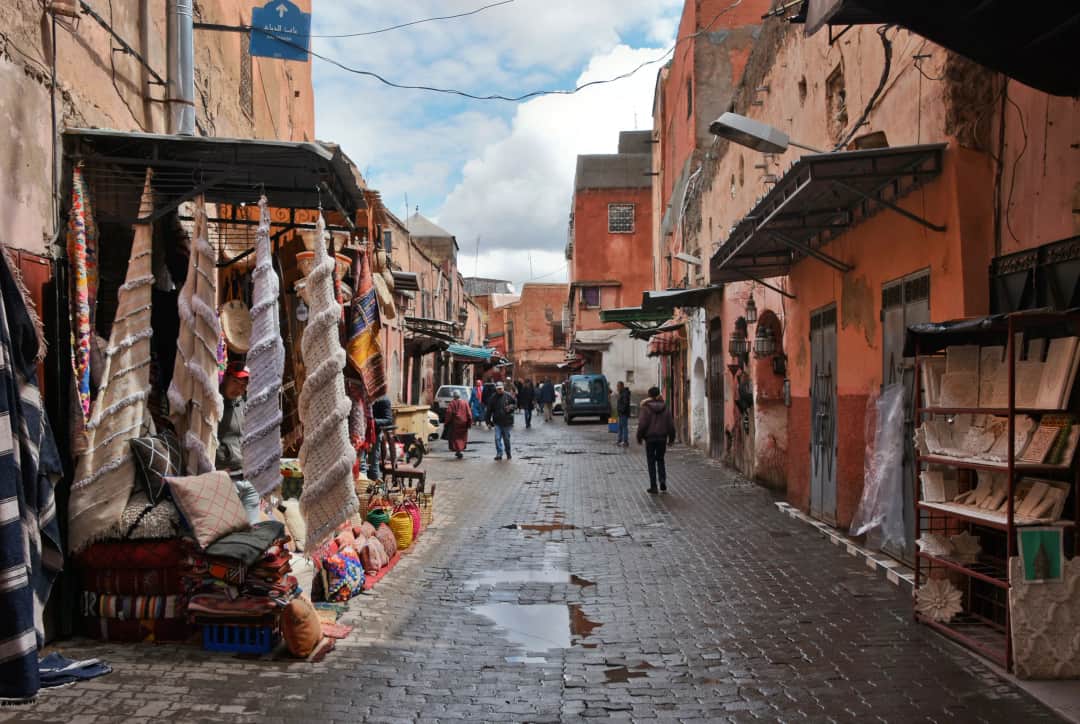
The thing to understand about the Marrakech medina is that it is not a preserved quarter, a heritage site or an open air museum. It is a walled city of well over a hundred thousand people where the bakery, the school, the hardware shop, the mosque and the man welding a gate are all on the same lane as the guesthouse you are staying in. Nothing has been arranged for visitors. The lanes bend, narrow, fork and dead end because that is how the city grew over nine hundred years, and the tourist route is simply threaded through the middle of ordinary life.
This has one enormous practical consequence. You are going to get lost, and getting lost is the experience rather than a failure of planning. Phone maps work approximately at best, because the alleys are too narrow and too many for the satellites and the signage, and following one confidently for ten minutes routinely delivers you to a wall. The medina is bounded by ramparts and cut through by a handful of main arteries, so you are never actually lost in any serious sense, only temporarily unsure. Visitors who fight this spend three days frustrated. Visitors who accept it, set out with a rough direction and a landmark to aim for, and treat the wrong turnings as the point, tend to leave saying it was the best city they have been to.
Marrakech was founded in the eleventh century by the Almoravids as a base on the plain below the High Atlas, and it has been a capital, a trading terminus for caravans coming up from the Sahara, and a seat of successive dynasties that each left buildings behind. That layering is what you are walking through: an Almohad minaret, a Merinid and Saadian madrasa, Saadian tombs sealed up for centuries, a nineteenth century vizier's palace, and a French built new town outside the walls from the protectorate era. The city is called the red city for the pinkish earth colour of its walls and its buildings, which is at its most convincing in the last hour of light.
Be honest with yourself about the sensory load before you go. The medina is loud, hot, crowded and relentless. Motorbikes come through gaps you would not have called a gap, hand carts want your side of the lane, the calls to prayer stack over the top of each other five times a day, and in the souks there is a running commentary from every stallholder you pass. The heat in summer is severe and the smells swing from mint and orange blossom to drains and hot metal within a few steps. It is not aggressive and it is not dangerous, but it is a lot, and the standard shape of a good Marrakech day accounts for that: out early, back to the riad courtyard through the worst of the afternoon, out again in the evening when the city softens.
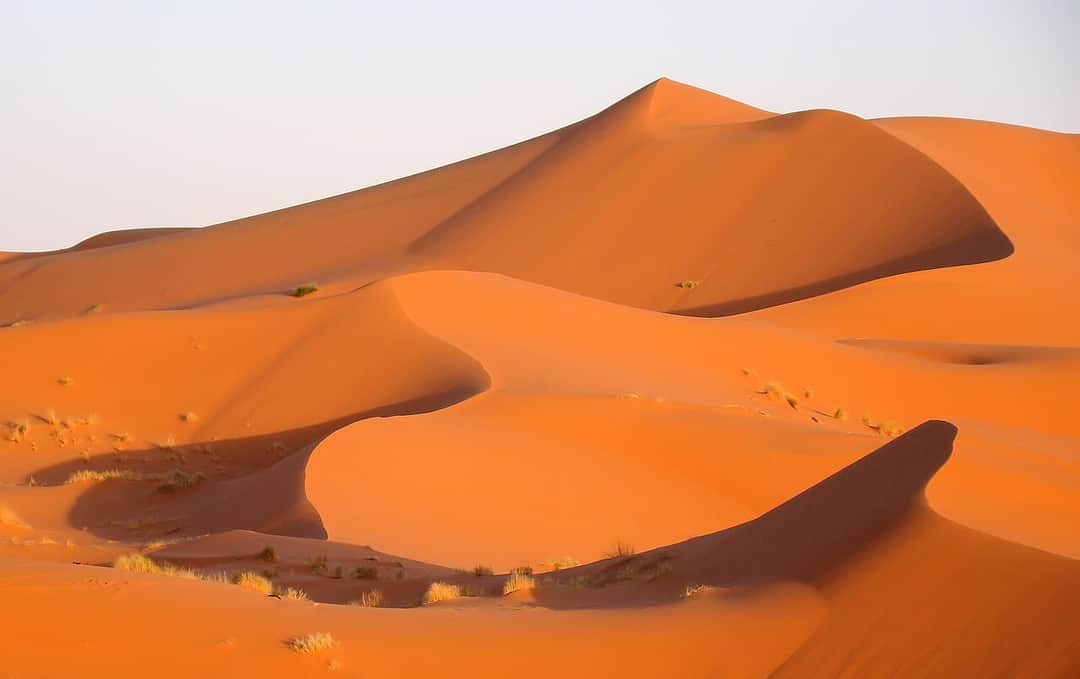
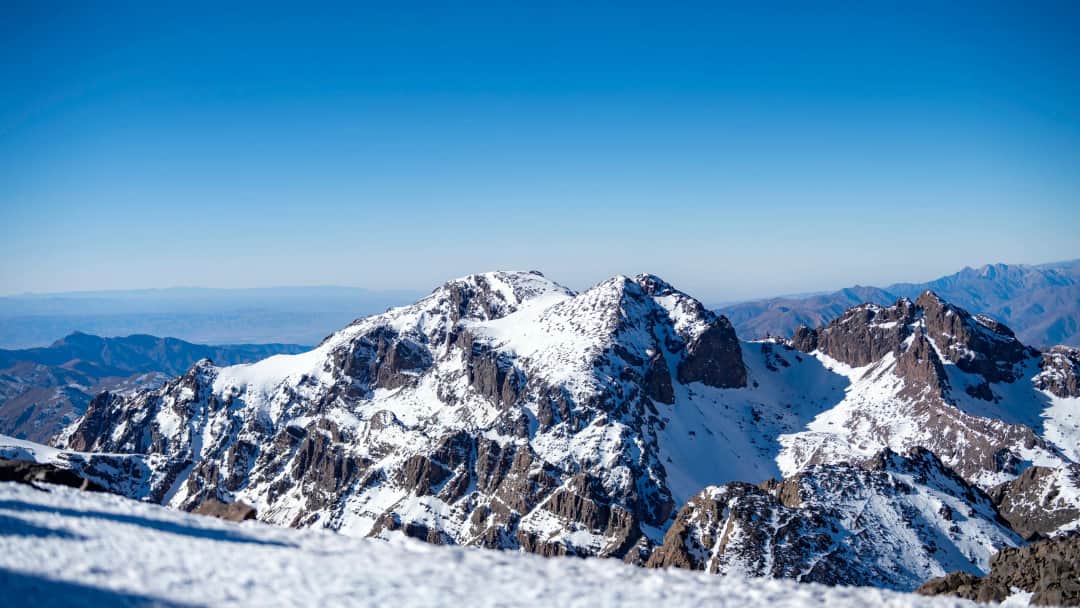
It is also the natural base for the south. The High Atlas is visible from the rooftops on a clear morning and Imlil, the trailhead for Toubkal, is ninety minutes away. The Agafay stone desert is under an hour, Essaouira on the Atlantic is under three, and the long road to the Sahara at Merzouga starts here. A very common and very good trip structure is two or three days in the medina at each end, with the mountains, the coast or the dunes in between.
Best time to visit
March to May and late September to November are the best months, and there is no serious argument against them. Daytime temperatures sit comfortably in the twenties, the light is clean, the gardens are at their best, and you can spend a full day walking the medina without needing to hide indoors. Spring adds jacaranda and bougainvillea in flower across Gueliz and the gardens, and on clear mornings the High Atlas still carries snow, which from a rooftop terrace above the medina is the view that surprises people most.
Summer, from June through August, is genuinely hot. Forty degrees is routine and higher is not unusual, and the medina holds heat in its walls long after dark. It is dry heat rather than humid, which helps, and the city is built for it: thick walls, shaded lanes, inward facing courtyards and an established habit of doing nothing much between two and five in the afternoon. If you come in summer, book a riad with a plunge pool and treat it as an essential rather than a luxury, start at eight in the morning, and plan the sights for the first half of the day. Prices are lower and the medina is noticeably less crowded, so it is a real trade off rather than a simple mistake.
Winter is the season most people misjudge, and they misjudge it in a specific direction. December to February days are usually mild, sunny and pleasant, in the high teens, with the best mountain views of the year. The nights are cold, and more to the point riads are built to shed heat rather than hold it, so a courtyard room with tiled floors and high ceilings can be genuinely chilly in January and heating is often a single portable unit. Check what heating a property actually has before booking in winter, and pack warmer clothes than the words north Africa suggest. Occasional rain falls between November and March, rarely for long, but medina lanes drain badly and turn slippery.
One more consideration that moves through the calendar: Ramadan. Daytime is quieter, many restaurants in the medina close or run reduced hours, and the pace of everything slows, while the evenings after the fast is broken are lively and warm and one of the more memorable times to be in the city. Nothing is closed to visitors and nobody expects you to fast, but eating, drinking or smoking openly in the street during daylight is inconsiderate. If you want the city at its most normal, avoid it. If you want the city at its most atmospheric in the evening, it is worth seeking out.
High season
Easter and the surrounding spring weeks are the busiest of the year, with October a close second and Christmas and New Year a short, expensive peak when riad rates roughly double. Long weekends draw heavy European short break traffic year round. July and August are quiet because of the heat, which makes them the cheapest and least crowded time to visit if you can handle the temperature. January and February, outside the holidays, are the calmest weeks in the medina.
Marrakech sits on the Haouz plain at around 460 metres, on a flat expanse of dry, stony, reddish ground with the wall of the High Atlas standing across the southern horizon. On a clear winter or spring morning, from a rooftop terrace or the roof of your riad, those peaks carry snow and look close enough to walk to, which does more to explain the city's position than any amount of history. Marrakech grew where it did because that mountain wall feeds it: snowmelt and groundwater brought to the plain through khettaras, underground channels dug by hand and vented by lines of shafts, are the reason a city of this size exists on the edge of a semi desert.
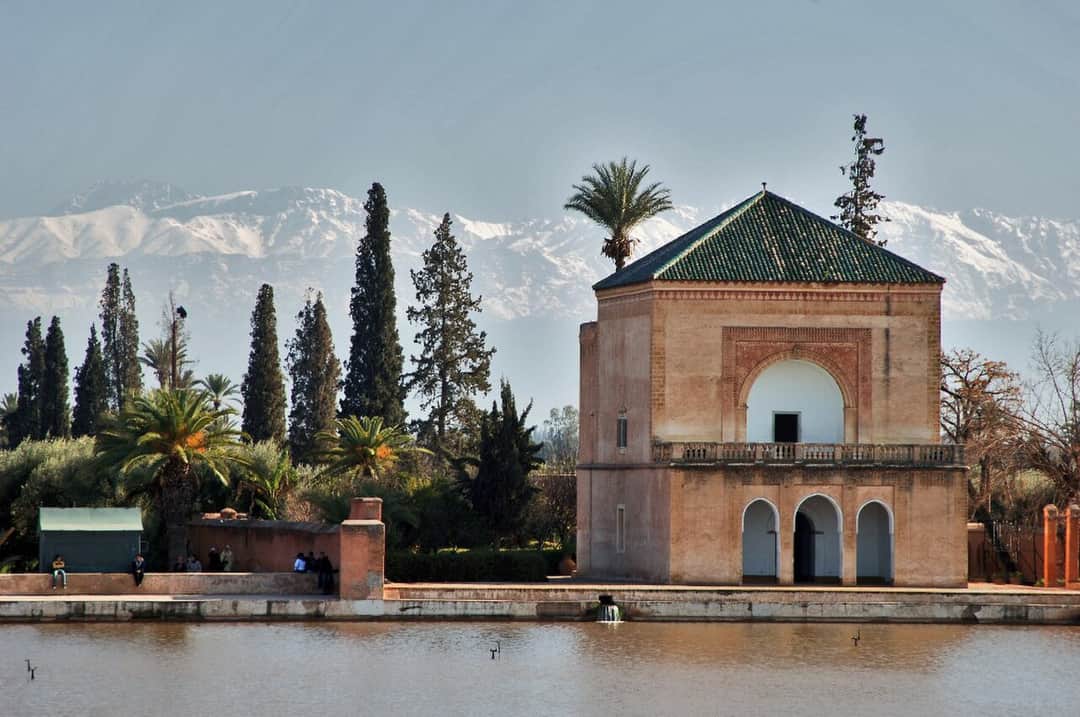
That scarcity is why gardens here are not decoration but the highest expression of the culture. The Agdal and Menara gardens, laid out under the Almohads, are enormous walled olive and fruit groves built around great open water basins that functioned as reservoirs as much as ornaments, and the Menara pavilion reflected in its pool with the Atlas behind it is the classic image of the city. The riad garden is the same idea shrunk to a house: a courtyard divided into four beds around a central fountain, planted with bitter orange, fig and jasmine, so that every room faces inward onto shade, water sound and scent while presenting a blank wall to the hot lane outside. Once you have seen it you understand the whole architecture of the medina.
The planted city is at its best in spring. Bitter orange trees line the avenues and fill the air with blossom for a few weeks. Jacarandas turn purple in Gueliz and along the boulevards. Bougainvillea spills over walls in magenta and orange, and the date palms of the Palmeraie on the northern edge of the city, an ancient irrigated grove now shared with hotels and villas, still stand in their thousands. Le Jardin Secret and the Majorelle Garden take the two available approaches, one restoring a classical Islamic garden inside the medina and the other assembling cactus and bamboo and exotics from around the world inside walls painted an intense cobalt blue.
Animals are a city story rather than a wild one. White storks nest on the ruined walls of the El Badi Palace and on the ramparts, clattering their bills and visible for most of the year, and they are the single most photographed non human residents of Marrakech. Swifts and house martins scream around the rooftops through spring and summer, cattle egrets commute out to the plain at dusk, and semi feral cats own every quiet corner of the medina, generally in better condition than people expect because households feed them. One honest note: the Barbary macaques and snakes worked in Jemaa el-Fnaa are handled for tourist photographs, the macaques are a threatened species taken from the cedar forests further north, and the welfare of both is poor. Declining the photograph is the useful response.
Jemaa el-Fnaa, from afternoon into night
The great square is two entirely different places depending on the hour, and seeing only one of them is the most common way to be disappointed by it. Through the day it is a hot open space with orange juice carts in rows, henna artists, water sellers in fringed hats, and men with monkeys and snakes waiting for photographs. It is at its least appealing then. From about five o'clock it fills: storytellers gather circles of listeners in Arabic, Gnawa musicians set up with qraqeb and guembri, and at dusk hundreds of food stalls are wheeled in and assembled from nothing into a grid of numbered kitchens under strings of bulbs and clouds of grill smoke. UNESCO recognised the square for its oral heritage tradition rather than its buildings, which tells you where its value lies. The Koutoubia mosque and its seventy seven metre twelfth century minaret stand just to the west, the model for the Giralda in Seville and the reference point that gets you home when you are lost. Watch the transformation from a cafe terrace on the square's edge with a mint tea, then go down into it.
The souks, organised trade by trade
North of Jemaa el-Fnaa the souks run for kilometres, and the thing that makes them navigable is that they are still arranged by craft the way medieval guilds arranged them. Souk Semmarine is the wide main artery. Off it, Rahba Kedima is the old apothecary square with dried herbs, spices and cosmetics, Souk Attarine handles perfume and spice, Souk Cherratine works leather in a permanent smell of hide, Souk Haddadine rings with hammers on iron, Souk Chouari turns wood on foot powered lathes, and Souk Sebbaghine, the dyers, hangs skeins of wool in wet colour above the lane. Wandering with no shopping list is the best way to use them: follow whichever noise or smell is nearest and let the trades tell you where you are. The tanneries near Bab Debbagh in the north are the exception to approach carefully, since the standard routine there is a stranger pressing mint leaves into your hand and then demanding a substantial fee for the tour you did not agree to. Go with an official guide or not at all.
The Kasbah quarter: Saadian Tombs, El Badi and the Mellah
The southern quarter holds the most concentrated set of sights in the city and they sit within a few minutes of each other. The Saadian Tombs were sealed off by a later sultan and only opened up again in the early twentieth century, which is why they survive so completely: a small walled garden of graves, and inside it the Chamber of the Twelve Columns with Italian marble, carved cedar and a honeycomb of plaster muqarnas above the tomb of Ahmad al-Mansur. It is small, the queue for the main chamber is single file, and it is worth arriving early for that reason alone. Around the corner the El Badi Palace is the opposite: a vast roofless rectangle of sunken orange gardens and bare pisé walls, stripped of its marble centuries ago, with storks nesting on the ramparts and a walkable roof terrace giving one of the best views over the medina. The Mellah, the old Jewish quarter, adjoins them, with its own spice market, the Lazama synagogue and the Miaara cemetery, and a distinctly different street architecture with balconies facing outward.
Bahia Palace and the courtyard houses
The Bahia is a nineteenth century grand vizier's palace and the best place in Marrakech to understand how the wealthy actually lived inside these walls. It is deliberately horizontal rather than tall, a sequence of courtyards, private apartments and reception rooms spreading across a large site, with painted cedar ceilings, zellij tilework, carved stucco and a great marble courtyard that photographs extremely well and consequently fills with people by ten in the morning. Go at opening. Two smaller houses make the same point in a quieter way and are among the medina's most rewarding hours: Dar el Bacha, a restored pasha's residence with exceptional tilework and a courtyard cafe, and the Maison de la Photographie, a converted riad whose collection of early Moroccan photographs is genuinely absorbing and whose roof terrace serves lunch with a view across the rooftops to the Atlas.
Ben Youssef Madrasa and the Mouassine quarter
The Ben Youssef Madrasa was for centuries the largest Quranic school in Morocco, housing hundreds of students in tiny cells around a central courtyard, and after a long restoration it reopened with its surfaces cleaned back to a startling clarity. The courtyard is the reason to come: a rectangular pool, walls of carved cedar above bands of zellij and a frieze of carved plaster and Kufic inscription, executed at a level of craftsmanship that makes the rest of the city's decoration read differently afterwards. Climb to the upper floor and look into the students' rooms, which are the size of a cupboard with a single window onto the light well, to grasp what the building actually was. The surrounding Mouassine quarter rewards unhurried walking: the Mouassine fountain, the small Almoravid Koubba, the neighbouring museum in a restored riad, and a growing number of good terrace cafes that have not yet emptied the area of its ordinary life.
The gardens, from Majorelle to Le Jardin Secret
The Majorelle Garden was made by the French painter Jacques Majorelle over decades, then bought and rescued by Yves Saint Laurent and Pierre Bergé, and its cobalt blue buildings against cactus, bamboo and palm are the most reproduced image in the city. It is small, it is extremely busy, and the honest advice is to book a timed entry for the first slot of the day, otherwise you will shuffle. The Berber Museum inside it is excellent and often skipped, and the Yves Saint Laurent museum next door is a serious building in its own right. Inside the medina, Le Jardin Secret is the better experience for many visitors: a restored palace garden divided into a formal Islamic quadripartite garden and an exotic garden, with a tower to climb for the view and far more room to sit still. Add the Menara gardens for their olive grove, pavilion and enormous reflecting basin with the Atlas behind, best in late afternoon, and the Agdal if you want scale over polish.
A hammam
The hammam is a steam bath and it is a normal part of weekly life here, not a tourist invention, and there are two versions available to you. A neighbourhood public hammam is cheap, local, single sex, and largely unadorned: you bring or buy savon beldi, a soft black olive soap, sit in the steam room until you are thoroughly softened, and either scrub yourself with a coarse kessa glove or pay an attendant to do it, which is a brisk and unsentimental process that removes a startling quantity of skin. It is a genuinely local experience and it is not remotely luxurious. The other version is the spa hammam attached to a riad or a hotel, where the same sequence is delivered privately with ghassoul clay, argan oil, a massage and a quiet room afterwards, at many times the price. Both are worth doing, the public one for what it is and the private one after a day of walking. Ask your riad which local hammam is used to visitors, take flip flops and a change of underwear, and be aware that in a public hammam you keep underwear on.
Using Marrakech as a base for the Atlas, the coast and the desert
Very few people spend a whole week in the medina, and the city is at its most useful as a hub. Imlil, the trailhead for Toubkal and the High Atlas, is around ninety minutes away, and even without trekking a day in the Imlil or Ourika valleys, walking through walnut terraces and eating beside a river, is the standard antidote to three days of souks. The Ourika valley with the Setti Fatma waterfalls is the closest and busiest, the Azzaden and Imlil valleys are quieter, and the Ouzoud waterfalls are about three hours north. The Agafay desert is forty minutes away and is worth understanding correctly: it is a stone and clay desert of bare rolling hills, not sand, and the camps there sell a Sahara style evening without the Sahara, which is fine if you know what you are buying. Essaouira on the Atlantic is under three hours and is the best overnight escape, windy, salty and much calmer than Marrakech. The real Sahara at Merzouga is two days of driving each way and needs three days minimum.
City
Marrakech
Take it with you
Everything on this page in one document you can keep, print, or send to whoever you are travelling with. No email required.
For a first visit, stay in the medina in a riad. A riad is a traditional courtyard house turned inward around a garden or pool, usually with only a handful of rooms and a roof terrace, and staying in one puts you inside the city rather than adjacent to it: you walk out of the door into the lane and everything is on foot. The trade offs are genuine. Taxis cannot reach most riads, so you finish the journey on foot with your luggage or with a porter, rooms can be dark and cold in winter, and the call to prayer before dawn is audible. Gueliz, the new town built during the French protectorate, is a different city entirely: wide boulevards, cafes, galleries, modern restaurants and hotels with lifts and parking. It is calmer and easier, and it is the right choice for a longer stay, for anyone with mobility difficulties, or for a second visit. Many people who love Marrakech end up splitting their nights between the two.
Three full days is the sensible answer for the city itself. One day gets you Jemaa el-Fnaa, the Koutoubia and the souks. A second covers the Kasbah quarter with the Saadian Tombs and El Badi, then the Bahia and the Mellah. A third takes Ben Youssef and Mouassine in the morning, the gardens in the afternoon and a hammam before dinner. Two days is possible but leaves no room for sitting still, which is a mistake in a city this intense. Beyond three days in the medina, most people want a change of pace, and that is the point at which you add the Atlas valleys, Essaouira, or the long trip south to the desert. If Marrakech is bookending a mountain trek or a Sahara trip, two nights at the start and one or two at the end works well.
Haggling in the souks is ordinary commerce, not a contest and not a sign of dishonesty. Most goods here have never had a fixed price, and the opening figure is understood by both sides as the start of a conversation rather than a statement of value. The workable approach is straightforward: decide before you ask what the item is worth to you, make a counter offer well below the opening price without being insulting, expect to meet somewhere in between, and stay friendly throughout, because the tone matters more than the tactics. Walking away is completely acceptable and is often when the real price appears, but do not use it as a trick if you have no intention of buying. Two useful calibrations: the Ensemble Artisanal, a government craft complex, sells at fixed prices and gives you a reference point, and prices in Gueliz boutiques are fixed and higher. If you paid slightly more than a local would, you have not been cheated, you have paid a tourist price, which is true of every market city on earth.
Unofficial guides are a normal part of the medina economy and most of them are not trying to harm you, they are trying to earn a commission. The usual patterns are an offer of directions followed by a request for money, a claim that the lane ahead is closed or that the square is this way, or an offer to take you to the tanneries or a workshop where the guide earns a cut of whatever you buy. Two responses work. Either decline clearly and politely, keep walking, and do not engage in the follow up conversation, or agree a price and a purpose out loud before you set off so that expectations are explicit. If you want a real guide, official ones carry a badge and can be arranged through your riad, and half a day with a good one at the start of a trip is genuinely worth it because it fixes the geography in your head for the rest of the week. Note that the tanneries in particular are where the pressure is most persistent.
Honestly, yes, particularly on the first day, and particularly for people who have not travelled in a comparable city before. The combination of heat, noise, narrow lanes, motorbikes, constant sales attention and the impossibility of navigating reliably is a lot to absorb at once. The fixes are practical. Arrive with low ambitions for day one and just walk. Build the day around a long break in the riad courtyard between two and five, which is what residents do. Eat on rooftop terraces where you can see the city instead of being pressed into it. Carry small notes so transactions are quick. Say no once, clearly, rather than apologetically five times. And accept that the medina is safe, that petty theft and pickpocketing are the realistic risks rather than anything worse, and that the pressure you are feeling is commercial rather than threatening.
Morocco is relaxed about visitors' clothing in Marrakech, and nobody expects you to cover your hair or dress traditionally. That said, covering shoulders and knees is the comfortable middle ground for both men and women: it attracts less attention, it is more respectful in a city where most local women dress modestly, and in the summer sun loose long sleeves are genuinely cooler than bare skin. Light, loose natural fabrics beat anything tight. Shorts and vest tops are common enough among visitors around Jemaa el-Fnaa and will not cause a problem, but in the residential lanes and away from the tourist circuit they draw comment. Practical points that matter more than modesty: wear shoes you can walk kilometres in on uneven ground, expect them to get dusty, and bring a warm layer for winter evenings because the temperature drops sharply once the sun goes.
Generally no. Working mosques in Morocco, including the Koutoubia, are closed to non Muslims, and the Koutoubia is appreciated from the outside and from its surrounding gardens rather than entered. This catches people out because the equivalent buildings in some other countries are open. What is open, and what carries almost all of the same architecture and craftsmanship, is the religious buildings no longer in daily use: the Ben Youssef Madrasa, the Almoravid Koubba, the Saadian Tombs and the various restored palaces and riads. Between them you will see zellij, carved cedar, muqarnas plasterwork and courtyard design at the highest level the city achieved. If your interest is specifically architectural, spend the time you would have spent trying to enter a mosque at Ben Youssef instead.
It works better than people expect, with adjustments. Jemaa el-Fnaa at night, the food stalls, the animals, the drummers and the general theatre of it are exactly the sort of thing children enjoy, and a riad with a plunge pool solves the middle of the day. The constraints are heat, crowds and the fact that pushchairs are close to useless in the medina, where lanes are uneven, busy and frequently blocked by carts and bikes. Carry small children rather than wheeling them. Keep older ones close in the souks, not for safety so much as because separation happens instantly in a crowded lane. Avoid the monkeys and snakes in the square. Day trips to the Ourika valley or the Atlas foothills, where children can be outside and in a river, break up the intensity well and are the reason many families with children stay in Marrakech for two nights rather than four.
The mountains, easily. Imlil and the Ourika valley are both around ninety minutes by road, and a day trip into the High Atlas foothills for a valley walk and lunch is the single best half day escape from the city. Toubkal itself, the highest summit in North Africa, needs two or three days from the same trailhead. The Sahara is a different proposition and it is where expectations most need managing: the sand dunes of Erg Chebbi at Merzouga are around 560 kilometres away, roughly nine hours of driving, so the minimum realistic trip is three days and two nights with an overnight in the Dades valley on the way. There is no day trip to the Sahara from Marrakech. What is sold as one is the Agafay desert, forty minutes from the city, which is a bare stone and clay landscape rather than sand, and which is perfectly pleasant for a sunset dinner as long as nobody has told you it is the Sahara.