Beach in Kenya
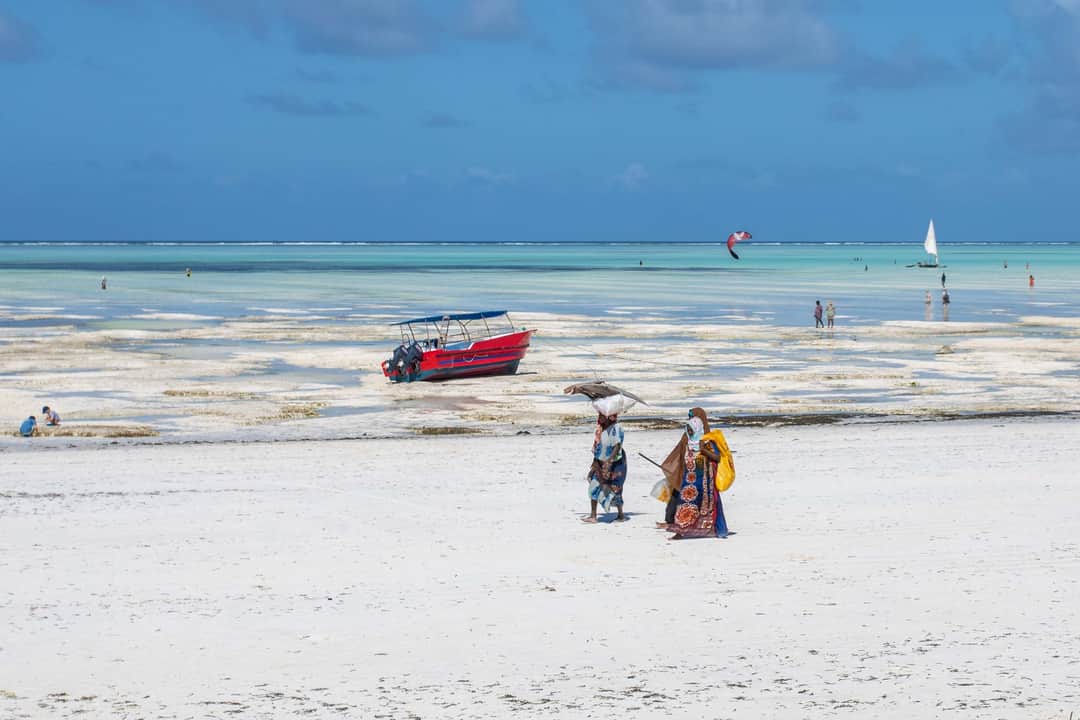
Diani does not behave like an ocean beach, and the reason is visible from the sand. There is a line of white water a long way out, and between that line and your feet nothing but flat, pale green water. The surf is breaking on a fringing reef that runs parallel to the shore, and almost none of it reaches you. That single piece of geography explains the colour of the water, the calm, the snorkelling, the kitesurfing and the reason families come back here rather than to beaches that photograph better in a wide shot.
The second thing to understand is the tide, and it is what catches almost every first-time visitor. The range on this coast is large, and at a low spring tide the lagoon simply leaves. Water that was chest deep after breakfast becomes ribbed sand flats, seagrass beds and stranded starfish by early afternoon, with the sea a bright band several hundred metres out and people wading towards it. Six hours later it is back against the sand and you can swim from your towel. Neither state is a problem once you expect it, but a lot of people book what they believe is a swimming beach, arrive at low water and spend their first afternoon quietly baffled. Hotels post the tide times at reception, and planning your swims, your snorkelling and your boat departures around them is the most useful habit you can form here.
The beach itself is a long, near unbroken strip of very fine white sand, the kind that squeaks underfoot and stays cool enough to walk on longer than you expect. It runs south from the mouth of the Congo river, past the main hotel strip, and on through Galu where the buildings thin out and you can walk for an hour with almost nobody on the sand. Behind all of it runs one road, Diani Beach Road, carrying hotels, restaurants, dive shops, supermarkets and a constant stream of tuk-tuks and motorbike taxis that will move you along it for very little. Look up as you drive and you will see rope ladders strung between the trees on either side. They are for the colobus monkeys, and they are one of the quietly impressive things about this town.
What separates Diani from a straightforward sun and sea week is that there is genuinely enough to do. An hour and a half south, past Shimoni, the Kisite Mpunguti marine park gives you the best snorkelling on the Kenyan coast and dolphins that turn up more often than not. Half an hour inland the Shimba Hills rise out of the heat with elephants and Kenya's only sable antelope. North lies Mombasa, a working Swahili port with an old town and a Portuguese fort. And from December to March the northeast monsoon delivers the steady side-on wind that has made this one of the better kitesurfing beaches in the Indian Ocean.
Be clear about what Diani is not. It is developed, in a low-rise, tree-shaded, thirty-years-in-the-making way rather than a wall of towers, but it is not an undiscovered coast and nobody should arrive expecting one. The strip mixes large all-inclusives, small owner-run hotels and private villas, and the difference between them matters more here than the star rating does. Two complaints come up repeatedly in reviews, seaweed and beach vendors, and both are real. Neither ruins a holiday, and both are dealt with honestly further down this page.
Best time to visit
The Kenyan coast is warm all year and the sea never gets cold, so the calendar here is not about temperature. It is about two monsoons, and they change the wind, the water clarity, the seaweed and the price of your room. The kaskazi blows from the northeast roughly from November to March. The kusi blows from the southeast, harder and rougher, roughly from June to September. The gaps between them are the rains.
January to March is the best all-round window and it is what most people should book. The kaskazi is steady rather than violent, the lagoon is glassy, visibility on the reef is at its best, and boat trips to Kisite run without anyone being sick over the side. It is the hottest part of the year and humid with it, so plan on a slow middle of the day, but this is when the water looks the way it does in the photographs. It is also prime kitesurfing season, with reliable side-on wind through most afternoons, and the window when whale sharks are occasionally reported off this coast.
April and May are the long rains and the one period to avoid if you have any choice. Rain here arrives in heavy bursts rather than all-day drizzle, so it is not a washout, but humidity is oppressive, the sea turns cloudy with runoff, boat trips get cancelled, and a number of hotels use the months for closure and refurbishment. It is by a wide margin the cheapest time to be here, and if a low price is the deciding factor it is survivable, particularly late in May. Just do not plan a diving trip around it.
June to September is the kusi, and it is a genuinely different holiday: cooler, breezier, less humid and much easier to be outside in the afternoon. The southeast wind is stronger and gustier than the kaskazi and the lagoon gets choppy, which experienced kitesurfers enjoy and beginners do not. This is also when humpback whales pass along the coast on their migration, roughly from July into September, and when the seaweed tends to be at its worst. August is busy because of European summer holidays. October and November are the shoulder, with the short rains arriving as brief afternoon storms in November, and they offer the best combination of decent weather, quiet beaches and reasonable prices in the whole year.
The short version: come in January or February for the calmest, clearest water; come in July or August for cooler air, whales and a livelier sea; come in October for value; and think hard before booking late April or May.
High season
The two clear peaks are Christmas and New Year, when the coast fills with Kenyan and European families and the better hotels book out months in advance at their highest rates of the year, and August, driven by the European summer. Easter is a shorter third peak. February and October are the sweet spots for anyone who wants good conditions without the crowd, and May is the quietest month on the beach by some distance.
The lagoon is the first thing to explore and you can do it from the beach with a mask. Inside the reef you get seagrass beds full of sea cucumbers, hermit crabs and small rays, and at low tide the exposed flats become a rock pool the size of a suburb, with brittle stars, sea urchins and octopus in the shallows. Wear something on your feet. Urchin spines and sharp coral rubble account for more spoiled afternoons here than anything in the water with teeth. The reef closest to the hotels is patchy and much of it is worn, so treat the lagoon as an interesting wander rather than the main event, and save the serious snorkelling for the marine park to the south.
Kisite Mpunguti, beyond Shimoni, is where the coral is properly alive and it is worth the early start. Expect parrotfish crunching audibly at the coral, sergeant majors in clouds, angelfish, moray eels wedged into crevices, and green and hawksbill turtles that carry on grazing while you hover above them. Bottlenose and Indian Ocean humpback dolphins are resident in the channel and encountered on a good proportion of trips, though nothing is promised. Beyond the reef the seasons bring bigger animals: humpback whales moving along the coast in the middle of the year, and whale sharks reported in the warm calm months, most often between December and February. Green turtles also nest on Diani itself, and local conservation groups monitor and protect nests along the beach, which is why you will sometimes see a marked-off patch of sand above the high-water line.
Inland the story is a forest that is disappearing. The coastal strip behind Diani is part of the East African coastal forest mosaic, one of the most fragmented habitats on the continent, and the surviving patches are small, sacred or both. Their signature animal is the Angolan colobus, a striking black monkey with a long white mantle and a plumed white tail, which lives in the canopy and does not come down for scraps the way the other monkeys do. That is exactly what made the road so lethal to them: they crossed on power lines and got electrocuted, or crossed on the tarmac and got hit. The rope ladders you see strung across Diani Beach Road were built specifically for the colobus, and they have measurably cut the deaths. Sykes' monkeys and vervets are everywhere and considerably bolder, so keep balcony doors shut, and bushbabies call from the trees after dark with a cry that sounds unnervingly like a child.
Birdlife is very good and mostly ignored by visitors. Palm-nut vultures sit in the coconut palms behind the beach, fish eagles call over the creeks, trumpeter hornbills fly across the road in the late afternoon making a noise like a distressed baby, and sunbirds work the flowering trees in hotel gardens. At low tide the exposed flats pull in waders, and the mangrove creeks south towards Funzi hold kingfishers, herons and, in the northern winter, migrant shorebirds that have come down the length of Asia to be here.
The beach, the lagoon and learning the tide
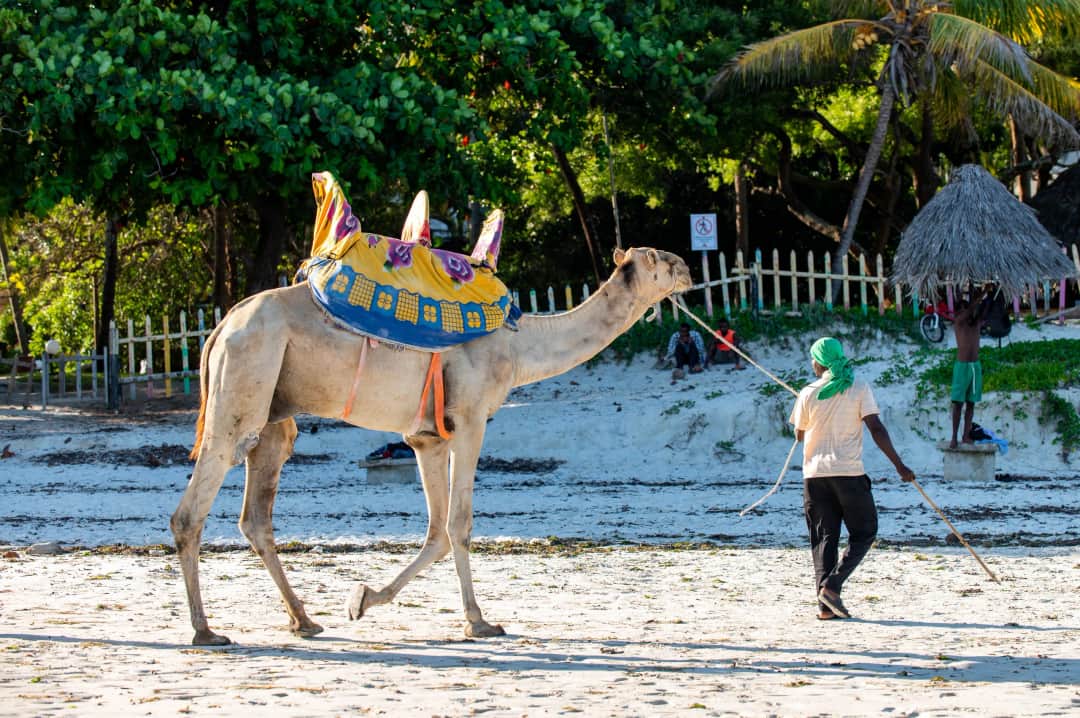
For the first day, do nothing else. Diani rewards the simple version of itself: a long walk south at low tide when the flats are exposed and the sand is firm underfoot, a swim off the beach at high tide when the lagoon is deep enough to float in without the reef in the way, and a long lunch in between. The stretch through Galu, south of the main hotel cluster, is where the beach goes quiet and the coconut palms lean out over the sand. Camels walk the beach in the afternoons and the local touts are up at the busier end, so a southward walk is the peaceful one. The practical detail worth repeating: the lagoon is a swimming pool at high tide and a wading flat at low, so check the times before you plan anything involving water. Reef shoes or old trainers are worth packing for the low-tide exploring, because urchins are common and the coral rubble is sharp.
Kisite Mpunguti marine park, Wasini and Shimoni
This is the best day out from Diani and it should be booked for a calm-sea month if at all possible. You leave early and drive south for around an hour and a half to Shimoni, where dhows and speedboats run out to the Kisite Mpunguti marine reserve near the Tanzanian border. The coral there has been properly protected for decades and it shows: thick fish life, clear water in the kaskazi months, turtles, and a resident dolphin population that puts in an appearance on most trips. The classic version includes a stop at Wasini Island for a Swahili seafood lunch, usually crab, fish and rice with coconut, and a walk on the raised coral gardens boardwalk over the mangroves. Shimoni itself has a set of coral caves that were used to hold enslaved people before shipment, and a visit there is a sobering counterweight to a day that is otherwise all sunshine. Take the trip on a dhow if you can rather than the fastest speedboat, because the sailing is half the point.
Kitesurfing and the monsoon wind
Diani has become one of the better kite beaches in the western Indian Ocean and the reason is structural rather than lucky. The reef flattens the water, the lagoon is wide and shallow with a sand bottom, and the monsoons deliver months of side-onshore wind rather than a few good days. The kaskazi from roughly December to March is the season for learning: consistent, moderate, warm and clean, with big flat water at mid-tide and schools all along the beach that can take you from nothing to riding in a handful of days. The kusi from June to September blows harder and gustier and the lagoon gets bumpy, which is fun if you already ride and demoralising if you do not. Tide matters here too. At the bottom of a spring low there is not enough water to ride safely on parts of the beach, so schools work around the tables and you should expect your lessons to be scheduled by the sea rather than by your lie-in.
The colobus, the coastal forest and Kaya Kinondo
Diani sits on top of what is left of a coastal forest that once ran the length of this coast, and the surviving fragments are worth an hour or two of anyone's holiday. The colobus conservation project in the middle of Diani runs short visits that explain the rope bridges over the road, the electrocutions that made them necessary, and the rehabilitation work on injured animals, and it is a genuinely useful stop rather than a photo opportunity. South of the main strip, Kaya Kinondo is one of the sacred Mijikenda forests, a place of ritual for the Digo people rather than a nature reserve, and it is one of very few kayas open to outside visitors. You go in with a local guide, you wear a cloth over your clothes, and you are told plainly what may and may not be photographed. It is a short, shaded, slow walk among enormous old trees with an explanation of why they are still standing, and it will teach you more about this coast than a week on a lounger.
Shimba Hills and Mwaluganje
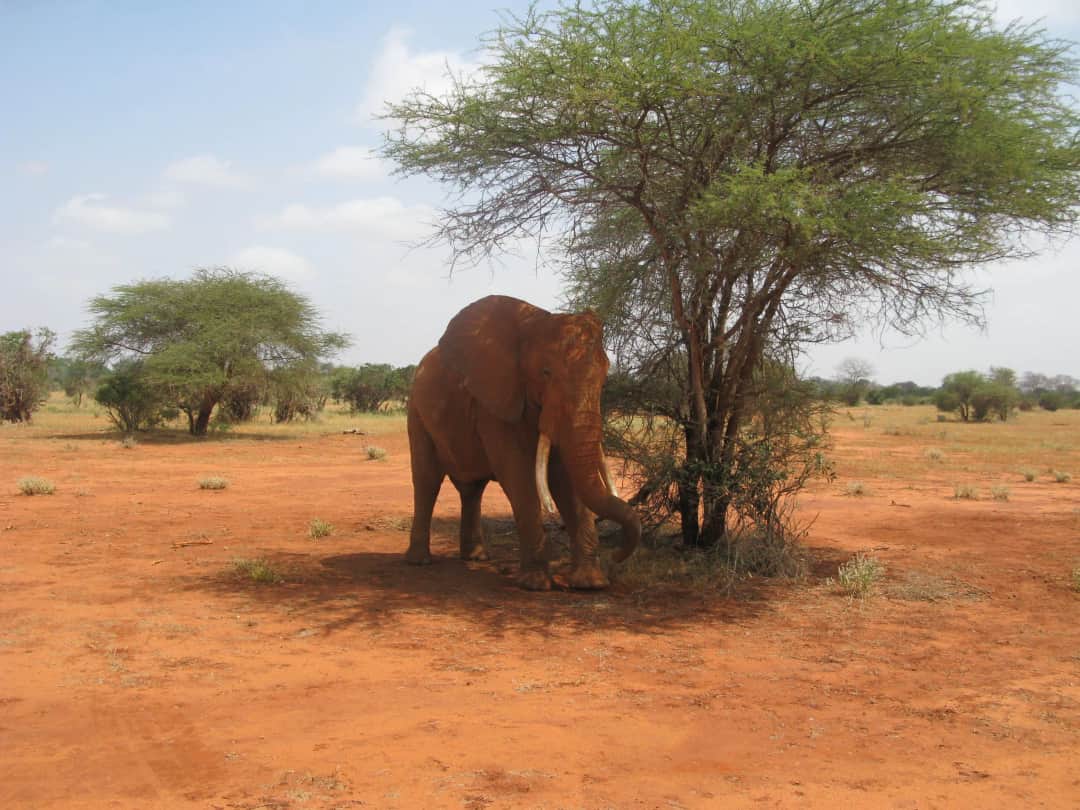
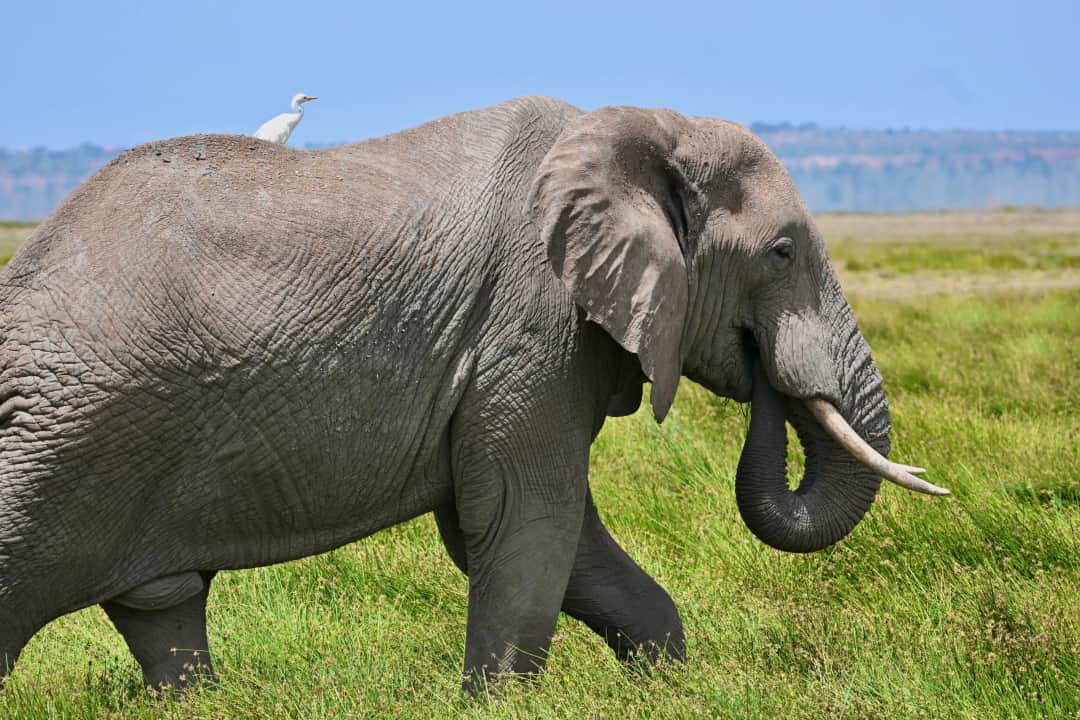
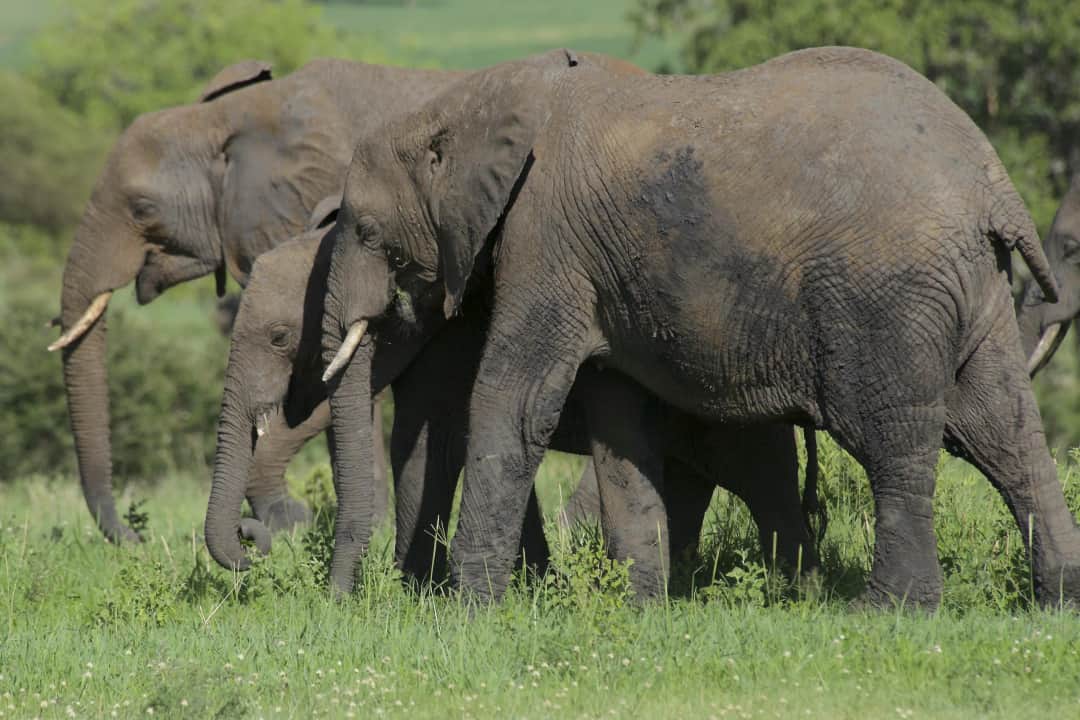
Half an hour inland the ground lifts into the Shimba Hills, and the temperature drops noticeably with it. This is coastal rainforest and rolling grassland rather than classic dusty savannah, and its distinction is sable antelope, a large dark antelope with sweeping ridged horns that survives nowhere else in Kenya. Elephants are present in good numbers and the reserve adjoins the Mwaluganje community sanctuary, which was set up specifically to keep an elephant corridor open through farmland. The other reason to come is Sheldrick Falls, reached on a guided walk of roughly forty-five minutes down through the forest to a waterfall with a plunge pool you can swim in, which is a rare thing to be allowed to do inside a Kenyan reserve. Go early. It is a half-day trip that most Diani visitors skip entirely, and it is the cheapest way to add real wildlife to a beach week without flying anywhere.
Swahili food, the strip and the markets
The food here is one of the better arguments for leaving your hotel, and the all-inclusive buffet is not what the coast actually eats. Look for biriani and pilau cooked properly with cardamom and cinnamon, samaki wa nazi which is fish in a coconut and tamarind sauce, mishkaki which is grilled marinated meat off a street brazier, and mahamri, the slightly sweet coconut doughnuts eaten at breakfast with spiced pigeon peas. Fresh crab, prawns, calamari and whatever came in that morning are the reason to eat on this coast at all. Along Diani Beach Road you will find everything from beach shacks to a well known restaurant set inside a natural coral cave, plus Italian food in surprising quantity thanks to decades of Italian visitors. Move around by tuk-tuk, agree the fare first, and if you buy carvings or kikoys at the craft markets expect a long, good-humoured negotiation rather than a fixed price.
Mombasa Old Town and Fort Jesus
Mombasa is a working port city rather than a resort, and that is exactly why the day trip is worth taking. Fort Jesus was built by the Portuguese at the end of the sixteenth century to control the harbour, changed hands repeatedly over the following two centuries, and now sits above the water as the anchor of a UNESCO listed site with a museum inside it. Behind it the Old Town is a knot of narrow lanes, carved wooden doors, balconies, coffee sellers with brass pots and traders who have been in the same family building for generations. Add the Mackinnon spice market if you want the smell of the place rather than the sights. The trip takes most of a day and the crossing is the variable: the traditional route uses the Likoni ferry, which can be quick or can be a long hot wait, while newer road links south of the city avoid it. Ask which route your driver intends to use before you agree a price.
Boats, islands and the air above the beach
Diani is a good base for getting out on the water in ways that do not involve a mask. Sunset dhow cruises leave from the creek at the northern end and from the south, and a traditional sailing dhow with the engine off is a far better hour than a motor cruiser with a bar. South towards the Tanzanian border, Funzi Island offers a boat through mangrove channels to a tidal sandbank that appears and disappears with the water, with crocodiles on the Ramisi river along the way. Chale Island, just off the coast to the south, is a small tidal island with mangroves and a sacred forest. Deep sea fishing boats run out through the reef channels for sailfish, marlin, tuna and wahoo, mostly in the calmer months, and most operators will now fish tag and release for billfish if you ask. For something less conventional, tandem skydiving operates seasonally over the beach, and the view on the way down, reef line, lagoon, forest and the whole coast at once, is the single best perspective on where you are staying.
Beach
Diani Beach
Take it with you
Everything on this page in one document you can keep, print, or send to whoever you are travelling with. No email required.
January to March is the strongest all-round window. The northeast monsoon is steady rather than rough, the lagoon is clear and calm, the underwater visibility is at its annual best and the boat trips south to Kisite are comfortable. It is hot and humid, so expect to spend the middle of the day in the shade. July to September is the other good option and it suits people who find the heat oppressive: cooler air, a fresher sea, humpback whales passing offshore, and lower prices outside the August peak. The two months to think twice about are April and May, which are the long rains, when humidity is heavy, the water clouds up and a number of hotels shut for refurbishment. October and November are quietly excellent value, with the short rains arriving as brief afternoon storms rather than washed-out days.
Yes, at times, and the honest answer is that it varies enormously by month, by year and by which few hundred metres of beach you are standing on. The weed comes in on the currents and piles up along the high-water line, and it is generally more of a problem during the windier southeast monsoon months in the middle of the year than in the calm season. Some hotels rake the beach in front of them every morning and you will barely register it. Others do not, and reviews from neighbouring properties in the same week can therefore read completely differently. It is not a health problem and it does not usually affect swimming, but it does affect photographs and bare feet. If a pristine sand line matters to you, ask the hotel directly what their beach looked like the previous week rather than relying on the marketing gallery, and consider the quieter stretches south through Galu.
The tide governs it. Diani has a large tidal range, and around low water, particularly on the spring tides near the full and new moon, the sea withdraws several hundred metres and leaves shallow flats of sand and seagrass. You can wade and paddle, and it is genuinely interesting for children hunting starfish and urchins, but you cannot swim properly. Around high tide the lagoon is deep, calm and protected by the reef, and it is as safe and pleasant a sea swim as you will find anywhere on this coast. The tide shifts by roughly an hour a day, so a week here gives you good swimming at a different time each morning. Every hotel posts the tables, and most also have a pool for the hours when the sea is out. Nothing about Diani makes sense until you start reading the tide table, and everything about it makes sense once you do.
There are three approaches. The easiest is to fly directly to the Ukunda airstrip just behind Diani, which takes light aircraft from Nairobi Wilson and connects onwards to the safari parks, and it puts you at your hotel within minutes of landing. The second is to fly into Mombasa's international airport and transfer south by road. The third is the long drive down from Nairobi, which is a full day and only makes sense if you want to see the country on the way. The complication has always been that Diani sits on the south side of the harbour, and the traditional crossing is the Likoni ferry, which can be a ten-minute affair or a very long hot queue depending on the hour. Newer road links around the south of the city now offer a way to avoid the ferry entirely. Ask your hotel or transfer company which route they use and how long they expect it to take, and travel outside the commuter peaks if you can.
They are persistent on the busy central stretch, and pretending otherwise would be dishonest. You will be approached repeatedly by people selling carvings, kikoys, boat trips, tours, fruit and, less pleasantly, other things. Most of it is ordinary trade by people making a living in a place with few other options, and a clear, friendly, unhesitating no works. What does not work is engaging, browsing without intending to buy, or accepting a gift, since all three are read as an opening. Walking south towards Galu, or walking at all outside the middle of the day, cuts the encounters down sharply, and hotels generally keep their own frontage clear. There is also a well documented sex tourism element on parts of this coast, which some visitors find uncomfortable, and it is worth knowing about before you arrive rather than being surprised by it.
Easily, and most people should. Light aircraft link the Ukunda airstrip directly to the main Kenyan parks, so you can finish a Maasai Mara or Amboseli itinerary and be on the beach the same afternoon without going back through Nairobi. Tsavo East and Tsavo West are the closest big parks to the coast and can be reached by road, which makes a two or three night safari a straightforward add-on to a beach week rather than a separate trip. The right order is safari first and beach second, because game drives start before dawn and a week of that is better recovered from on a lounger than prepared for on one. If your time is very short, the Shimba Hills half day inland from Diani will give you elephants and sable antelope without any flights at all, though it is not a substitute for the big parks.
Diani is one of the more relaxed places on the Kenyan coast and ordinary caution covers most of it. Walking the beach and the main road in daylight is normal, tuk-tuks are the standard way to get around, and hotels along the strip employ their own security. After dark, take a taxi or tuk-tuk rather than walking the unlit stretches, do not carry valuables onto the beach, and use the room safe as you would anywhere. In the water, the risks are mundane rather than dramatic: sea urchins, sharp coral and, at some spots, currents through the reef channels on a falling tide, so swim where other people are swimming and ask the hotel about their frontage. Check your own government's current travel advice before booking, since advisories for parts of coastal Kenya are updated periodically and are more useful than any general reassurance written in advance.
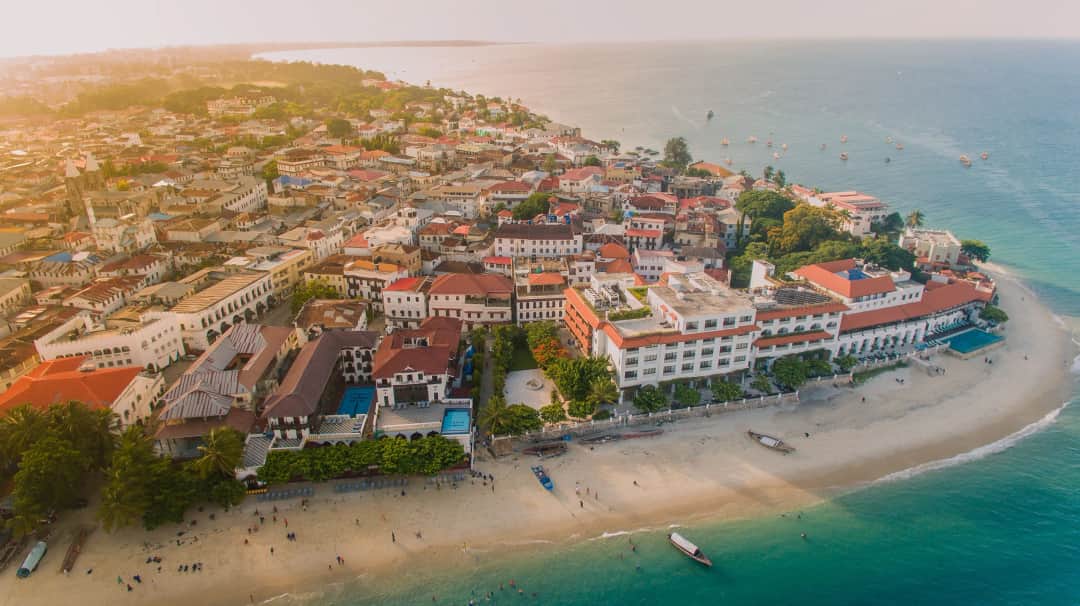
They are more different than the brochures suggest. Zanzibar gives you Stone Town, a deeper Swahili and Omani history you can walk around in, spice farms, and a much wider spread of beaches with very different characters, but it also has a bigger tidal problem on the east coast, a longer transfer from the airport to most beaches and a heavier crowd. Diani is a single beach that is consistently good along its whole length, easier to reach from the Kenyan safari circuit, better set up for watersports, and cheaper to eat and move around in. If your priority is culture and variety, go to Zanzibar. If it is a calm swimmable lagoon, kitesurfing, a straightforward transfer and a beach leg attached to a Kenyan safari, Diani is the better answer. The two are close enough by air that ambitious itineraries occasionally do both, though one week each is the minimum for that to be worth it.
The south coast is largely Muslim, and the Digo people who live here are part of the wider Mijikenda community. Swimwear on the beach and around the hotel is entirely normal and nobody expects anything else. Off the beach it is different. In Ukunda, in Mombasa Old Town, in the villages and at Kaya Kinondo, covering shoulders and knees is a small courtesy that will be noticed and appreciated, and it will change how you are treated. During Ramadan, eating, drinking and smoking in public during daylight is best avoided outside hotel grounds. Ask before photographing people, particularly in the markets and at the kayas, where some places may not be photographed at all. Learning a handful of Swahili greetings is worth more here than it sounds: jambo will get you a smile, but habari yako and asante sana will get you a conversation.