Viendo original · Ver traducción
Duración
9 días
Tipo de tour
Tour privado
Tamaño del grupo
1-6 personas
Nivel físico
Fácil
Edad mínima
12 años
Idiomas
Inglés, Francés, Swahili, Árabe, Portugués, Español, Alemán, Italiano, Neerlandés, Chino
Traslado al aeropuerto
Incluido en el precio
The Northern Circuit is Kilimanjaro’s longest and most scenic route, a 9-day expedition that circles the remote northern slopes of Africa’s highest mountain in near solitude. Unlike the busier southern routes, this journey takes you through rarely visited terrain where the mountain reveals itself one extraordinary landscape at a time: lush montane rainforest, dramatic volcanic moorland, high-altitude lava formations, and the breathtaking barren alpine desert of the upper mountain. The extended itinerary is not merely about distance or spectacle and it is purposefully designed around the single most critical factor in summit success: exceptional acclimatization. By spending more days on the mountain and gradually ascending the remote northern slopes, your body has every opportunity to adapt to the altitude, dramatically increasing your chances of reaching Uhuru Peak (5,895m), the roof of Africa on summit night. This is the route chosen by experienced mountaineers, altitude-conscious trekkers, and anyone for whom reaching the summit is not merely a hope but a plan. With Kilimanjaro Climbing Tours, every stage of this extraordinary journey is supported by professional mountain guides, expert cooks, and a dedicated porter team, all fairly compensated and ethically treated, so that your only task is to walk, breathe, and absorb one of the most profound experiences available to any human being on this planet.
$3,800Por persona
Trekking de montaña
 Organizado porWildflip Safaris
Viendo original · Ver traducción
Tipo de viaje
High-altitude trek, not a technical climb: no ropes or climbing experience needed
Nivel físico
Good general fitness and the ability to walk 5 to 8 hours a day for multiple days in a row
Edad
Recommended for ages 12 and up due to walking distances
Notas de salud
Consult a doctor if you have heart, lung, or blood pressure conditions. Altitude affects everyone differently regardless of fitness.
Your Kilimanjaro adventure begins at Lemosho Gate, located at 2,100 metres, following the registration formalities. This is a brief and straightforward process before you take your first steps into one of Africa's most remarkable mountain ecosystems. The trail immediately enters the lush montane rainforest, Kilimanjaro's richest and most biologically diverse zone, where towering trees draped in moss create a cathedral-like canopy overhead. The air is cool and damp, while birdsong fills the surrounding forest. This gentle first day is designed to help you ease gradually into the mountain environment. The terrain is manageable, the path is well defined, and the forest provides spectacular scenery throughout the journey. Black-and-white colobus monkeys are frequently seen moving through the upper canopy, while a remarkable variety of colourful birdlife can be found among the trees and undergrowth. Sunbirds, turacos, and hornbills are among the species commonly encountered. The 7 km walk takes approximately three to four hours at a comfortable pace and ends at Mti Mkubwa Camp, located at 2,780 metres. Also known as "Big Tree Camp," this is where your support crew will have the tents prepared, water boiling, and a three-course hot meal ready to welcome you at the end of your first extraordinary day on Kilimanjaro.
Leaving the rainforest behind, Day 2 brings a dramatic transformation in the landscape as the trail ascends into moorland terrain, the second of Kilimanjaro's five distinct ecological zones. The vegetation gradually changes from dense forest to a more open landscape of giant heathers and volcanic rock formations. In sheltered gullies, some of these heathers can grow taller than a person, while dense stands along exposed ridges may reach heights of five to six metres. As the forest canopy disappears behind you, the views begin to open spectacularly. Mount Meru, Tanzania's second-highest peak at 4,566 metres, appears on the southern horizon with remarkable clarity on clear mornings. It rises above the Arusha Plain with its distinctive volcanic profile. Ahead, the upper slopes of Kilimanjaro become visible for the first time, revealing the snow-capped summit and the vast Shira Plateau stretching across the horizon. This is when you begin to understand the true scale of the mountain you are climbing. You will arrive at Shira I Camp at an altitude of 3,500 metres, with the expansive plateau stretching ahead and the towering slopes of Kilimanjaro rising above you.
Today's stage crosses the vast Shira Plateau, one of the world's highest plateaus and a genuinely extraordinary geological formation. The plateau is the eroded remnant of Kilimanjaro's oldest and most westerly volcanic cone, Shira, which collapsed approximately 500,000 years ago. What remains is a high, flat tableland at around 3,700 metres. The landscape is unlike anything encountered at lower elevations, with wide-open and treeless terrain, the massive Kibo summit rising dramatically to the east, and endless sky stretching in every other direction. The route across the plateau is relatively gentle and deliberately paced, as today is as much about acclimatisation as it is about covering distance. Your body is working hard at elevations between 3,500 and 3,850 metres, and the shorter seven-kilometre trek leaves the afternoon free for rest, recovery, and preparation for the higher elevations that begin from Day 4. Shira II Camp, located at approximately 3,850 metres, occupies one of the plateau's most dramatic locations. It offers wide views across the mountain and, on clear evenings, spectacular sunsets over the Tanzanian plains far below.
Day 4 marks the transition into the alpine desert zone, Kilimanjaro's fourth and most otherworldly ecosystem. The vegetation becomes increasingly sparse as you climb through the moorland, and the landscape gradually transforms into a stark environment of volcanic rock, coarse gravel, dust, and the occasional hardy plant surviving in conditions of extreme altitude, intense UV radiation, and dramatic temperature changes between day and night. The trail climbs gradually across this dramatic volcanic terrain towards the remote Moir Camp at 4,200 metres. This is the highest camp of the entire nine-day itinerary after School Hut and the point where the Northern Circuit properly departs from the main southern routes and enters a more remote and less-travelled part of the mountain. The 10 km walk takes approximately five to six hours and passes through scenery that creates a powerful sense of absolute wilderness. Sweeping mountain vistas stretch in every direction, the summit looms increasingly large overhead, and there is a quiet awareness that very few trekkers have walked across this particular landscape. The views from Moir Camp at sunset are truly unforgettable, especially when the last light of the day catches the ice fields high above the mountain.
Today, the route turns decisively northward, traversing some of the most remote and rarely visited slopes of the entire mountain. This section of the Northern Circuit is what truly sets it apart from every other Kilimanjaro route. The landscape you walk through on Day 5 is rarely experienced by other trekkers. It is wild, rugged, and remarkably untouched, with the only sounds being the wind moving across the volcanic scree and the crunch of boots on the trail. The reward for this remoteness is extraordinary. As the route progresses northward, the terrain gradually reveals sweeping views across Kenya's plains. On clear days, the panorama stretches beyond the international border and across the vast savannahs, where you may even catch sight of the distant blue outline of Kenya's Chyulu Hills. By the time you reach Pofu Camp at 4,020 metres, one of the most secluded overnight locations on Kilimanjaro, the sense of genuine wilderness becomes truly profound. It is also worth noting that today's route involves a slight descent from Moir Camp at approximately 4,200 metres. This provides some natural acclimatisation relief before the final ascent begins the following day.
The journey continues eastward across Kilimanjaro's vast northern circuit on Day 6, following rolling alpine desert landscapes beneath the towering volcanic ridges of the mountain's upper zones. The terrain remains wild and beautiful, with vegetation now reduced mainly to the extraordinary Lobelia and Senecio plants that represent some of Kilimanjaro's most iconic high-altitude flora. Giant groundsels can rise between five and six metres from the ground, resembling prehistoric trees and surviving in an environment at the very edge of what plant life can endure. Today's gradual ascent continues to support excellent acclimatisation. Your body has now spent five nights on the mountain and has had valuable time to adapt to the increasing altitude. The route offers breathtaking views of the mountain's northern face in all its grandeur, with volcanic ridges and rock walls rising thousands of metres above and the summit snows visible when weather conditions are clear. Upon arriving at Third Cave Camp at an altitude of 3,870 metres, you begin the final stage of the journey towards the summit zone. Tomorrow brings School Hut, the final camp before the midnight ascent to the summit.
Today is the final full day before summit night, a day focused on both anticipation and preparation. The trail moves eastward towards the summit zone, ascending through increasingly barren and dramatic terrain. As you climb higher, the landscape begins to feel almost lunar, with grey volcanic gravel, little to no vegetation, noticeably thinner air, and the extraordinary ice-clad summit of Kibo dominating the western sky as you approach. The 5 km route takes approximately four to five hours at a deliberately measured pace. You will arrive at School Hut, located at 4,750 metres, in the early afternoon. This is the final base camp before the summit attempt. The remainder of the day follows a simple and essential routine. You will have an early dinner consisting of carbohydrate-rich food to fuel the night's effort, followed by a summit briefing from your guide covering the route, what to expect, and how to manage the challenge ahead. Afterward, it is time to rest and conserve your energy for the climb. The midnight alarm will arrive sooner than expected.
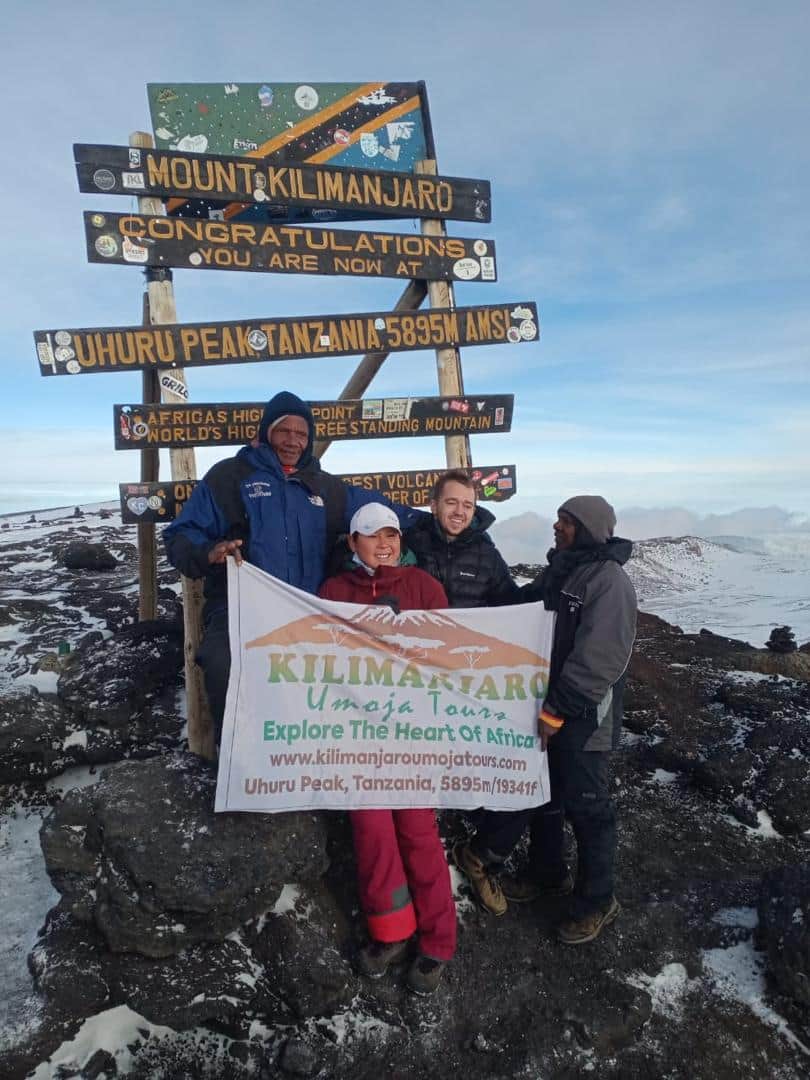
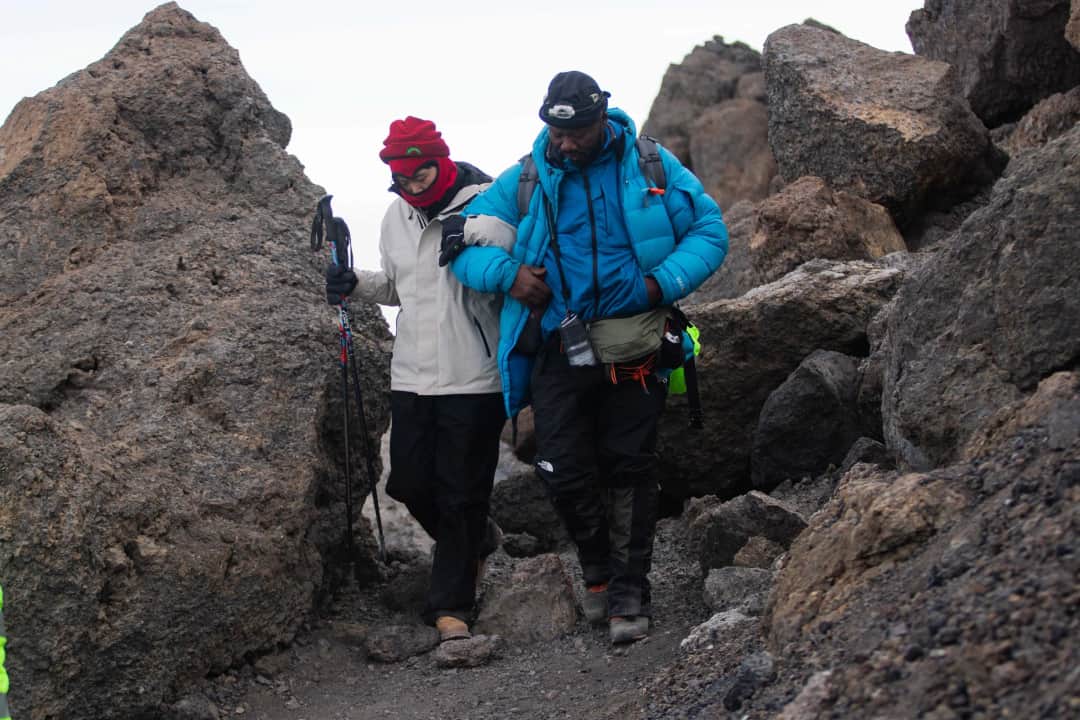
The longest, hardest, and most extraordinary day of the entire nine-day adventure begins around midnight. Under an impossibly clear and star-filled sky, the kind visible only at high altitude where the thin atmosphere reveals the Milky Way as a brilliant river of light, your guide wakes you for the final push towards the summit. At School Hut, temperatures around midnight typically range between -10°C and -20°C, so every layer you have brought will be needed. The ascent follows the Rongai Route approach, climbing steadily through the scree towards Gilman's Point at 5,681 metres on the crater rim. Reaching Gilman's Point is an achievement in itself and is recognised with a Certificate of Achievement. From here, the route continues westward along the crater rim, offering an extraordinary walk at an altitude of more than 5,600 metres. On one side lies the vast volcanic crater, while on the other, the landscape of Tanzania stretches far below. The final push from Gilman's Point to Uhuru Peak, at 5,895 metres, takes approximately one to one and a half hours. Then, finally, you arrive at the Roof of Africa and the highest point on the continent.As you stand at Uhuru Peak, the sunrise begins, creating a spectacle that leaves both first-time visitors and experienced mountaineers in complete silence. The shadow of Kilimanjaro stretches westward across Tanzania towards the horizon as the first light transforms the glaciers from silver to gold. Below, clouds spread across the Rift Valley and gradually begin to glow pink in the morning light. This is the moment that makes every step of the journey worthwhile. After taking photographs and celebrating beside the famous summit sign, the long descent begins. You will descend through Barafu and continue down through the moorland to Millennium Camp at 3,820 metres, where a deeply earned overnight rest awaits.
The final morning on Kilimanjaro begins after breakfast at Millennium Camp and a well-deserved lie-in following the previous day's extraordinary effort. The trail descends for the last time through lush montane rainforest towards Mweka Gate. After days spent in the alpine desert and high mountain zones, the return of trees, birdsong, humidity, and the rich scent of earth and vegetation feels like a welcome return to familiar life. The 10 km descent takes approximately three to four hours at an easy pace, allowing tired legs to gradually find their rhythm along the well-worn trail. Colobus monkeys may be seen watching from the forest canopy overhead. At Mweka Gate, located at an altitude of 1,640 metres, the official Kilimanjaro trek comes to an end. Here, you will receive your Kilimanjaro Summit Certificate, one of the most meaningful rewards for completing this remarkable journey. Your Wildflip Safaris vehicle will be waiting to transfer you back to your hotel in Arusha, where a hot shower, a comfortable bed, and a lifetime of unforgettable memories await.
Dónde dormirás y qué comerás cada noche del viaje.
Sin alojamiento
Sin alojamiento
Sin alojamiento
Lo que este operador recomienda llevar al viaje.
Por persona, según el tamaño del grupo. Solicita una cotización para el precio exacto en tus fechas.
| Temporada | 1 to 6 people |
|---|---|
| Tamaño del grupo | 1 a 6 |
| Por persona (adulto) | $3,800 |