Mountain in Ethiopia
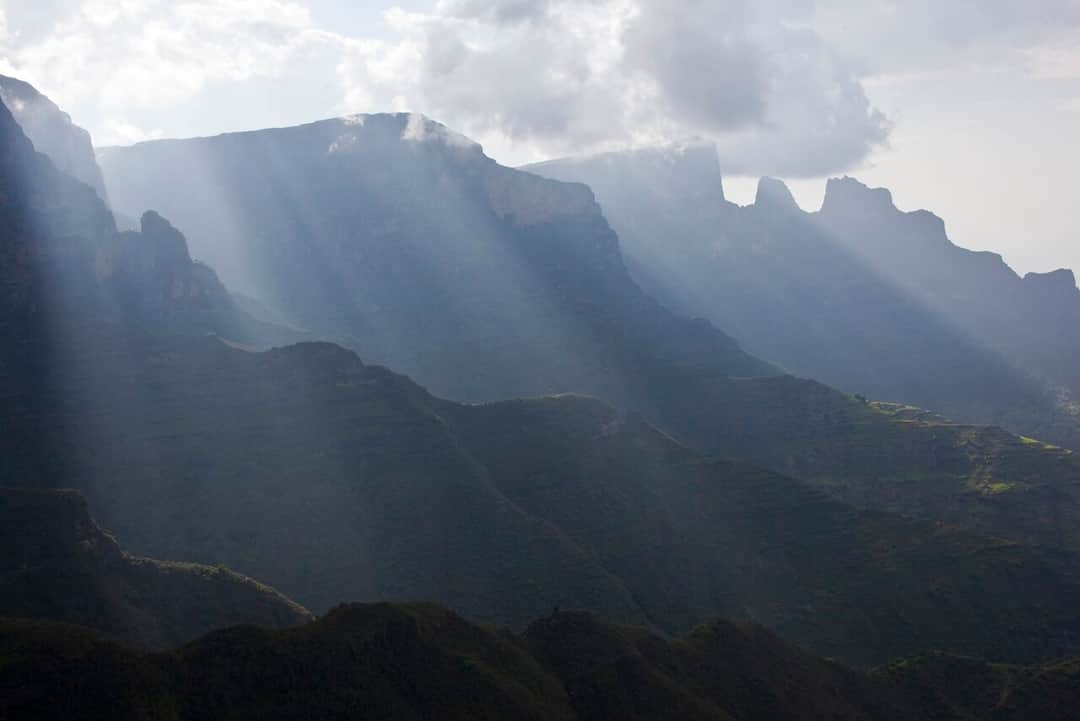
The Simiens are not a mountain range in the way most people picture one. There is no cone, no ridge line marching away to a summit, nothing that looks like it was pushed up. What happened here is the opposite: an immense pile of lava built up a high plateau tens of millions of years ago, and then rivers spent the time since cutting backwards into it. What is left is an edge. A wall of pinnacles, buttresses, isolated towers and grass-topped promontories, with drops of a thousand metres and more falling away from ground you can stand on with your hands in your pockets. Ethiopians call it the roof of Africa and it is one of the few places where the phrase is not marketing.
That geology decides how you walk here. You are not climbing towards anything for most of a Simien trek, you are traversing along the top of the escarpment, following the rim as it swings in and out around each new abyss, with the plateau rolling gently away on your left and nothing at all on your right. The gradients are mostly kind. The altitude is not: the standard route lives between about 3,200 and 4,000 metres for days at a time, and side trips go higher. Ras Dashen, at 4,533 metres the highest point in Ethiopia and one of the highest in Africa, sits well to the east of the main rim and is a serious multi-day objective in its own right rather than something you tack onto a short trek.
The geladas are the reason many people come, and they exceed expectations rather than meeting them. These are large highland primates found nowhere on earth but the Ethiopian mountains, and they are unlike any other monkey: they live almost entirely on grass, they feed sitting down and shuffling along on their backsides, and they gather in troops that can run to several hundred animals. They sleep on ledges in the cliff face for safety and come up over the lip at first light. Because nothing here hunts them on the grassland and they have never been persecuted, they largely ignore people. Sit down at a respectful distance and stay still and the troop will simply carry on grazing around you, adult males with their manes and the bare red patch on the chest, females bickering, infants riding and falling off. It is not a sighting. It is an hour spent inside a wild primate society while it goes about a normal morning.
The rhythm of a trek is straightforward and pleasant. You are up early because the tent is cold, the sun arrives over the escarpment and everything warms fast, you walk four to six hours across grassland and heather with the mules and the kitchen going ahead, and you are usually in camp by early afternoon with the whole day still to look at. Then around four the temperature falls off a cliff, you put on everything you brought, eat early, and are in a sleeping bag by eight because there is nothing else to do and it is the warmest place available. Every camp sits on the rim or near it, so the view from the tent door is the same view you walked all day to see.
Two practical things shape any trip. First, the park is entered from Debark, a busy highland market town a few hours north of Gondar, where you arrange the mandatory guide and the mandatory armed scout, plus a cook and muleteers if you are camping. Second, a road now runs from Debark along the escarpment past Sankaber to Chennek, which has quietly transformed what is possible. You can be driven to a viewpoint, walk a spectacular section, and sleep in a bed. That option did not really exist a generation ago and it means the Simiens no longer demand a week. It also means the deep quiet has moved further east, and anyone who wants the mountains to themselves should be planning towards Ras Dashen rather than towards Sankaber.
Best time to visit
October to December is the best window and it is not close. The kiremt rains finish through September, and what follows is a short, brilliant season when the grassland is green, the streams are still running, wildflowers are out across the plateau, and the air has been washed clean so the views from the rim go on for a hundred kilometres. The yellow Meskel daisies that carpet the Ethiopian highlands after the rains are at their best in this period. If you have flexibility, come now.
January and February are also dry and are the traditional peak of Ethiopian travel, but the country is browning off, the streams are shrinking, and these are the coldest nights of the year: frost on the tents at Geech and Chennek is entirely normal and a hard freeze happens. The views are still excellent and the walking is easy, so this is a perfectly good time to come, simply a drier and colder version of it. March through May the heat builds, haze reduces the long views, and afternoon storms start rolling in ahead of the main rains, which can be dramatic to watch from the rim but unpleasant to be caught out in.
Late June to September is the kiremt and it is the season to avoid unless you have a specific reason. Cloud sits on the escarpment for days, which matters enormously here because the escarpment view is the entire product. The trails turn to slick mud, river crossings on the eastern routes become serious, camping in continuous rain at 3,600 metres is grim, and the road can be difficult. The counterargument is that the mountains are at their greenest and emptiest, the waterfalls are actually falling, and prices are at their lowest. Experienced walkers who are properly equipped and who accept that they may see nothing for a day and a half do go, and some of them love it.
Whatever month you choose, plan for cold. This is the single most common mistake visitors to the Simiens make. People come to Ethiopia expecting Africa, arrive with a light fleece, and then spend nights at 3,600 metres where the temperature drops below freezing and the tents are canvas. Days are warm and the equatorial sun at this altitude will burn you badly in an hour, so you also need sun protection and a hat. It is a mountain climate, cold nights and strong sun, and it needs mountain clothing regardless of the month.
High season
October to January is the busy period, peaking around late December and early January when the weather is at its best and the Ethiopian festival season draws visitors to the northern circuit. Debark, Sankaber and Chennek see the most traffic then, and the day-walk viewpoints reachable by road can gather a fair number of vehicles at midday. June to September is very quiet. The eastern half of the park towards Ras Dashen stays quiet in any month.
The gelada is the animal that defines this park. Theropithecus gelada survives only in the Ethiopian highlands, and the Simiens hold some of the largest and most approachable troops anywhere. They are the world's only primate that lives principally by grazing grass, which is why they are out on open ground in daylight rather than in trees, and why you can watch them for hours: they spend most of the day sitting, plucking and chewing, shuffling forward a body length at a time. Males carry a heavy cape of hair and a bare hourglass of red skin on the chest, which is where the old name bleeding heart baboon came from. Troops sleep on the cliff faces, descending at dusk down routes that look impossible, and coming back over the rim shortly after sunrise. Early morning near a cliff edge camp is the reliable way to be among several hundred of them.
The Walia ibex is the park's other endemic and its emblem, a heavy-horned wild goat that lives nowhere in the world except this escarpment. It came very close to disappearing and is still not common, but numbers have recovered enough that sightings are realistic if you go to the right place, which means the cliffs around Chennek and the slopes below the Bwahit pass, and it means looking early or late. Scan the near-vertical ground below the rim rather than the grassland: they feed on ledges that no other large animal can use. The Ethiopian wolf, the rarest canid on earth, also occurs here in small numbers on the highest Afroalpine ground towards Bwahit and Ras Dashen. Seeing one is a matter of luck and altitude, and anybody whose main goal is the wolf should be going to the Bale Mountains in the south instead.
Beyond the three headliners there is klipspringer on the rocky ground, bushbuck in the heather, common jackal and, at night around camps, spotted hyena calling. Hamadryas and olive baboons live lower down on the approaches. Birds are excellent and easy. The lammergeier, the bearded vulture that drops bones onto rock to get at the marrow, is the one to wait for: they patrol the cliff line at eye level and pass close enough that you hear the air over the wings. Add thick-billed raven, wattled ibis, white-collared pigeon and blue-winged goose, all Ethiopian or Horn endemics, plus Verreaux's eagle and augur buzzard working the updraughts along the rim.
The vegetation is a large part of the strangeness of the place. Below the rim there is remnant montane forest, and around the 3,000 to 3,500 metre band you walk through forests of giant heather hung with lichen. Above that comes true Afroalpine grassland dotted with giant lobelias, absurd columns three or four metres tall with a rosette of leaves on top, which look like nothing else on earth and are the plants that make Simien photographs unmistakable. Add red hot pokers, Abyssinian roses and everlasting flowers, and after the rains the plateau is genuinely colourful, which surprises people expecting bare high ground.
Debark, the park gate and getting the trek set up
Everything starts at Debark, a working highland town on the road north from Gondar, about three hours by vehicle and around 2,850 metres up, which conveniently means you sleep one night at altitude before you start walking. This is where the park headquarters is, where fees are settled, and where the two mandatory people are assigned: a guide and an armed scout. The scout is not negotiable and is not for show, it is a long-standing arrangement that puts local men from the surrounding communities on the payroll of the park, and yours will usually be an older farmer in a shamma carrying an ancient rifle who walks the entire route faster than you do and knows exactly where the ibex are. If you are camping you also engage a cook and muleteers with their mules. Reputable operators handle all of this in advance, which is worth paying for: doing it yourself at the gate on the morning you want to start walking usually costs half a day.
Day one: Buyit Ras to Sankaber
The classic trek starts by driving up from Debark to the Buyit Ras area on the escarpment edge, roughly 3,250 metres, so the first steps you take are already at the top of the wall. This is deliberate and it is the right way round, because it puts the view in front of you within minutes rather than after a day of climbing through farmland. The walk to Sankaber is a gentle four to five hours along the rim through heather and grassland, with the country falling away on your left in a series of amphitheatres, and it is usually the day you meet your first gelada troop. It is an easy day by design: your body is adjusting, and the point is to arrive early, sit at the edge and let the altitude settle. Sankaber camp sits at around 3,250 metres with a view straight down the escarpment. If you have only two nights in the park, this stage plus a return by road still gives you the essential Simien experience.
Day two: Sankaber to Geech, and the Jinbar falls
The stage from Sankaber to Geech is the one that converts people. You continue along the rim, drop through a gorge and cross the Jinbar river, then climb steadily onto the higher plateau, five to seven hours in total with a climb of several hundred metres. The set piece is the Geech Abyss, where the Jinbar river reaches the escarpment edge and simply falls off it, several hundred metres straight down into a bowl of vertical rock. In October the fall is running properly and the spray drifts back up; by February it can be reduced to a ribbon. Geech camp is at roughly 3,600 metres, and this is where the cold becomes a factor. The village of Geech that once stood nearby was relocated out of the park as part of the long effort to reduce grazing and cultivation pressure inside the boundary, which is worth knowing because the tension between a national park and the farming communities who have used this land for centuries is the central conservation story here.
The Geech rim day: Imet Gogo, Saha and Kedadit
This is the single best day in the Simien Mountains and it is worth building an itinerary around. From Geech you walk out along a narrowing spur to Imet Gogo, a promontory at about 3,900 metres that projects into the void with cliffs falling away on three sides, and the view from it is the definitive Simien image: a ragged sea of pinnacles and towers, layered ridges going blue into the distance, and vultures circling below your feet. Continue to the viewpoints at Saha and Kedadit for entirely different angles on the same country. It is a six to eight hour loop with real height gain, no packs to carry because you return to the same camp, and it is where the altitude will tell you honestly how you are coping. Start early: cloud commonly builds against the escarpment from late morning and by two in the afternoon Imet Gogo can be inside it, which turns the best view in Ethiopia into a grey wall.
Geech to Chennek over Inatye
The third stage climbs to Inatye at around 4,070 metres, the high point of the standard trek and a place where the ground is genuinely Afroalpine: tussock grass, giant lobelias, frost-shattered rock and thin air. From there the route descends along the rim to Chennek camp at about 3,600 metres, six to seven hours all told. Chennek is the best camp in the park for wildlife by some distance. The cliffs immediately below it are Walia ibex country, and the classic Chennek routine is to be out at the rim at first light with binoculars while a large gelada troop comes up over the edge behind you. Lammergeiers work this section of the escarpment constantly. If you are doing a short trek and have to choose where to spend an extra night, spend it here rather than at Sankaber.
Bwahit pass and the road east
From Chennek the trail climbs steeply to the Bwahit pass at roughly 4,200 metres, with the summit of Ras Bwahit at 4,437 metres a further push above it. Many people walk up to the pass and back as a day trip from Chennek, which is the best acclimatisation test available and gives you the first sight of Ras Dashen across the enormous Mesheha valley to the east. The pass is also the gateway: everything beyond it belongs to a longer trip. This high ground is the most likely part of the park for Ethiopian wolf, and it is bleak, beautiful and often bitterly windy country of frost-heaved earth and lobelias. Anyone who reaches the pass and turns round has still had one of the finest days in the park, and has seen the two ends of the Simiens in one walk.
Ras Dashen, the full expedition
Ras Dashen, at 4,533 metres, is the roof of Ethiopia and it is a proper undertaking. From Chennek you cross the Bwahit pass, drop a punishing thousand metres and more into the Mesheha valley, cross the river and climb to a base at Ambiko around 3,200 metres. Summit day from there is long, ten to twelve hours of walking and scrambling with a final section over broken rock among a cluster of similar-looking summits, and then you have to come back the way you arrived, over the same pass. Allow eight to ten days for the whole round trip on foot from Debark, or shave days off by using vehicle support where the road allows. No technical skill is needed and there is no snow to worry about, but the cumulative altitude and the enormous height losses and gains are what break people. This is the itinerary for walkers who want the mountains rather than the viewpoints, and it takes you into the eastern half of the park where you will see almost nobody.
The short version: lodge-based day walks with vehicle support
Not everybody has a week, and the road along the escarpment means you no longer need one. A lodge or hotel on the escarpment near the park boundary, or accommodation in Debark, plus a vehicle and a guide, lets you drive to Sankaber or Chennek and walk the best sections as day hikes with a bed and a hot shower at the end. Two full days done this way gets you gelada troops at close range, a fair chance of Walia ibex at Chennek, and at least one major viewpoint. Three days can include the Imet Gogo walk if you start very early. What you lose is the thing that makes the Simiens special, which is waking up on the rim, and the slow acclimatisation that comes from sleeping high for several nights in a row. It is a compromise rather than an equivalent, but it is a good compromise, and it is far better than skipping the park because you only have three days in the north.
Mountain
Simien Mountains
Take it with you
Everything on this page in one document you can keep, print, or send to whoever you are travelling with. No email required.
There is nothing technical about the standard Simien routes. No ropes, no scrambling beyond the odd rocky step, no glaciers, no exposure worse than walking near a cliff edge you can stay away from. What it demands is stamina at altitude: four to seven hours a day, several days in a row, between 3,200 and 4,000 metres, with a few thousand metres of cumulative ascent over a week. If you can walk in hilly country for five hours with a day pack and feel fine the next morning, you can do the classic three-night trek. Ras Dashen is a step up: summit day alone is ten to twelve hours, and the descent into and climb out of the Mesheha valley is over a thousand metres each way. Mules carry the luggage on all camping treks, which changes the difficulty substantially, so ask what you will actually be carrying.
Yes, this is real altitude and people do get sick here, which surprises those who think of altitude as a Himalaya or Kilimanjaro problem. Geech and Chennek sit around 3,600 metres, Inatye is above 4,000 and Ras Dashen is 4,533. The saving grace is the profile: most people arrive via Gondar at around 2,200 metres and sleep at Debark near 2,850 before starting, and the trek gains height gradually over several days rather than sprinting up. That is a reasonable acclimatisation pattern. Headaches, poor sleep and breathlessness on the climbs are normal for the first two days. Persistent vomiting, worsening headache, confusion or breathlessness at rest are not, and the response to those is to descend, which is easy here because a road runs along the escarpment. Do not fly in from sea level and start walking the same afternoon.
It is a park regulation and it is not open to negotiation, so build it into your plan rather than arguing about it. The scouts are drawn from the communities in and around the park, and the requirement functions as much as a local employment and consent arrangement as a security one: it gives the surrounding villages a direct stake in the park existing. In practice your scout is a quiet, extremely fit local man who walks the route in sandals or thin shoes, carries an old rifle, knows the wildlife better than anyone and speaks little or no English, so your guide is the one you talk to. Most scouts have spent decades on this escarpment. Treat him as part of the team, tip him properly at the end, and if you get lucky he will be the one who spots the ibex.
Three nights in the park is the sensible minimum for a trek and gets you the standard Buyit Ras to Sankaber to Geech to Chennek traverse with a rim day thrown in, which contains almost everything most visitors come for: geladas, the Geech Abyss, Imet Gogo and the Chennek cliffs. Four or five nights lets you add the Bwahit pass and walk at a civilised pace instead of route-marching. Ras Dashen needs eight to ten days from Debark on foot, or six or seven with vehicle support at the ends. If you have only two days, do it as vehicle-supported day walks from a lodge rather than not going: two days on the escarpment is far better than none, and you will still be sitting among geladas within an hour of the first morning.
The camps inside the park at Sankaber, Geech and Chennek are basic and honest about it: cleared ground for tents, a stone shelter that serves as a kitchen and mess, pit toilets, no showers and no electricity. Water comes from streams and is treated. Your cook produces genuinely good food from a tent kitchen, usually a lot of pasta, soup, eggs and vegetables, and it will be hot, which matters more than you expect at 3,600 metres. Bring or hire a proper cold-rated sleeping bag and an insulating mat, because the ground is freezing. The alternative is lodge-based, with a couple of comfortable places on the escarpment near the park boundary that have heating, hot water and views over the same country, driving in to walk each day. Lodges are more comfortable, cost more, and cut you off from the mountain at exactly the hours it is at its best.
Geladas are as close to guaranteed as any wild animal gets. Troops live permanently along the escarpment, they are diurnal, they feed in the open on grass, and they are frequently seen from the road itself before you have taken a step. On a three-night trek you will encounter them every day, often several times, and sometimes in troops of several hundred. As for distance, the rule is that you let them decide. Sit down on the grass, stay quiet, keep your hands still and do not approach directly, and a feeding troop will often work its way past within a few metres, which is astonishing and completely unforced. Never offer food, never get between a male and his group, and back away if an animal is displaying. Walia ibex are a different matter entirely and are genuinely uncertain, so treat those as a bonus rather than a plan.
A four-season sleeping bag, or a good three-season one with a liner, is the item people most often get wrong and most regret. A down or synthetic insulated jacket for the hours between four in the afternoon and eight in the morning. A hat and gloves, which sound absurd for Ethiopia and will be worn every evening. At the other extreme, high-factor sun protection, sunglasses and a sun hat, because the ultraviolet at 4,000 metres near the equator is fierce and people burn on the first day. Proper walking boots with ankle support for the rocky descents. A head torch, since camp is dark by seven. Water treatment of some kind. Cash in small notes for tips at the end, which are expected and are a meaningful part of what your guide, scout, cook and muleteers earn. Trekking poles help a great deal on the descent off Bwahit.
The normal route is to fly Addis Ababa to Gondar, which takes about an hour, then drive north to Debark, which takes roughly three hours on a mountain road with plenty to look at. Most operators build this as an afternoon transfer with a night in Debark or at a lodge on the escarpment before the walk starts, which is good practice because it puts you above 2,800 metres the night before you begin. Driving the whole way from Addis is possible and is a very long two days. Coming from the other direction, Debark sits on the road between Gondar and Axum, so a Simien trek slots naturally into a northern circuit that also takes in Lalibela and Lake Tana. Give yourself a buffer day at the end if you have an international flight to catch, because road and weather delays do happen.
Yes, and it is one of the easier great landscapes in Africa to see without effort, because the road along the escarpment reaches genuine viewpoints. You can be driven from Debark to Sankaber and on to Chennek, stopping at the rim, and see gelada troops, thousand-metre drops and the pinnacled skyline without walking more than a few hundred metres at a time. What you will miss is Imet Gogo, which cannot be driven to and which is the single best view in the park, and the experience of dawn on the rim, which is the emotional core of the place. If a full trek is out of the question, the honest recommendation is two nights on the escarpment with day walks, including one long enough day to reach a proper promontory. That gets you most of the way there.