Site in Ethiopia
Almost every famous building on earth was assembled. Lalibela was excavated. The masons who made these churches started with a hillside of solid volcanic rock, cut a deep rectangular trench to free a standing block, then worked inwards and downwards through that block until they had doorways, windows, pillars, aisles, arched ceilings and a roof, every part of it the same continuous piece of stone. There is no mortar in Lalibela because there is nothing to join. You do not walk up to these churches. You arrive above them, look down onto their roofs, and descend.
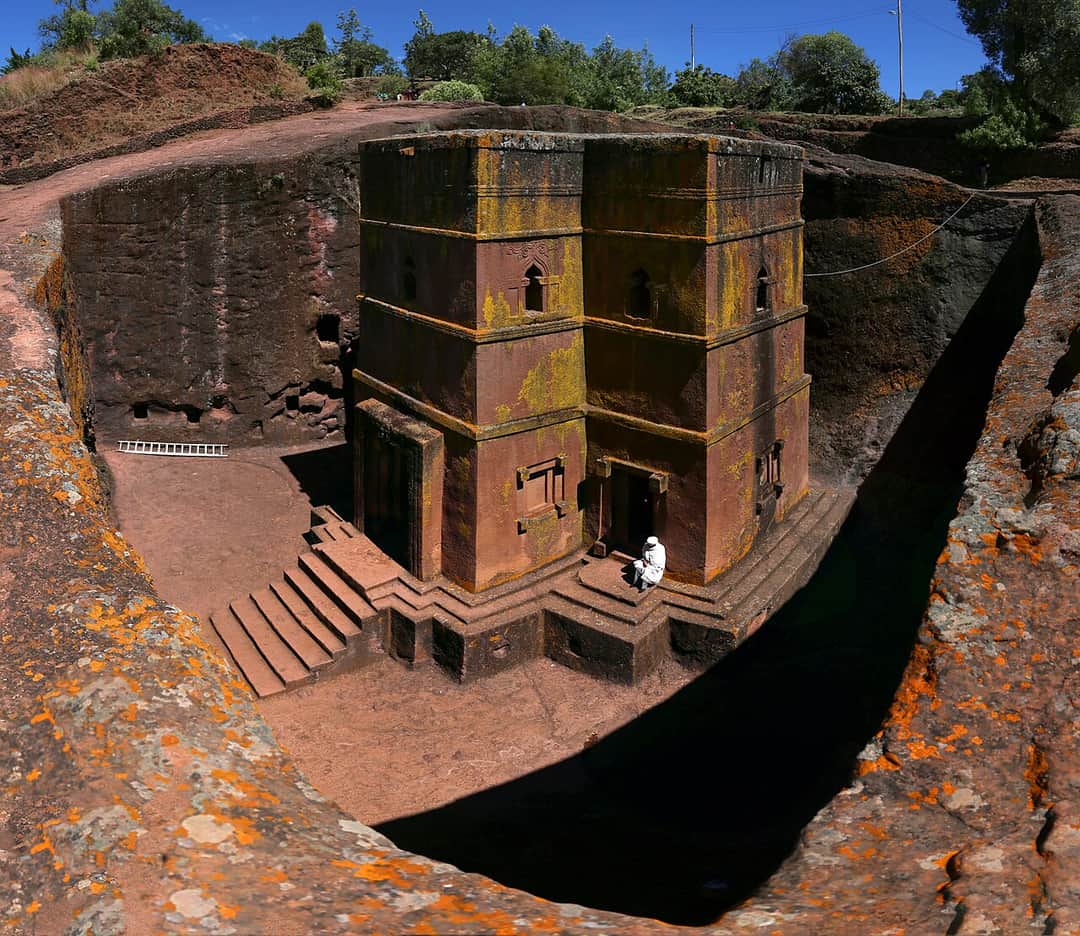
There are eleven of them, spread over a hillside in the Lasta highlands of northern Ethiopia at around 2,500 metres. Tradition credits them to King Gebre Mesqel Lalibela of the Zagwe dynasty, who ruled around the turn of the thirteenth century and set out to build a second Jerusalem in the Ethiopian mountains after pilgrimage to the first became impossible. The town he did it in was called Roha and now carries his name. A small stream running between the two main groups of churches is called the Yordanos, the Jordan, and the naming is not incidental: the northern cluster is read as the earthly Jerusalem and the eastern cluster as the heavenly one, with a tomb of Adam, a Golgotha and a Bethlehem among the chambers. Bete Giyorgis, the church of Saint George, stands on its own to the southwest, a perfect Greek cross sunk into the ground, and it is the image that brings most people here.
Lalibela is not a ruin and it is not a museum. It is a working parish, and it has been in continuous use for something like eight hundred years. That single fact governs the entire visit. Services start in the small hours. Priests and deacons in white and gold move between the churches carrying hand crosses and drums. Elderly pilgrims who have walked for days sleep in the hollows cut into the trench walls, which were made for exactly that. There are carpets and beeswax candles and the smell of incense in stone rooms that have never been dry-cleaned. Visitors are welcome and have been for a very long time, but you are a guest at somebody's church rather than a ticket holder at a monument, and the difference shows in how you dress, where you point a camera, and whether you talk while a psalm is being sung six metres away.
A visit has a natural shape. Most people give the northern group a long morning, because it holds the largest churches and the most complicated architecture and you need time for your eyes to adjust in each interior. Lunch, then the eastern group in the afternoon, which is smaller but more atmospheric, full of tunnels, trenches, bridges and a pitch black passage you walk through by touch. Bete Giyorgis is usually saved for late afternoon, when the light drops into the pit and the cross throws its own shadow. That is a full day and it is what most itineraries allow. Two days is better by a wide margin, because it gives you an early morning at a service, which is the thing people remember longest, and it lets you go back to a church you rushed.
Set your expectations on two points before you go. First, several churches now sit under large protective shelters on steel legs, put up to stop water damage. They do their job and they are genuinely ugly, and they will be in your photographs of the northern group whether you like it or not. Bete Giyorgis is uncovered, which is part of why it dominates every picture of Lalibela ever published. Second, this is rough ground: steep uneven steps cut in rock, no handrails worth the name, low doorways, dark floors, and shoes off at every threshold. It is a physically busy day at altitude. Come with a torch, thick socks and shoes you can slip on and off forty times without sitting down.
Best time to visit
October to March is the straightforward answer. The highland rains, the kiremt, run from late June through September, and while Lalibela in the wet is green, empty and often beautiful, the trenches around the churches hold water, the cut rock turns slippery, the unpaved approaches get difficult and cloud sits on the hillside for days. October is the sweet spot for landscape: the rains have just finished, the countryside around the town is green and the sky is usually clear.
Then there are the festivals, and in Lalibela they are not a side attraction, they are the main event of the year. Genna, Ethiopian Christmas, falls on 7 January and it is the single biggest day at this church. Tens of thousands of pilgrims converge, many on foot from villages days away, and they fill the trenches, the rooftops and every open surface around Bete Maryam through the night before. The chanting, the drums, the sistra and the white crowds packed in around a sunken church are as powerful as anything you will see in Africa. It is also, plainly, extremely crowded. You will not have quiet contemplative access to the churches at Genna, you will have a religious festival, which is a different and in most ways better thing, as long as you chose it deliberately. Timkat, Epiphany, follows on 19 January and is another large occasion. Fasika, Ethiopian Easter, is moveable, comes at the end of a long fast and is intense in a quieter way.
November to early January is the most comfortable travelling window generally: dry, clear, warm in the sun and cold once it goes. February to May is dry, dustier and browner, hotter through the middle of the day, and quieter at the churches, which is a real advantage if the architecture rather than the ceremony is what you came for. April and May are the hottest months here and the light is harsh, though at 2,500 metres hot is relative and the mornings are still cool.
If you want photographs, go outside the festivals. If you want to understand why these churches exist, go during one. Very few people can do both on one trip, and trying to split the difference by arriving two days after Genna gets you neither the crowds nor a hotel room, because the town is still full. One further practical note: Ethiopia runs its own calendar, seven to eight years behind the Gregorian one and with thirteen months, and religious dates are fixed to it. Confirm the exact date of any festival you are planning around rather than assuming last year's date repeats.
High season
The Genna period around 7 January is the peak by an enormous margin, followed by Timkat on 19 January, and accommodation in a small town with limited beds is taken months ahead for both. The general tourist high season runs October to January, when the weather is at its best. June to September is the quietest, wettest and cheapest stretch, and April to May is a genuinely underrated quiet window with reliable dry weather.
Lalibela is a site rather than a park, and the first thing worth understanding is the rock itself. This is the Ethiopian highlands, built from enormous outpourings of basalt lava, and the churches are cut into a reddish volcanic tuff that behaves in a way that made the whole project possible: soft enough to be worked with iron hand tools, and hard enough to hold a carved edge for centuries once it has weathered. Look closely at the walls inside and you can still see the tool marks running in bands. The same rock explains the damage, because it is porous, and water getting into the roofs and running down the walls is what the shelters overhead are fighting.
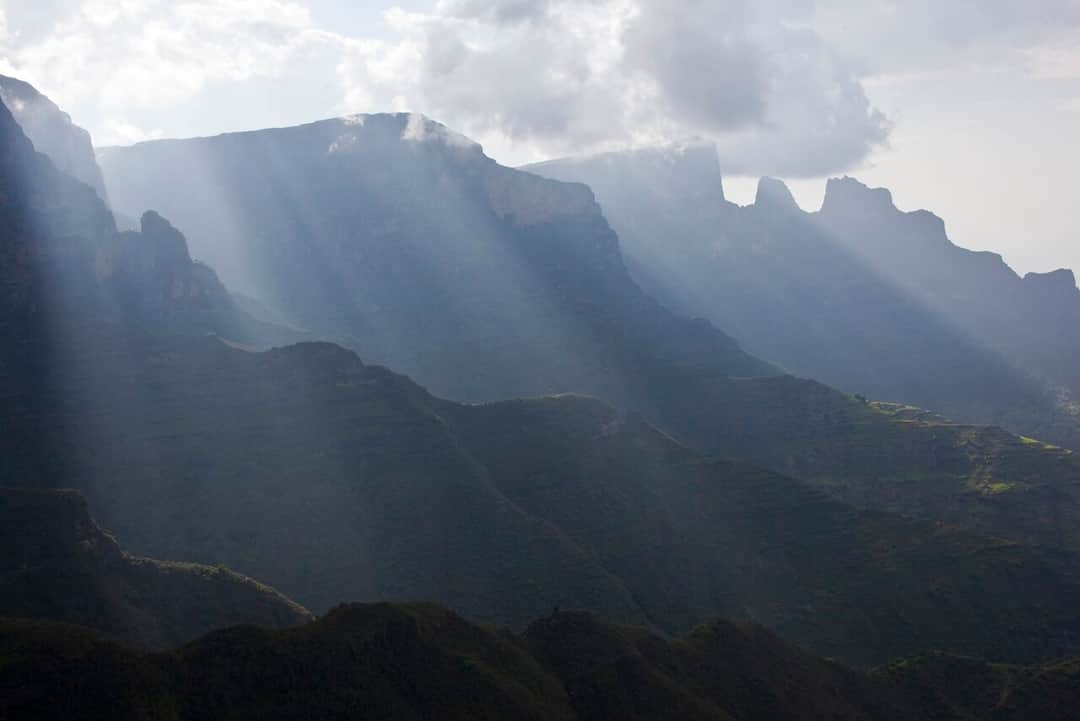
The setting is agricultural highland, not wilderness. The town sits on a slope with terraced fields of teff and barley falling away below it, eucalyptus stands planted for firewood, round stone houses with thatched roofs, and the distinctive two-storey circular houses of Lalibela itself. Above the town rises the Abuna Yosef massif, which climbs past 4,000 metres and holds Afroalpine grassland and giant heather. That high ground is real wildlife country: gelada monkeys graze in troops on the escarpment, and a small and precarious population of Ethiopian wolves lives up there, one of only a handful of places on earth where the species survives. Very few Lalibela visitors go up, and a day walk or a mule ride onto the massif is the best possible way to spend a second or third day.
Birds are easy and constant. Thick-billed ravens, absurdly large and endemic to the Horn, patrol the church compounds and make a noise like a cork being pulled. Lammergeiers, the bearded vultures that drop bones onto rock to break them, cruise the cliffs on huge angled wings. Add wattled ibis and white-collared pigeon, both Ethiopian endemics you will see without trying, augur buzzards on the thermals, and the small flocks of speckled pigeons that live in the church niches and fly out when the drums start.
The living culture is the real subject here, though. Ethiopian Orthodox Tewahedo practice is one of the oldest continuous Christian traditions anywhere, and Lalibela is one of its beating hearts. Priests keep goatskin manuscripts written in Ge'ez, the liturgical language, illuminated in ochre and indigo, and will bring them out to show you. Services use drums and sistra, the metal rattles, and a chanting tradition that is unlike anything in European churches. Deacons hold ornate processional crosses, each church with its own. Saturday is market day in town and worth an hour: highland farmers come in with grain, chillies, salt, live chickens and firewood, and it is the least self-conscious thing in Lalibela.
Bete Giyorgis, the church of Saint George
It is the icon for a reason. A cruciform church, cut as a Greek cross with equal arms, standing free in a squared pit roughly fifteen metres deep with nothing touching it but the floor it stands on. The roof, which is what you see first because you arrive at ground level, is carved as three nested crosses. Tradition says Saint George arrived on horseback, annoyed at being left out of the other ten churches, and hoof marks in the trench wall are pointed out as his. You walk down a sloping cut in the rock to the entrance, and the interior is plain compared with the drama outside, which is the point: the exterior is the achievement. Go late in the afternoon when the sun is low enough to light one face and leave the others in shadow, and again first thing if you can, when priests are around and the pit is quiet. It is the only major church with no shelter over it, so it is the only one you can photograph as it was meant to be seen.
The northern cluster and Bete Medhane Alem
The northern group is the architectural heavyweight and needs an unhurried morning. Bete Medhane Alem, the House of the Saviour of the World, is the largest rock-hewn monolithic church anywhere, surrounded by a colonnade of square pillars that reads like a Greek temple until you remember that none of it was placed there, all of it was left behind when everything else was cut away. Bete Maryam next door is smaller, older in feel and far more decorated, with carved reliefs, faded frescoes and a central pillar permanently wrapped in cloth which the priests say carries writing about the past and the future and which nobody is permitted to unwrap. Around them are Bete Meskel and Bete Denagel, cut as chapels into the trench walls rather than as free-standing blocks, and Bete Golgotha with its life-size carved figures of saints in wall niches, connecting through to the Selassie chapel and what is called the Tomb of Adam. The whole group is linked by trenches and courtyards, so you move between churches without returning to the surface.
The eastern cluster and the tunnels
Across the Yordanos stream, the second group is smaller in scale and much stranger in feel. Bete Amanuel is the most refined piece of carving in Lalibela, its outer walls cut with the stepped and recessed banding that imitates the wood-and-stone walls of ancient Aksumite palaces, in stone, for no structural reason at all. Bete Merkorios and Bete Gabriel-Rufael have the character of a fortress rather than a church, approached across a walkway above a deep trench. Bete Abba Libanos is the semi-monolithic one, freed on three sides but still joined to the mother rock at its roof, and legend gives it a single night's construction by the king's wife with angelic assistance. Between them run tunnels, the most famous of which is completely dark for forty or so metres and is walked without a light on purpose, understood as a passage through hell before emerging into the day. Take a guide through this cluster: the order in which you see it is the whole meaning of it.
An early morning service
This is the thing to organise if you do only one thing beyond the standard tour. Ethiopian Orthodox services begin very early, and on major mornings people gather well before dawn. You stand at the rim of a trench in the cold and the dark, wrapped in a shawl like everyone else, while chanting comes up out of a hole in the ground lit by candles, drums keeping a slow beat and sistra rattling on the offbeat. White-robed figures move along the courtyards below with hand crosses. Then the light comes up over the ridge and the whole compound turns from black to red. Nobody is performing this for visitors, which is precisely what makes it worth getting up at four for. Ask your guide the evening before which church has the earliest service, stand at the back, keep quiet, and put the camera away for at least the first twenty minutes.
Genna, Ethiopian Christmas
On 7 January, Lalibela receives tens of thousands of pilgrims and becomes something else entirely. People arrive on foot from across the northern highlands, many walking for days, and camp on any flat ground they can find. On Christmas Eve the crowd packs the trenches and the rooftops around Bete Maryam and stays all night, and the singing does not stop. Priests in embroidered velvet umbrellas process. The town's supply of everything runs thin. It is one of the great religious gatherings of the continent and it is genuinely moving even if you hold no faith at all. Be clear-eyed about the trade: you will queue, you will be pressed in crowds, you will not get an unobstructed photograph of anything, and beds must be booked a very long way ahead. Anyone whose main interest is the architecture should come at a different time of year.
Yemrehanna Kristos
About forty kilometres north of town, up a rough road that takes well over an hour each way, is a church that is older than the Lalibela group and completely different in method. Yemrehanna Kristos was not carved out of rock, it was built inside a cave, in layered courses of pale stone and dark wood in the Aksumite manner, with a decorated wooden ceiling and carved windows, and it stands almost untouched in the shelter of the overhang. The floor is laid over marsh grass and wooden beams. Behind the church, in the darkness at the back of the cave, are the remains of pilgrims who came here to die, which is confronting and is left exactly as it is. Fewer visitors make the trip than should, and going gives you the crucial comparison: this is what Ethiopian church building looked like, and Lalibela is what happens when somebody decides to reproduce it in solid rock.
Asheton Maryam and the Abuna Yosef massif
High above the town, at around 3,150 metres on the flank of the Abuna Yosef massif, is the monastery of Asheton Maryam, cut into a cliff face and reached by a steep climb of a couple of hours on foot, or by mule most of the way with a walk at the end. It is a modest church by Lalibela standards. The reason to go is the ascent and the view: terraced fields dropping away, vultures level with you, and the whole Lasta country opening out. Nearby, and much easier, is Na'akuto La'ab, a small church built into a shallow cave a short drive from town where holy water drips from the roof into stone basins and an old priest will show you the crowns and crosses. Both are good half-day options if you have a second day, and Asheton in particular is the antidote to a morning spent in dark interiors.
The town, the market and the food
Lalibela town is small, steep, dusty and more interesting than the average visitor allows. The traditional houses here are unusual, circular and two storeys, built in red stone with the animals kept below and the family above. Saturday market draws farmers from the surrounding highlands and is a working market rather than a craft one, so expect grain, spices, chillies, salt and livestock, and expect to be the only foreigner not in a tour group. Eat injera, the sour fermented flatbread made from teff, with whatever is on it, and note that on Wednesdays and Fridays and through fasting seasons most kitchens serve only fasting food, which is vegan by definition and often the best meal you will get. Tej, the honey wine, is served in flask-shaped glasses in small bars and is considerably stronger than it tastes. A few restaurants on the ridge above town are built for the view over the valley, which is worth an evening.
Site
Lalibela
Take it with you
Everything on this page in one document you can keep, print, or send to whoever you are travelling with. No email required.
One full day covers the eleven churches and is what most itineraries allow, but it is a rushed and slightly punishing day: dark interiors back to back, shoes on and off constantly, and no time to sit anywhere. Two days is the right answer for most people. It lets you split the northern and eastern clusters across two mornings when the light is better and the crowds are thinner, get to an early service, and keep an afternoon for something outside the core site. Three days opens up Yemrehanna Kristos, which needs a half day for the drive alone, plus Asheton Maryam or the Abuna Yosef highlands. If you are coming for Genna, add a day either side simply for the congestion.
Yes, and not for the usual reasons. The churches are not labelled, the eleven are not in an obvious order, and half of what makes the site extraordinary is symbolic: which chamber is Golgotha, why the trench is named after the Jordan, what the wrapped pillar in Bete Maryam is said to hold, why one tunnel is walked in complete darkness. Without that you are looking at rooms. Official guides can be arranged at the ticket office and through hotels, and it is worth asking for one who can also get you into a service and explain what is happening rather than only reciting dates. Guides are also the practical answer to the shoe-minding, the tips and the priests who expect a word before a photograph.
Yes. Visitors of any faith or none are welcome inside the churches, and have been for a very long time. What is closed to everyone except priests is the maqdas, the innermost sanctuary of each church that holds its tabot, a consecrated replica of the Ark of the Covenant. You will see the curtain and you will not see behind it, and that applies to Ethiopian Orthodox worshippers as well, so it is not a restriction aimed at you. What is asked in return is straightforward respect: shoes removed before entering, shoulders and knees covered, women often cover their hair, no talking during services, and do not step in front of somebody praying to get a photograph.
The rock these churches are cut from is porous, and centuries of rain running off the roofs and into the walls has been doing real structural damage, made worse by earlier repair attempts. Large steel-framed shelters were erected over several of the northern churches as a temporary measure to keep the water off while a permanent solution was worked out, and temporary has lasted a long time. They are effective and they are unattractive, and they dominate the view of the churches they cover. Bete Giyorgis, the most photographed church of all, has none, which is why almost every image you have seen of Lalibela is of that one church. Plan your photography accordingly and do not expect the northern group to look like the postcards.
Shoes you can take off and put back on without sitting down, because you will do it at every single church, and thick socks, because the floors are cold, gritty and sometimes damp and you will be walking on them. Long trousers or a long skirt, and sleeves. A scarf is useful for women, both for covering the head in church and for the cold at dawn. A torch or a headlamp matters more than people expect: several interiors are genuinely dark, one tunnel is completely dark, and a phone light held over your head while you negotiate rock steps is a poor arrangement. Layers, because a highland morning at 2,500 metres is cold and midday is not. A small amount of low-denomination cash for shoe minders and priests who show you crosses and manuscripts.
It depends entirely on the date. On ordinary days outside the festivals, Lalibela is quiet by the standards of any comparable world heritage site, and there are hours when you will be alone in a church with a priest. Tour groups cluster in the middle of the day and around Bete Giyorgis at sunset, so an early start moves you ahead of them. At Genna in January the answer flips completely: tens of thousands of pilgrims, no space to move around the northern group, and no chance of a quiet moment anywhere. That crowd is the experience rather than an obstacle to it, but you should choose it knowingly rather than discover it on arrival.
Almost everyone flies. Lalibela has a small airport around half an hour from town by road, served from Addis Ababa and usually linked with the other northern towns on the historic circuit, so it slots in easily between Gondar, Axum and Bahir Dar. Overland is possible and it is a serious undertaking: long days on mountain roads with heavy climbs and descents, sections that are unsurfaced, and journey times that vary with weather and road works. The scenery is spectacular and the drive from the Gondar direction crosses genuinely dramatic country, but it costs days rather than hours. If your trip is short, fly and spend the recovered time on a second day at the churches.
Yes, if you approach it as engineering and as anthropology rather than as devotion. What is remarkable here is not that somebody built churches, it is that somebody removed a hillside to leave churches standing in the hole, working downwards with hand tools, with no possibility of correcting a mistake, and produced doorways, pillars and vaulted ceilings inside a single block of stone. That is a genuinely astonishing act of planning, and standing in the trench at Bete Giyorgis makes the difficulty of it obvious in a way no photograph does. The second half of the appeal is that the whole thing is still in use by the descendants of the people who made it, with the same liturgy in the same language. If neither of those interests you, one day is enough and you will still be glad you came.
It is one stop on what is usually called the northern historic route, and it works best as part of that rather than alone. The standard run pairs it with Gondar for the seventeenth century castle compound and the painted ceiling at Debre Berhan Selassie, Bahir Dar for Lake Tana and its island monasteries and the Blue Nile falls, and Axum for the stelae and the Ark tradition. The Simien Mountains slot in from Gondar and give the trip its walking and its wildlife, which balances a lot of churches. Four to five days between Gondar, the Simiens and Lalibela is a coherent short version. If you want to add the south, that is a separate journey through the Rift Valley lakes and the Omo, and it does not combine neatly with the north on a short trip.