City in Egypt
Luxor is a modest provincial city built on top of, and partly out of, the greatest concentration of ancient monuments anywhere on earth. Ancient Thebes was the capital of Egypt through its wealthiest and most confident centuries, and what it left behind is not a site you tick off in an afternoon but a landscape you live inside for several days. Hotels back onto temple walls. A working mosque sits on the roof of one temple, high above the original floor, because the sand had buried the building that deep by the time it was built. Farmers grow sugarcane a few hundred metres from the tombs of kings.
The Nile splits the city in two, and that split is not scenery, it is the organising fact of the place and of your itinerary. The east bank, where the sun rises, was the land of the living: the town, the corniche, the market, and the two great temples of Karnak and Luxor. The west bank, where the sun sets, was the land of the dead: mortuary temples strung along the edge of the green, tombs cut into the hillsides above them, and a dry rock valley hidden behind the cliff where the New Kingdom pharaohs were buried out of sight of the river. Every sensible Luxor itinerary is built as a series of half days, one bank at a time, because bouncing back and forth wastes hours you will want later.
Heat is the governing constraint, and it is not a detail to plan around afterwards. From May to September the middle of the day is genuinely punishing, and the Valley of the Kings is a treeless rock amphitheatre that traps and reflects it. Inside a tomb, in a narrow corridor with fifty other people breathing, it is hotter still. This is why the local rhythm exists: out of the hotel at or before dawn, the west bank done by late morning, a long flat pause through the afternoon, then the east bank temples in the evening when the stone has cooled and the light is worth something. Fight that rhythm and you will see less, badly, while feeling terrible.
A day here has a particular texture. You cross the river on a small ferry or over the bridge south of town, drive past the two seated colossi standing alone in a field, and climb into a valley of pale rubble with numbered doorways in it. You walk down a sloping corridor cut through solid rock and the walls turn out to be covered, floor to ceiling, in painted figures and columns of hieroglyphs that still hold their colour after three thousand years. Then you come back out into the glare, blink, drink a litre of water, and do it again in the next tomb. It is a strange rhythm and it takes people a day to settle into it.
One more thing to know before booking. Luxor is the usual start or end point for a Nile cruise to Aswan, and a large share of visitors see the city as two rushed half days bolted onto a boat. That works, but it is the thin version. The city rewards a few extra nights: the tombs of the nobles that no cruise group visits, the workers' village at Deir el-Medina, a second unhurried morning at Karnak, an evening walk through Luxor Temple when it is floodlit and half empty. Decide early whether Luxor is a stop on your trip or the point of it, because the two versions look nothing alike.
Best time to visit
October to April is the season, and within it December and January are the most comfortable weeks of the year: dry, clear, daytime temperatures that let you stand in the sun without suffering, and mornings cool enough that you will want a fleece on the west bank before sunrise. People consistently underpack for those early starts, then stand shivering at a balloon launch site in a t-shirt. Nights in midwinter drop further than the brochure photographs suggest.
From May through September Luxor is very hot, and in July and August it is extreme. This is Upper Egypt, well south of Cairo, in a dry valley with no sea breeze. The heat is at least dry rather than humid, and hotels and vehicles are air conditioned, but the archaeology is outdoors and much of it involves climbing. If you come in summer, the day compresses into two viable windows: from first light until around ten, and after four in the afternoon. Everything in between is for shade, water and sleep. Summer is not impossible, it is simply a different and much stricter trip, and it comes with the compensation of thin crowds and the lowest rates of the year.
March to May carries a specific nuisance worth knowing about: the khamsin, hot sand-carrying winds that blow up out of the desert for a day or two at a time, turning the sky yellow and putting grit into everything. They are episodic rather than constant, and most spring visitors never meet one, but a khamsin day is also the sort of day balloon flights do not fly.
On balance, November and February are the sweet spot for most people: proper cool-season weather without the Christmas and New Year crush, and the temples still lit well in the low sun. If your dates are fixed and land in summer, book a hotel with a pool and treat the afternoon rest as part of the itinerary rather than a failure of ambition.
High season
Late December through February is the peak, with Christmas and New Year the busiest and most expensive fortnight of the year in Luxor, followed by the Easter period and Egypt's own spring holiday. The pressure is felt most inside the tombs, where a corridor that holds thirty people comfortably ends up holding a hundred, and at the popular sights between roughly nine and eleven in the morning when the cruise boats disembark together. July and August are the quietest months by a wide margin, for obvious reasons.
Luxor is a city rather than a park, so the setting is the thing to understand, and the setting here is one of the most legible landscapes in the world. Egypt is a narrow green thread laid across an enormous desert, and at Luxor the thread is only a few kilometres wide. Stand on the west bank and you can see the whole system at once: the river, then a band of intensely farmed floodplain, sugarcane and alfalfa and date palms, then an abrupt line where the irrigation stops, then bare limestone desert rising into cliffs. The ancients built on that line deliberately. Fields were too valuable and too wet for tombs, so the dead went just beyond the last furrow, which is why the mortuary temples sit exactly where the green ends.
The cliff behind the west bank is the other piece of geography that explains everything. Above Deir el-Bahari the rock rises to a natural pyramid-shaped peak, al-Qurn, which the tomb builders understood as a sacred form and as the home of a cobra goddess. The Valley of the Kings sits in a dry watercourse directly behind it, invisible from the river and reachable through a single narrow entrance, which is precisely the point. It is a wadi, a desert flood channel, and the flash floods that occasionally roar down it have both damaged tombs and, by dumping metres of debris, hidden others well enough that they survived to be found.
The river itself is still a working waterway rather than a scenic feature. Feluccas tack across it with the prevailing north wind, small motor ferries shuttle locals and their shopping between the banks all day, and long white cruise boats moor up three and four abreast at the corniche. On the water and along the banks there is more birdlife than most visitors expect: cattle egrets following the plough in the fields, pied kingfishers hovering and dropping, herons, hoopoes on hotel lawns, black kites riding the thermals over the desert, and in winter, migrant waders and ducks using the Nile as a flyway. On the west bank you will see donkeys and water buffalo working the fields much as they appear on the tomb walls above, which is an odd and quietly powerful thing to notice.
The green season, if it can be called that, is not driven by rain here because it essentially never rains. What changes the landscape is the agricultural calendar: sugarcane standing tall and then cut, alfalfa cropped, fields flooded and replanted. Photographers should know that the low winter sun does far more for the west bank cliffs and the temple reliefs than the flat vertical light of summer, when carvings that look spectacular in December can read as blank grey stone at midday in July.
Karnak, and giving it more time than your tour will
Karnak is not a temple, it is a temple complex built and rebuilt over roughly two thousand years by successive pharaohs, each adding, demolishing and re-inscribing. The scale is genuinely difficult to absorb. The Great Hypostyle Hall alone holds well over a hundred sandstone columns, the central ones so thick that several people with linked arms cannot reach around one, standing in a forest so dense you lose your group in it. Beyond the hall are obelisks, a sacred lake, ranks of ram-headed sphinxes, the Open Air Museum with reconstructed early chapels, and outer precincts most visitors never enter. Most group itineraries give Karnak ninety minutes, and that is roughly half of what it needs. If you have any control over your schedule, go at opening time before the coaches, walk the main axis first, then go back and take the side courts slowly. There is also an evening sound and light show which divides opinion sharply: the narration is dated and theatrical, but walking the complex after dark is worth the ticket on its own.
Luxor Temple after dark
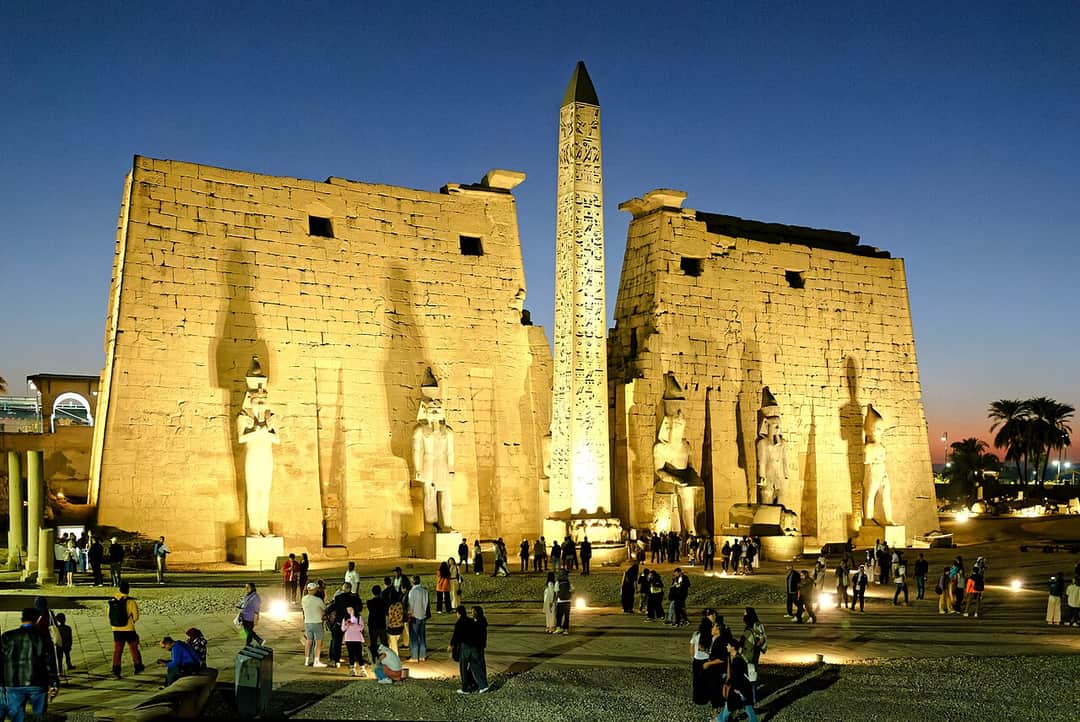
Luxor Temple sits right in the middle of the modern town, walled off from the corniche traffic, and it is the one major site that is unambiguously better at night. Floodlighting rakes across the columns and colossi and does what daylight cannot, throwing the carving into relief and turning the courts into something closer to how they were meant to feel. It is also cooler, quieter and immediately after the cruise groups have gone back to their boats for dinner. The temple is a lesson in layers: a pharaonic core, a chapel added by Alexander, a Roman camp with painted frescoes still visible, a Coptic church, and the mosque of Abu al-Haggag built high up on the wall because the temple was buried in sand to that level when it was founded and is still in use today. One obelisk stands at the entrance and the pair to it is in Paris. Connecting Luxor Temple to Karnak is the avenue of sphinxes, close to three kilometres of processional way, excavated and reopened along its full length. Walking even part of it, at dusk, is the best free thing to do in the city. The excellent and mercifully compact Luxor Museum is a short walk along the corniche and is the right antidote to temple fatigue.
The Valley of the Kings and the tomb rotation
The Valley of the Kings is a barren gorge with numbered doorways cut into its walls, and the payoff is entirely underground. You walk down long sloping corridors into burial chambers whose walls are covered with funerary texts and painted figures, much of it still holding astonishing colour because it sat sealed in bone-dry rock. The single most important practical fact is that not all tombs are open at once. The authorities rotate them to control humidity, dust and wear, so the ones open on your visit are decided on the day, not by your guidebook. A general ticket admits you to a limited number of tombs chosen from the open list, and a handful of the finest, including Seti I with the deepest and most complete decoration in the valley, Tutankhamun where the mummy itself is on display in a small and frankly unremarkable chamber, and Ramesses V and VI with its extraordinary astronomical ceiling, require separate tickets. If you are choosing, prioritise decoration over fame: Ramesses VI and Seti I are far more impressive than KV62. Guides are not permitted to lecture inside the tombs, so a good one briefs you thoroughly outside before letting you go in alone.
Hatshepsut's temple at Deir el-Bahari
Nothing else in Egypt looks like this. Three colonnaded terraces rise out of the desert floor and set themselves flat against a vertical amber cliff several hundred metres high, linked by long ramps, all straight lines and horizontal rhythm against a wall of rock. It is unmistakably ancient and yet reads as almost modern, and it is the mortuary temple of Hatshepsut, one of the very few women to rule Egypt as pharaoh, who was systematically erased from monuments after her death. You can still see where her images and names were chiselled out. The reliefs in the side colonnades are the reason to linger: an expedition to the land of Punt with its ships, its trees carried in baskets and its famously depicted queen, and the story of Hatshepsut's divine birth used to justify her reign. There is almost no shade here and the terraces radiate heat, so this is a first-thing-in-the-morning site, not a late-morning one. A small electric shuttle runs from the car park to the base of the ramp, which is worth taking on the way in if the sun is already up.
The Valley of the Queens and the Tombs of the Nobles
The Valley of the Queens holds the tombs of royal wives and children, and its crown is the tomb of Nefertari, the principal wife of Ramesses II. It is widely considered the finest painted tomb in Egypt, with colour and modelling of a quality that makes the royal tombs look coarse, and access is tightly controlled with limited numbers, short visits and a separate and expensive ticket. If your budget stretches to exactly one splurge in Luxor, this is the strongest candidate. Nearby, on the hillside of Sheikh Abd el-Qurna, the Tombs of the Nobles are the most underrated sites on the west bank. These belonged to officials rather than kings, and because they were not preoccupied with the afterlife texts, their walls show daily life: harvesting, banqueting with musicians, fowling in the marshes, cattle being counted, a girl adjusting an earring. The tombs of Sennefer with its vine-painted ceiling, Ramose with its exquisite low relief, Rekhmire and Nakht are the usual picks. They are small, mostly quiet, and they tell you more about how Egyptians actually lived than everything in the Valley of the Kings put together.
Deir el-Medina, the village of the tomb builders
Deir el-Medina is skipped by almost every standard itinerary and should not be. This was the purpose-built village of the workmen and artists who cut and painted the royal tombs, housed together in a walled settlement in a side valley so their knowledge of the tombs' locations stayed contained. You can walk the stone foundations of the streets and see the plan of individual houses. Above the village these same craftsmen built their own tombs, and because they were the best decorators in Egypt working for themselves, tombs like Sennedjem's are small, intensely coloured jewel boxes, in better condition than many royal chambers. What makes the site remarkable, though, is what the rubbish heaps produced: thousands of ostraca, notes and sketches on limestone flakes and pottery shards, recording wages, absences from work, disputes, laundry lists, love poems, and a labour strike over late rations. It is the closest thing we have to an ordinary written record of ancient Egyptian working life, and standing in the village with that in mind changes how the whole west bank reads.
Medinet Habu, the Ramesseum and the Colossi of Memnon
The mortuary temples along the edge of the cultivation are where the kings were worshipped after death, and two of them are essential. Medinet Habu, the temple of Ramesses III, is the best preserved and, for many repeat visitors, the single best site on the west bank: fortress-style gateways, reliefs cut so deep they hold shadow at any hour, and substantial surviving paint on the ceilings and upper walls. Its exterior carries the famous scenes of the naval battle against the Sea Peoples. It also receives a fraction of the visitors that Deir el-Bahari does. The Ramesseum, the mortuary temple of Ramesses II, is more ruined, and the reason to go is lying in pieces in its second court: the collapsed colossus of the king, which Shelley turned into Ozymandias, the shattered visage and the sneer of cold command still legible on the fragments. On the road between them stand the Colossi of Memnon, two enormous seated statues of Amenhotep III alone in a field, all that is conspicuously left of what was once the largest temple in Thebes, now under long-running excavation. Roman tourists came to hear the northern statue make a sound at dawn after an earthquake cracked it, and stopped coming once it was repaired and fell silent.
A balloon flight over the west bank at sunrise
The balloons launch before first light, which means a hotel pickup in the dark, a short ferry crossing and standing in a field watching burners fill the envelopes while the sky goes from grey to pink. You fly for around an hour, sometimes low enough to see farmers looking up from the sugarcane, sometimes high enough to take in the whole west bank at once: the green strip, the mortuary temples on the boundary line, Hatshepsut's terraces against the cliff, the ridge hiding the Valley of the Kings, and the Nile turning silver behind you. It is the one experience that makes the geography of Thebes obvious in a single glance, and it is the most photographed hour in Luxor for good reason. Flights are weather-dependent and are grounded for wind, which happens more often than the sales pitch implies, so build it into your first morning rather than your last so you have a spare day to rebook. Choose an operator on their safety record and equipment rather than on price, ask how many passengers ride in a basket, and be aware that landings can be firm and involve a braced crouch.
The river itself: feluccas, the ferry, and cruising to Aswan
The Nile is not scenery here, it is the reason the city exists, and spending time on it is not an optional extra. The cheapest and most honest way to do it is the local ferry between the banks, which costs almost nothing and takes a few minutes among commuters and their shopping. The better hour is a felucca at the end of the afternoon: a lateen-rigged sailing boat, no engine, tacking upstream against the current with the north wind, usually out to and around one of the islands, with the west bank cliffs turning orange as the sun drops behind them. Agree the price and the duration before you step aboard and be clear whether you want the island stop or not. Luxor is also the standard northern terminus of a Nile cruise to Aswan, three or four nights either way, stopping at the Esna lock and the temples of Edfu and Kom Ombo, which are hard to reach otherwise. Sailing upstream to Aswan or downstream to Luxor makes little difference to what you see; what matters is that a cruise gives you only a day or two in Luxor itself. If Luxor is your priority, add nights on land at one end rather than assuming the boat covers it. Smaller sailing dahabiyas carry a fraction of the passengers and moor in quieter places, at a price.
City
Luxor
Take it with you
Everything on this page in one document you can keep, print, or send to whoever you are travelling with. No email required.
Two full days is the working minimum and it covers the headline sights: one morning on the west bank for the Valley of the Kings, Hatshepsut and the Colossi, one morning or evening at Karnak and Luxor Temple. That is what most cruise itineraries allow and it is a real visit, if a brisk one. Three to four days is where Luxor becomes a different experience, because you can add the Tombs of the Nobles, Medinet Habu, Deir el-Medina and the Valley of the Queens, go back to Karnak a second time, and put a balloon flight and a felucca into the schedule without cutting anything. If you have five days or more, use the extra time for the long day trip north to Dendera and Abydos, two of the most complete temples in Egypt and almost empty by Luxor standards. The one thing not to do is try to compress the west bank into a single afternoon. The heat, the walking and the sheer volume of decoration mean that people hit a wall around the fourth tomb, and everything after that blurs into the one before it.
The open tombs rotate. The authorities close and reopen them on a schedule that responds to conservation work, humidity and visitor wear, so the list on the day of your visit may differ from what any guidebook, blog or even your operator's brochure says. Your standard ticket admits you to a set number of tombs from whichever are currently open, and you choose which ones when you are inside the valley. A few of the very best are always separately ticketed and never included: Seti I, Tutankhamun and Ramesses V and VI are the usual names. The practical advice is not to arrive with your heart set on one specific tomb, and not to let anyone sell you a trip on the promise of it. Ask your guide, on the morning, which of the currently open tombs have the best surviving decoration, then spend your allocation on those rather than on the most famous names. The valley rewards depth over checklist: two tombs looked at slowly, reading the ceilings and the sequences on the walls, beat four walked through at pace.
Rules vary tomb by tomb and they change, which is the honest answer and the only reliable one. Photography inside the Valley of the Kings has swung between banned, permitted with an additional photo pass, and permitted for phones but not cameras, and individual tombs carry their own restrictions on top. Some of the most tightly protected interiors, Nefertari's tomb among them, restrict or prohibit photography entirely regardless of what applies elsewhere. Flash is prohibited essentially everywhere because it damages pigment, and tripods are not allowed. The workable approach is to assume you may need to buy a photo pass at the ticket office before you go in, ask your guide what the current position is that week, and then obey the guardians inside without negotiating. The other thing worth saying: put the camera down for at least one tomb. Painted chambers photograph poorly in bad light and read magnificently in person, and a visit spent through a screen is a waste of a very long journey.
More than almost anywhere else in Africa, yes. Luxor's sites are essentially unlabelled and the decoration is a language: registers, sequences, cartouches, gods identified by their headdresses, scenes that are episodes in a specific text. Without someone to read it, a tomb becomes beautiful wallpaper and a temple becomes a lot of columns. A licensed Egyptologist guide, and Egypt does license them properly after a formal qualification, will turn a wall you would have glanced at into the most interesting twenty minutes of your day. There is a second benefit that visitors underrate: a guide absorbs the hassle. Ticketing, drivers, the guardians inside the tombs who materialise to point a torch at something and then want paying, the shop stops nobody asked for. All of that gets handled without you having to negotiate it in the heat. If you would rather be independent, hire a guide for the west bank day, which carries the most information, and do the east bank temples yourself in the evening with a good book.
It is real and it is persistent, particularly on the east bank corniche, around the temple entrances and at the ferry landings. Expect calèche drivers, taxi drivers, felucca captains, papyrus and alabaster shops, and a standard opening line asking where you are from. Inside sites, guardians will offer to show you something off the marked route, or to take your photograph, and will expect a tip afterwards. None of this is dangerous. It is a tourism economy under real pressure, and quiet years hit Luxor hard. What works is being friendly, brief and unambiguous. A smile and a clear no thank you, in Arabic if you can manage la shukran, then keep walking without breaking stride and without further discussion. Do not engage in conversation you do not want, because a long polite exchange reads as interest. Do not accept unsolicited help, a photograph taken with your own phone, or an item pressed into your hand, since all of them come with an expectation. Carry small notes for tips you do genuinely want to give. Getting irritated does not help and being rude is unnecessary: a firm, cheerful refusal is understood perfectly and no offence is taken on either side.
For most people, yes, with two caveats. It is worth it because Luxor is the rare place where an aerial view is genuinely explanatory rather than just pretty: from a few hundred metres you see in one glance why the temples sit exactly where they do, how thin the cultivated strip is, and how the cliff hides the Valley of the Kings from the river. Add sunrise over the Nile and it is the hour people remember. The caveats are practical. Flights are cancelled or delayed for wind and poor visibility, and a khamsin day grounds everything, so book it early in your stay rather than on your last morning. And choose the operator carefully. Ask about the company's safety record and maintenance, how many people share a basket, and what the pilot's experience is, then pay the difference for a smaller basket if you can. This is not the item on your itinerary to buy from whoever is cheapest on the corniche.
A cruise between Luxor and Aswan is a genuinely good way to travel this stretch of the river, mainly because it reaches Edfu and Kom Ombo, which are inconvenient by road, and because the sailing hours between temples are the most restful part of an Egypt trip. Three or four nights is standard. Direction matters less than people think: you see the same temples either way, and the main practical difference is which city you fly out of. The real decision is how much land time you add. A cruise typically allocates a day and a half to Luxor, which covers the Valley of the Kings, Hatshepsut, Karnak and Luxor Temple and nothing else. If the archaeology is why you came, add two or three nights in a Luxor hotel before you board or after you disembark and use them for the nobles, Medinet Habu and Deir el-Medina. Consider a small dahabiya rather than a large cruise boat if the crowd at each temple entrance is the thing you are dreading, since large boats arrive and unload in convoy at the same hours.
There is an airport at Luxor with frequent short flights from Cairo and seasonal international connections, and it is the sensible option for most itineraries: a flight is roughly an hour against a very long day by road. The overnight sleeper train from Cairo is the atmospheric alternative, taking most of the night in a compartment with a bunk and a basic meal, and it saves a hotel night, though light sleepers should think twice. Day trains along the same route are slower still but pass continuously through the farmland of the valley, which is a genuine sight in itself. On safety, Luxor is a heavily policed tourism city with a visible tourist police presence, checkpoints on the roads and security screening at the major sites, and ordinary travellers very rarely have problems. Normal precautions apply, as in any city: watch your belongings in crowds, agree taxi fares before setting off, and take care crossing the corniche, where traffic does not slow down for pedestrians. The most common actual problems in Luxor are heat exhaustion, dehydration and an upset stomach, not crime.
If you have a spare day, they are among the best excursions in Egypt, and they run north from Luxor rather than south towards the cruise route, which is why the crowds are so much thinner. Dendera, the temple of Hathor, is the closer of the two, and its hypostyle hall ceiling was cleaned of centuries of soot to reveal astronomical scenes in colours that look freshly painted. There are crypts to squeeze into, a roof to climb, and a completeness to the building that Luxor's more ruined temples cannot match. Abydos is further, cult centre of Osiris and the site of Seti I's temple, which holds some of the finest low relief carving in the country and the king list, a wall recording the names of Seti's predecessors that has been central to reconstructing Egyptian chronology. Doing both in one day is long, generally starting early and returning late, and combining them makes better sense than doing either alone. Go with a driver and a guide, take food and water, and accept that it is a long time in a vehicle for a payoff that is worth it to anyone genuinely interested rather than to someone already saturated with temples.