Site in Egypt
The thing nobody prepares you for is the traffic. You approach the Giza plateau expecting open desert and instead you sit at a junction on a busy suburban street, apartment blocks and shop awnings on either side, and then above the rooflines, the Great Pyramid. Cairo has grown right up to the fence. There is a fast food terrace that looks straight at the Sphinx, and the photograph people take from it is one of the more honest images of the place.
That closeness stops feeling like a disappointment once you understand the geography. Walk twenty minutes west across the plateau, past Khafre and Menkaure, and the city drops behind the rise. From the panorama point on the desert side there is nothing but sand, the pyramids in a line and whatever wind is blowing. Giza was always meant to sit on that edge: the west bank of the Nile was the land of the dead, the green strip behind you was the land of the living, and the boundary between them is still about as abrupt as it was four and a half thousand years ago.
Scale is the second surprise, and it refuses to photograph. The Great Pyramid of Khufu stood roughly 146 metres high when it was finished and remained the tallest structure on earth for the best part of four thousand years. Standing at the base you cannot see the top, and the blocks at eye level come up past your waist. The age is the part that reorders your sense of history: Cleopatra lived closer in time to us than to the men who built the monument she grew up looking at.
The third surprise is the least romantic. Giza is worked hard. Camel and horse handlers, men offering to take your phone and photograph you, men pressing a scarf or a small carving into your hand and calling it a gift, men who will tell you an entrance is closed when it is not. It is persistent, it is very rarely threatening, and it grinds down people who arrive unprepared for it.
None of that is a reason to stay away, and almost nobody regrets going. It is a reason to plan properly. Arrive at opening, take a guide, decide before you go what you are and are not buying, and give the plateau half a day rather than the ninety minutes a rushed coach itinerary will hand you.
Best time to visit
October to April is the season, and the rest is a compromise. Egypt's winter, roughly December to February, gives mild days and genuinely cool mornings, which is exactly what you want on an exposed limestone plateau with no shade anywhere on it. It is also the busiest stretch of the year and the plateau feels it.
The shoulder months, October to November and March to early April, are the sweet spot. Days are warm rather than punishing, the light is good, and the crowds thin noticeably either side of the Christmas and New Year peak. The one caveat is the khamsin, the hot dry wind that blows dust up out of the desert in spring. When it arrives the sky goes flat beige, the pyramids lose their outlines and photographs are hopeless. It passes in a day or two, but it is worth having a spare morning in your plan.
May to September is hot in a way that changes how you visit rather than whether you visit. Temperatures well above 35 degrees are normal, there is no shelter on the plateau, and the stone radiates heat back at you all afternoon. If you come in summer, be at the gate when it opens, be finished by late morning, and spend the middle of the day in a museum. The upside is real: fewer visitors, more room, and operators are keener to fill seats.
Time of day matters more than time of year. The first hour after opening is cooler, quieter and far less hassled, because the touts are still setting up. Late afternoon gives the warmest light on the west faces and a good sunset from the panorama point, but you share it with everybody who slept in.
High season
Late December through January is the peak, when European winter holidays and the Nile cruise season overlap and the plateau, the Egyptian Museum and the Cairo airport queues all feel it at once. February and the Easter period are close behind. If you want the Sphinx without a crowd in front of it, come in November or early March and be there for opening.
Giza is a site rather than a park, and the natural interest here is the ground itself. The plateau is a shelf of limestone laid down when this was all sea floor, and if you look closely at the blocks you can find fossil shells in them. Most of the stone was quarried a few hundred metres from where it stands. The finer white casing limestone came across the river from Tura, and the last surviving patch of it still caps the top of Khafre's pyramid, which is why that one looks taller than Khufu's from a distance even though it is not.
The edge is the other thing to notice. Egypt is a green thread through a very large desert, and at Giza you can stand with one foot in each. To the east is the Nile valley and a city of more than twenty million people. To the west and south the desert runs on, and the pyramid fields run with it: Abu Sir, Saqqara and Dahshur are strung along the same escarpment over roughly thirty kilometres, all of them built on the boundary line for the same reason.
There is more bird life than people expect for somewhere so built up. Black kites circle over Cairo more or less permanently and you will see them riding thermals off the plateau. Hooded crows patrol the tombs, laughing doves are everywhere, and hoopoes, unmistakable with their crest and dipping flight, work the sandy ground near the Sphinx enclosure early in the day.
The animals you will actually meet are horses and camels, and it is worth being clear eyed about them. Condition varies enormously between handlers. Some animals are well kept and some plainly are not, and the ones in poor condition are usually the ones being pushed hardest at tourists near the gates. If riding matters to you, look at the animal before you look at the price, and walk away from anything thin, sore or hobbling. Refusing the worst operators is the only pressure that reaches them.
The Great Pyramid of Khufu
The oldest and largest of the three, built around 2560 BC and still the thing everybody comes for. What surprises people at the base is not the height, which you cannot really perceive from underneath, but the individual blocks: rough, enormous, stacked with a precision that becomes more impressive the longer you look at the joints. Walk a full lap if you have the time, because the north face where the entrances are, the eroded east side with its ruined queens' pyramids and boat pits, and the quiet south side all feel like different places. Do it first, before the coaches arrive, and do it slowly.
Khafre, Menkaure and the smaller pyramids
Khafre's pyramid is the photogenic one, slightly smaller than Khufu's but built on higher ground and still wearing a cap of its original polished casing stone at the summit, which is the closest you will get to seeing how all three once looked: smooth, pale and blinding in the sun. Menkaure, the third and much the smallest, is worth the walk for the granite blocks at its base and the vertical gash in its north face, left by a thirteenth century attempt to demolish it that was abandoned after months of effort. Around all three sit the queens' pyramids, mastaba tombs of officials and the workers' cemetery, which together turn the site from three monuments into a city of the dead.
Going inside a pyramid, and whether you should
Be honest with yourself first. Entering the Great Pyramid means a long stooped shuffle up a low passage, then the Grand Gallery, then a small bare granite room. It is hot, humid, airless and crowded, there is nothing decorated to look at, and anyone genuinely claustrophobic should skip it without regret. What you are buying is the experience of being inside, not a sight. If you want that experience with less of a scrum, Khafre's interior is quieter and Menkaure's quieter still, and the Red Pyramid at Dahshur is the calmest and most atmospheric interior of them all. Interiors rotate in and out of closure for conservation, so treat any specific one as a bonus rather than a plan.
The Great Sphinx and the Valley Temple
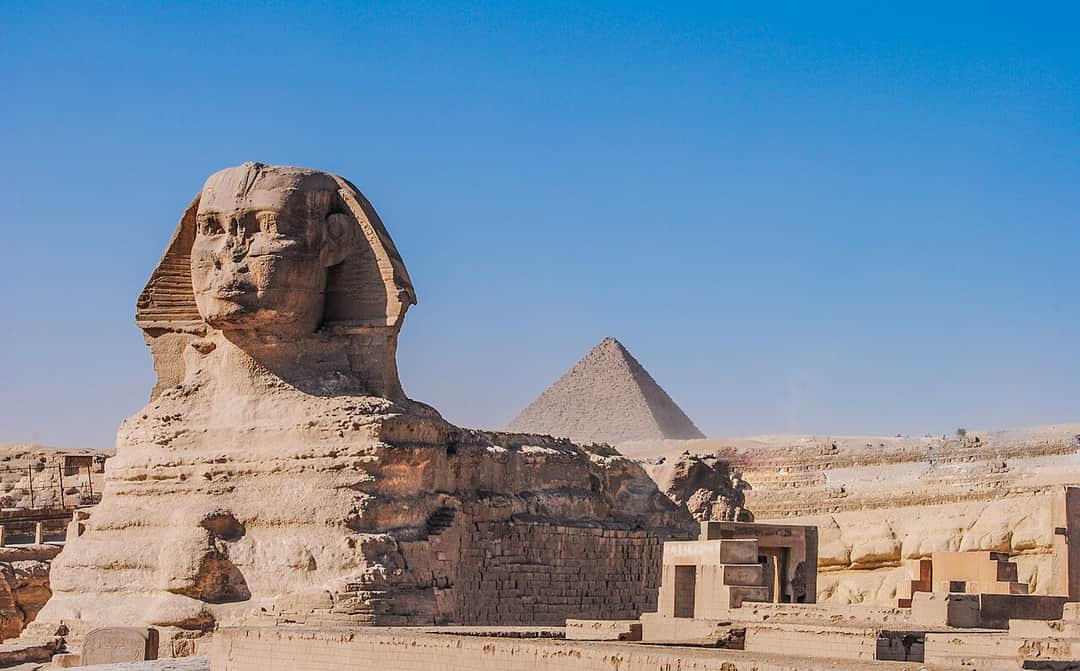
The Sphinx is smaller than the pictures suggest and better than expected anyway, chiefly because of where it sits: carved in place out of the bedrock, down in a quarried hollow, staring east at the sunrise with Khafre's pyramid behind it. The viewing terrace keeps you at a distance, so give yourself time to move around it and find the angle you want. Immediately beside it is the Valley Temple, built of colossal granite blocks with the simplest possible geometry and no decoration at all, and it is one of the most quietly impressive buildings on the plateau. Most visitors walk through it in ninety seconds on the way out. Stop for ten minutes.
The panorama point
A track runs out into the desert southwest of the plateau to a viewpoint where all three pyramids line up with the queens' pyramids beside them and no city in the frame. This is the shot people have in their heads, and it is the one place on the site where the desert setting finally reads the way you imagined. You can drive, ride or walk out to it, though walking in the heat is longer than it looks. Sunset here is the best hour of the day. It is also the single most heavily worked spot on the plateau for camel touts and photo sellers, so go with your answers already decided.
Camels, horses and getting around the plateau
The site is big, roughly two kilometres from the Great Pyramid to the far viewpoint, over sand and slope, and in hot months walking it all is more than most people want. That is why the animal rides exist and why they are pushed so hard. A short ride between the pyramids and the panorama point is genuinely useful and, on a good animal with a fair handler, enjoyable. The rules that save people trouble are simple: agree the total price and the exact route before you get on, agree explicitly that it covers getting down again, pay nothing up front, and never accept anything described as a gift. Electric shuttles run on the plateau as an alternative, which is worth asking your guide about.
The Grand Egyptian Museum
The vast new museum sits a short drive from the plateau and has changed how a Giza day is planned, because it is no longer a case of pyramids in Giza and antiquities across town in Tahrir. It holds the complete Tutankhamun material, shown together in a way it never was before, along with a colossal statue of Ramesses II in the atrium and a grand staircase of monumental sculpture that ends with a window looking out at the pyramids themselves. Allow half a day, not an hour. It pairs naturally with a morning on the plateau, and it is the obvious place to be while the sun is at its worst.
Saqqara and Dahshur, the trip that completes the picture
If you have a second day, spend it south of Giza rather than doing Giza twice. Saqqara has the Step Pyramid of Djoser, the earliest large stone building in the world and the prototype for everything at Giza, plus painted mastaba tombs whose reliefs of farming, fishing and butchery show you the daily life that Giza's bare granite does not. Dahshur, further south and much quieter, has the Bent Pyramid and the Red Pyramid, where you can often walk into the interior with nobody else in it. Seen in order, Saqqara then Dahshur then Giza, the whole thing turns into a legible engineering story rather than three famous shapes.
Site
Pyramids of Giza
Take it with you
Everything on this page in one document you can keep, print, or send to whoever you are travelling with. No email required.
Half a day is the realistic minimum and it is enough to see the three pyramids, the Sphinx and the panorama point without sprinting. A ninety minute stop, which is what some coach itineraries amount to once you subtract the drive, gets you photographs and very little else. If the pyramids are the reason you came to Egypt, build a full day around them: the plateau at opening, the Grand Egyptian Museum in the heat of the afternoon, and back to the panorama point for the last of the light.
It depends entirely on what you are expecting. There are no paintings, no carvings and no treasure inside, only bare passages and an empty granite chamber, so if you want decorated tombs you want Luxor, not Giza. What you get instead is the sensation of being deep inside the largest stone building ever raised, which some people find genuinely moving. Be realistic about the physical side. The ascending passage is low enough that you climb it bent almost double, it is hot, humid and stale, and you often meet people coming the other way. Anyone claustrophobic, or with knee or back trouble, should skip it. A good compromise is entering Khafre's pyramid instead, which is much less busy, or the Red Pyramid at Dahshur, which is the best interior experience of the lot.
It is constant rather than aggressive. Expect to be approached repeatedly by people offering camel rides, photographs, souvenirs and unsolicited help, and expect a few of them to give you wrong information to steer you somewhere. Nobody is likely to threaten you, but it does not stop on its own. What works is being friendly, brief and unambiguous. A clear no thank you without breaking stride is far more effective than an apologetic conversation. Never accept anything handed to you, because the gift is the opening move and payment is the second. Agree a price out loud before any service starts, including how the ride ends. Having a guide with you removes most of it entirely, which is much of what you are paying a guide for.
It is a pleasant way to cover the sandy stretch out to the panorama point, and the photographs are the ones people frame. The problem is that welfare standards vary a lot and the animals worked hardest at the gate are often the ones in worst condition. Look at the animal before you agree anything: it should be a decent weight, moving freely, with no sores under the saddle or girth. If it is not, walk away and say why. Agree the full price and route in advance, pay at the end, and be aware that a common trick is to stop somewhere inconvenient and rename the return leg as a second ride.
No. Climbing the pyramids is prohibited and enforced, and people who try are removed and can be fined or arrested. It is not a rule that gets bent for tourists, and it exists for good reasons: the blocks are high, uneven and worn, falls have killed people, and the monument is being damaged by the traffic. If somebody on the plateau offers to let you climb a little way up for a tip, they are selling you a problem.
Yes, in the ordinary sense. The site has a heavy police and tourism police presence, violent crime against visitors is rare, and the vast majority of trips pass without incident. The realistic risks are the mundane ones: overcharging, misdirection, pickpocketing in crowds, heatstroke in summer and road traffic, which is by some distance the most dangerous part of any Egyptian holiday. Keep valuables closed away, carry more water than you think you need, and use a driver rather than crossing multi-lane roads on foot.
You do not need one to enjoy the pyramids, but a good Egyptologist guide changes the day in two ways. The first is content: the plateau has almost no interpretive signage, so without a guide you are looking at extraordinary shapes with very little idea of who built what, when, or how the pieces relate. The second is friction. A guide handles the touts, knows which entrances are quiet and manages the logistics of a site that is bigger and hotter than it looks. Book through an operator rather than accepting an offer at the gate, where anyone can call themselves a guide.
Strongly, if you have the day. Saqqara's Step Pyramid is the ancestor of everything at Giza, and its nobles' tombs have the vivid painted reliefs of daily life that Giza itself lacks. Dahshur is quieter still, and the Red Pyramid is usually the one place in Egypt where you can walk down into a pyramid with hardly anyone else inside. Visiting them in chronological order, from Saqqara's stepped experiment through Dahshur's near miss and correction to Giza's perfected version, is far more interesting than seeing Giza alone.
A half day tour is the right choice if Giza is a stopover, a layover or one item in a packed week, and it does the essential job: the three pyramids, the Sphinx, the viewpoint, back to your hotel. Choose a longer Cairo itinerary if you want the pyramids to be more than a photograph. Three days lets you take the plateau slowly, give the Grand Egyptian Museum the time it deserves, add Saqqara and Dahshur, and still see Islamic Cairo and Khan el-Khalili, which is where the modern city becomes as interesting as the ancient one.