National park in Namibia
Most African parks reward searching. You drive, you scan the bush, you follow a guide's hunch and you hope. Etosha does not work like that, and visitors who arrive with the searching instinct spend their first day frustrated. Here you park at a waterhole, switch the engine off, and let the day walk towards you. In the dry months there is almost no free water in twenty thousand square kilometres of northern Namibia except at a scattering of springs and boreholes, and every animal in the park has to come to one of them eventually. The skill is not tracking. It is choosing a good waterhole and having the patience to still be sitting there two hours later when the elephants arrive.
The reason for all this is the pan. Etosha Pan is a salt flat so large it is easily picked out from orbit, a dry lakebed left behind when the rivers that once fed it changed course, and for most of the year it is a blank white sheet of cracked mineral crust with nothing living on it at all. In hard afternoon light it goes so bright that the horizon dissolves and giraffe walking along its edge appear to be standing in the sky. The Oshindonga name is usually translated as the great white place, and standing at the Etosha Lookout with the pan running away in every direction, you understand the naming immediately. That emptiness is the engine of the whole park: because the pan itself holds nothing, life is squeezed into the fringe of grassland and mopane and thorn scrub around it, and into the springs along its southern edge.
The game viewing that comes out of this arrangement is unusual. Rather than a single lion under a tree, you get theatre. A waterhole in September might hold two hundred zebra pressed into a nervous crescent, a family of elephants walking straight through them without breaking stride, giraffe splayed at an absurd angle to drink, oryx standing back with their horns up and springbok going in and out in short panicked rushes, all while a lioness lies fifty metres off in the grass doing nothing whatsoever. Nobody is hiding. You watch relationships and hierarchies play out over an hour rather than catching a two minute glimpse.
Then there is the part that genuinely sets Etosha apart from almost anywhere else on the continent. The three main rest camps each have their own waterhole, floodlit, with a low wall and benches, right on the camp perimeter. You can walk out after dinner, sit down in the dark and watch black rhino come to water at eleven at night. In most national parks you are locked in your camp at sunset with nothing to do; in Etosha the night is the second half of the show, and it is free, and nobody is driving. Regulars will tell you the best sighting of their trip happened after ten in the evening with a blanket over their knees.
One last thing to set expectations, because Etosha is often oversold. This is not a pretty park. It is dust, low pale scrub, thorn, glare and heat, and at midday it can look genuinely dead for an hour or two at a stretch. It is also very easy to visit independently: the main roads are good graded gravel, an ordinary saloon car copes, the camps are run by the state tourism company and you can drive yourself for a fraction of what a guided safari costs elsewhere in the region. That combination, high drama at the water and low cost of entry, is why people who know Namibia keep coming back to it.
Best time to visit
The dry season, roughly May to October, is when Etosha does the thing it is famous for. As the seasonal pans and puddles left by the rains evaporate through May and June, the animals are progressively forced back onto the permanent waterholes, and by August, September and October the concentration is extraordinary. Grass is cropped short and pale, the bush has dropped its leaves so you can see through it, and a single afternoon at a good waterhole can produce elephant, rhino, giraffe, zebra, oryx, kudu, springbok, jackal and a lion without you moving the vehicle. October is often the single best month for numbers, and it is also brutally hot, with afternoons that push into the high thirties and beyond while everyone waits for rain that has not yet come.
June and July are the cool dry months and they are a genuine surprise to people who packed for Africa rather than for Namibia. Days are pleasant, the light is clean, and the nights drop close to freezing. Sitting at the Okaukuejo waterhole at nine in the evening in July without a proper jacket, a hat and something over your legs is a mistake you make exactly once. It is also school holiday season in southern Africa and Europe, so the camps fill.
The green season runs from around November to April, with the heaviest rain usually falling January to March, and it turns Etosha into a different park with different rewards. Water appears everywhere, so the animals disperse and the waterhole method stops working. The grass grows long and hides things. In exchange you get thunderstorm skies over the pan that photographers travel for, enormous numbers of newborn springbok and wildebeest calves in the first months of the year, migrant birds arriving in force, and the pan itself potentially holding a shallow film of water. In a strong rain year that water brings flamingos and pelicans in numbers, which is a spectacle nobody expects from a desert park and which does not happen every year. Roads can be waterlogged, some tracks close, and the north is a seasonal malaria area in the wet months.
If this is your only visit and you want the classic Etosha, go between July and October and accept the heat at the back end of that window. If you have been before, or you care about photography and green landscapes more than about animal numbers, the green season is the better trip and it is quieter and cheaper. April and May are an underrated middle ground: the country still has some colour, the water is beginning to concentrate, and the camps are not full.
High season
July through October is the peak, with the Namibian winter school holidays in July and August the tightest of all. The three main rest camps inside the park are state run, limited in number and book out months ahead for that window, and a chalet at Okaukuejo with a waterhole view is one of the harder rooms to get in Namibia. Christmas and New Year is a second, shorter peak. February and March are the quietest months in the park.
Etosha's headline animal is the black rhino, and this is one of the most reliable places on earth to see one. They are browsers, largely nocturnal, bad tempered and shy, which is exactly why the floodlit camp waterholes matter so much: a black rhino that would never let you near it in daylight will walk into the lit circle at Okaukuejo at half past ten at night and drink for twenty minutes while forty people watch in silence. Halali's Moringa waterhole is the other strong bet after dark. White rhino also occur, and are more often seen on the private reserves along the park boundary than inside it.
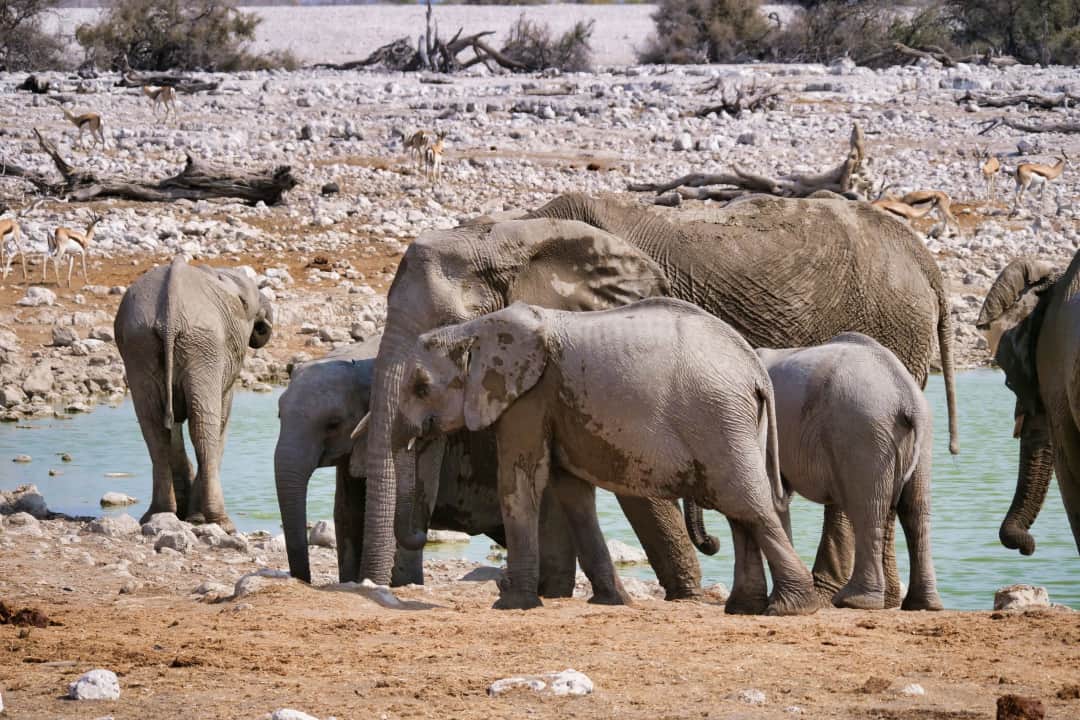
Elephant here look wrong to anyone who knows them from East Africa. Etosha bulls are among the tallest on the continent, and they are almost always coated in the pale grey calcrete dust of the pan, which turns them into ghosts moving through the thorn. They come to water in family groups through the middle and late afternoon and they take absolute precedence: zebra and giraffe simply retreat and wait. Lion are widespread and often lying up in the open near the springs, and Etosha lions have a habit of ambushing at waterholes rather than stalking, which means the drama sometimes happens right in front of you. Cheetah favour the open plains west and south of the pan, leopard are present and genuinely difficult, and spotted hyena are common at night while the shy brown hyena is a rare prize.
The plains game is what fills the frame. Plains zebra in their thousands, blue wildebeest, springbok everywhere in bounding herds, gemsbok standing motionless in the heat looking like something drawn rather than born, giraffe, greater kudu, eland, red hartebeest, steenbok and warthog. Two species are worth knowing by name because you will not see them in most other parks. The black-faced impala is a subspecies restricted to northwestern Namibia and southwestern Angola, and Etosha is its stronghold; look for the dark blaze down the face, most reliably around Namutoni in the east. The Damara dik-dik, a tiny antelope barely knee high, lives in the denser mopane thickets around Halali and Namutoni and freezes rather than runs, so most people drive past it.
Birds are better than the landscape suggests. Ostrich stalk across the plains, kori bustards, one of the world's heaviest flying birds, walk the short grass, secretary birds stamp through it hunting snakes, and pale chanting goshawks sit on almost every other roadside post. Crimson-breasted shrikes flash red through the thorn, and lappet-faced and white-backed vultures gather fast on anything dead. In wet years, when the pan holds water, greater and lesser flamingos and great white pelicans arrive in huge numbers to breed on it, and the same white nothing that looked lifeless in September becomes one of the largest waterbird gatherings in southern Africa. There is also a small and rather special resident population of blue cranes here, far from the rest of the species' range.
Sit at the Okaukuejo waterhole, especially after dark
Okaukuejo is the oldest and busiest of the rest camps, sitting near the southern Anderson Gate at the western end of the pan, and its floodlit waterhole is the single most famous piece of ground in Namibian tourism. There is a low stone wall, tiered benches, and a rule of silence that most people actually keep. Late afternoon brings elephant and giraffe and long queues of zebra; after dinner the light comes on and the night shift arrives, and this is when black rhino turn up, sometimes several in one night, sometimes with lion and hyena in the same hour. The trick is to treat it as a place to stay rather than a place to check. Bring a jacket even in summer, take a torch you will not need to use, and give it two or three hours instead of twenty minutes. People who sit through a slow hour are the ones who describe a rhino standoff at midnight afterwards.
Work the waterhole circuit west and south of Okaukuejo
The finest half day of driving in Etosha runs out from Okaukuejo across the open plains, and it is unusual for a safari because you can see what is coming from kilometres away. Ombika, just inside the southern gate, is a natural spring in a rock basin and one of the busiest waterholes in the park. Nebrownii and Gemsbokvlakte sit out on flat treeless grassland where elephant and lion have nowhere to hide. Okondeka, north of the camp on the pan edge, is worth the detour for a resident lion pride and for the view straight out onto the white. On the same loop lies Sprokieswoud, the so-called fairy tale forest, a strange isolated stand of moringa trees whose bulbous pale trunks and tangled limbs look nothing like the surrounding bush and are, oddly, the only place in the park that photographs well at midday.
Halali, the dolomite hill and the Moringa waterhole
Halali sits midway between the two better known camps and is quietly the choice of a lot of returning visitors. It is built against a dolomite outcrop, so it has actual trees and shade, and it is the only camp with a hill to climb: a short walk up to a viewpoint over the surrounding bush. Its Moringa waterhole is smaller and more intimate than Okaukuejo's, cut into rock below a viewing terrace, and it has a serious reputation for black rhino and for elephant after dark, sometimes with several rhino present at once and the tension that comes with it. The country around Halali is thicker mopane, which is where dik-dik and leopard live, and the waterholes on this stretch, Goas, Rietfontein, Salvadora and Sueda, sit at the pan edge and are among the best in the park for cats through the middle of the day.
Namutoni, the fort, and the eastern pans
Namutoni in the east is built around a whitewashed German colonial fort from the early 1900s, complete with towers you can climb for sunset over the surrounding palms. It feels least like a bush camp and most like a place with a history, and the country around it is different again: denser, greener in patches, with makalani palms and shallow seasonal pans. This is the best part of the park for black-faced impala and for Damara dik-dik. Fischer's Pan loops east of camp and floods in wet years into something that draws flamingos and waders, and Twee Palms, a waterhole marked by two lone palms against the flat, is the most photographed spot on this side of the park at first light. Chudop and Klein Namutoni are the productive waterholes to sit at. Its own King Nehale waterhole is floodlit but the least dramatic of the three camps.
Drive out onto the pan at the Etosha Lookout
For most of its length the pan is a thing you look at from the edge, but between Halali and Namutoni a short spur road runs out onto the surface itself at the Etosha Lookout, and this is one of the very few places in the park where you are permitted to get out of your vehicle away from camp. Standing on the crust with nothing in any direction, no vegetation, no landmark, no sound, the heat shimmer swallowing the horizon, is the closest thing Etosha has to a religious experience and it takes about four minutes to understand why the place is named the way it is. Go in the early morning or the last hour of light, when the surface turns pale gold and pink rather than white glare. Do not attempt to walk far out, and do not drive off the marked spur: the crust is thin over mud in places and vehicles have been lost through it.
The western sector, Dolomite Camp and the Olifantsrus hide
West of Okaukuejo the park changes character into dolomite hills and denser bush, and this sector was closed to general visitors for decades, which is still reflected in how few vehicles you meet out there. Galton Gate is the western entrance. Dolomite Camp sits on a ridge with chalets scattered along the crest and long views, and the western population includes Hartmann's mountain zebra and black rhino. The reason to make the effort, though, is Olifantsrus. It is a campsite only, no chalets, but it has the best hide in the park: a double storey structure right on the water where you sit at eye level with drinking elephants, on foot, behind glass and steel, with nothing between you and them but a few metres of air. It is the only place in Etosha where you experience an elephant at that range without a vehicle around you, and it is worth rearranging an itinerary for.
Self-drive it, and drive it properly
Etosha is one of the easiest great parks in Africa to visit under your own steam, and that changes the economics of a Namibian trip completely. The main routes are graded gravel that an ordinary hire car handles, fuel and shops exist at the main camps, and the rules are simple: stay in the vehicle except at designated points, keep to sixty kilometres an hour, and be inside a camp gate by sunset because the gates genuinely close. Driving well here means driving slowly and stopping often. The single most common mistake is treating the day as a route to complete, racing between waterholes and arriving at each one for five minutes. Pick two or three waterholes, sit for an hour at each, and eat lunch in the vehicle at one rather than going back to camp. If you would rather not drive, guided game drives leave from every rest camp, and they are the only way to be out legally before the gates open and after they close.
Add a night on the private reserves along the boundary
Etosha is surrounded by private conservancies that share unfenced or partly unfenced boundaries with the park, principally Ongava on the southern edge near Anderson Gate, Onguma in the east near Von Lindequist Gate, and Etosha Heights in the southwest. They matter because the national park rules that keep Etosha in good condition also limit what you can do there. On the private side you can drive after dark with a spotlight for genet, aardwolf, porcupine, brown hyena and hunting lion, you can go out on foot with an armed guide and learn to read tracks and dung rather than only look at animals, and several of them hold white rhino, which are far harder inside the park. Two nights outside the boundary and three inside is a better structured week than five nights of the same thing, and the contrast makes both halves better.
National park
Etosha National Park
Take it with you
Everything on this page in one document you can keep, print, or send to whoever you are travelling with. No email required.
For classic Etosha game viewing, August to October. By then the seasonal water has gone, the bush is bare, and the animals have no option but to come to the permanent waterholes, so the concentrations at places like Okaukuejo, Ombika and Goas are at their densest of the year. The cost is heat: October in particular is severe, and you will be sitting in a vehicle in it. June and July are cooler and very comfortable by day, though the nights get close to freezing and the camps are busiest. If you would rather have green landscapes, dramatic storm light, newborn antelope and very few other vehicles, come between January and March and accept that you will drive further for fewer animals. There is no bad month, but there are very different months, and the honest summary is that the dry season is for wildlife and the green season is for photographs.
Yes, and no. Etosha is one of the most self-drive friendly parks on the continent. The main roads through the park are graded gravel and are perfectly manageable in a standard two wheel drive hire car in the dry season, which is why so many Namibian itineraries are built around driving yourself. A high clearance vehicle is more comfortable, gives you a better viewing angle over the scrub, and is worth having if you are also doing the rest of Namibia's gravel network, but it is not a requirement for Etosha itself. In the wet season some of the minor loops can become difficult and the park closes tracks as needed. The rules are strict and enforced: you stay in your vehicle except at marked viewpoints and camps, you keep to the speed limit, and you are inside a camp by sunset. Plan the day around the gate times rather than assuming you can push on.
Okaukuejo for the waterhole, and it really is worth at least one night for that alone. Its floodlit waterhole is the best night viewing in the park and the reason many people come. Halali is the quieter middle option with real shade, a hill to climb and a smaller, more intimate waterhole with a strong black rhino record, and a lot of repeat visitors prefer it. Namutoni in the east has the fort, the palms and the best access to black-faced impala and dik-dik, but the weakest of the three camp waterholes. The natural structure for a three or four night trip is a night or two at Okaukuejo and a night or two at Halali or Namutoni, so you cover the western and eastern halves without driving the whole park every day. If a chalet with a waterhole view at Okaukuejo is available for your dates, take it and stop deliberating.
Better here than almost anywhere, provided you are prepared to stay up. Black rhino are largely nocturnal and shy, so daylight sightings are luck, but the floodlit waterholes at Okaukuejo and Halali reverse the problem entirely: you sit still in the dark and they walk in. On a good dry season night at Okaukuejo, several rhino may come through between about eight in the evening and midnight, sometimes in tense standoffs with each other. It is not guaranteed on any single night, which is the argument for two nights rather than one. White rhino also exist in the area but are seen much more often on the private reserves bordering the park than inside it. Do not use flash and do not talk loudly at the waterhole. Both will empty it, and the other forty people will not forgive you.
Not in the strict sense, and it is worth knowing before you go. Lion, leopard, elephant and rhino are all present, and Etosha is exceptional for two of them, but there are no buffalo in the park at all. There are also no hippo and no crocodile, because there is no permanent river to hold them. If the five species are your scorecard, Etosha will disappoint you on paper. What it gives instead is a viewing experience the classic big five parks cannot: enormous mixed gatherings at water, night viewing on foot, arid-country species like gemsbok and black-faced impala, and open ground where you can watch a lion approach a waterhole for ten minutes before it arrives. Judged as a place to watch animal behaviour rather than tick species, it is one of the best parks in Africa.
Three nights is the sensible minimum and four or five is better. Two nights only works if you are content with one part of the park, because Etosha is long from east to west and moving between camps eats most of a day when you drive it properly, stopping at waterholes on the way. Three nights lets you base at Okaukuejo for the western waterholes and the night viewing, then move east to Halali or Namutoni for the pan edge and the mopane country. Five nights lets you add the western sector through Galton Gate and the hide at Olifantsrus, which very few visitors reach. If you are on a fixed two week Namibian loop, Etosha usually justifies more nights than the standard itinerary gives it, generally at the expense of a night somewhere on the road.
It is, but only if you know what you are buying. From roughly December to April the rain fills pans and hollows across the whole park, so animals no longer need the permanent waterholes and simply disperse. The grass grows long and hides everything shorter than a zebra. Sitting at a waterhole, the defining Etosha activity, largely stops working. In exchange you get a park almost nobody else is in, thunderheads and light that photographers plan whole trips around, springbok and wildebeest calving in large numbers, migratory birds, and the real possibility that the pan itself holds water and fills with flamingos and pelicans in a way that never happens in the dry months. Rates are lower and the camps have space. For a first visit, choose the dry season. For a second or third, the green season is the more interesting park.
You leave camp at gate opening, which is sunrise, because the first two hours are the coolest and the most active, and you drive slowly to a waterhole and sit. Mid morning you move to a second one. From about eleven until three the park goes quiet, the heat builds, and this is the part people find hardest: the honest answer is that midday is often dead and the right response is either to return to camp for a swim and a sleep, or to park in shade at a waterhole and read a book with one eye up. The last two hours before sunset are the second peak, when elephant families and giraffe tend to come in, and you have to be back inside a gate by sundown. Then dinner, then the floodlit waterhole, which is genuinely a second game drive and the one most visitors underuse. Long days, two thirds of them very good.
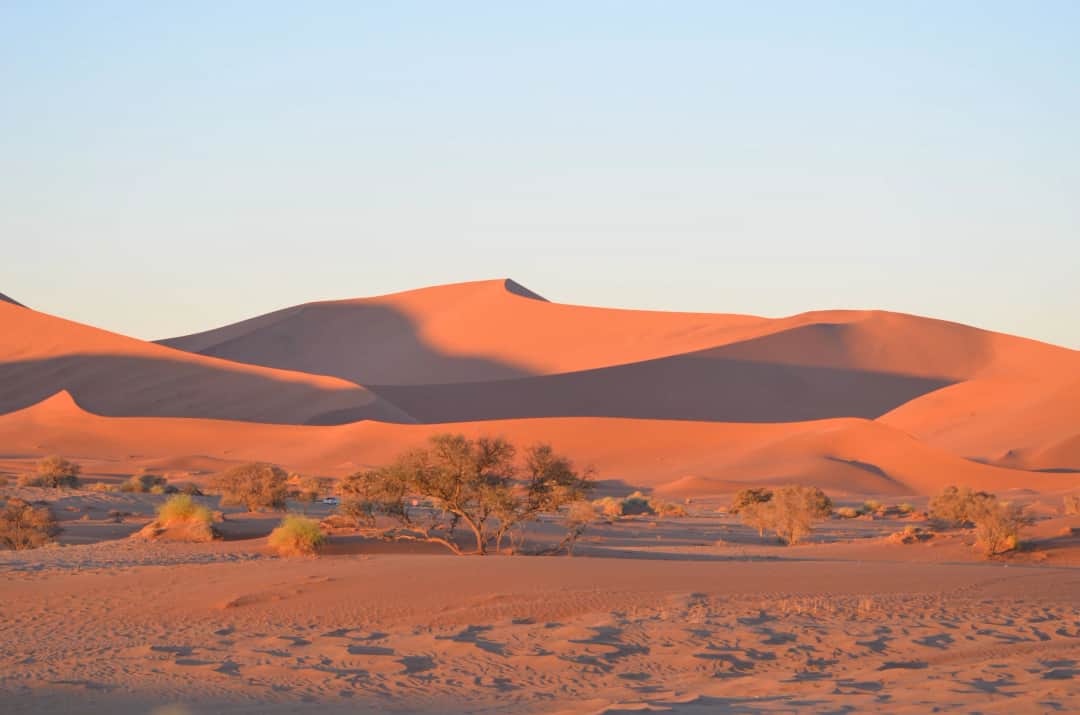
It is the wildlife chapter of what is otherwise a landscape country, and it sits in the north, so it usually anchors the top of a loop. A common and well proportioned two week route runs Windhoek, south to the Sossusvlei dunes, west to Swakopmund and the coast, north through Damaraland for desert-adapted elephant and rock art at Twyfelfontein, then east into Etosha before returning to Windhoek. Done that way, Etosha comes as relief: after a week of empty desert horizons, the sheer volume of animals lands harder. The drive from Windhoek direct to the southern gate is a long but straightforward day on good roads. If you have longer, the Caprivi in the far northeast adds rivers, hippo, crocodile and buffalo, and covers exactly the gaps Etosha leaves.