Site in Namibia
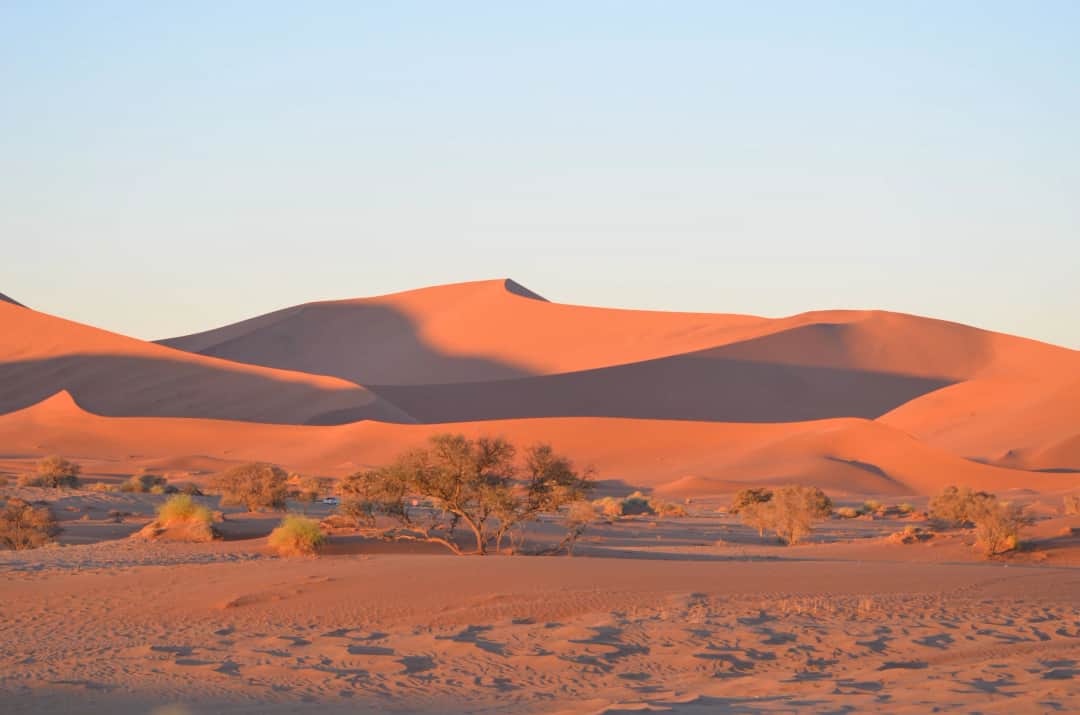
Sossusvlei is not really a place you visit. It is a light you have to be standing in at the right moment, and everything else about planning the trip follows from that. In the middle of the day the great dunes of the Namib are a flat, hazy, washed out orange, and people who arrive at eleven in the morning take a few photographs, get too hot and leave slightly puzzled about what the fuss was. At sunrise the same dunes split cleanly into two faces, one still black in shadow and one burning orange, divided by a knife-sharp crest that runs for hundreds of metres. That line is the reason anyone comes. It lasts about ninety minutes and then it is gone for the day.
The dunes sit at the eastern edge of the Namib, along a dry riverbed called the Tsauchab which ran out of the escarpment inland and once reached the sea, before the sand advanced and blocked it. Now it ends in a series of clay pans hemmed in by dunes on every side. Sossusvlei is the largest of those pans and the one the whole area is named after. The sand itself is old, worn round and stained deep red by iron oxide over an immense span of time, and it was carried here from the Orange river far to the south, pushed up the coast by the Benguela current and then blown inland. The Namib is generally described as the oldest desert on earth, arid in some form for tens of millions of years, and it feels it. There is nothing tentative or recent about this landscape.
The more famous image, the one on the covers, is not actually Sossusvlei but Deadvlei, a smaller pan a short walk away. It is a floor of white cracked clay, blinding in the sun, studded with the black skeletons of camel thorn trees that died centuries ago when the dunes cut off their water and which have never rotted because it is too dry for anything to rot. Behind them rises a dune wall several hundred metres high. White, black and orange, with nothing else in the frame and no scale to hold on to, it is one of the most immediately recognisable landscapes in the world, and it is one of the few that is not a disappointment in person.
The visit itself has a rhythm dictated entirely by the gate at Sesriem and by the sun. You get up in the dark, you drive sixty kilometres of tarred road between dune walls that are still grey, you climb something, and by ten in the morning the good light has gone and the heat has arrived and your day at the dunes is effectively finished. The afternoon is for the shade, the pool and Sesriem Canyon, and the evening is for the sky, because with no towns, no moisture and no light for hundreds of kilometres, this is some of the darkest and clearest night sky on the planet.
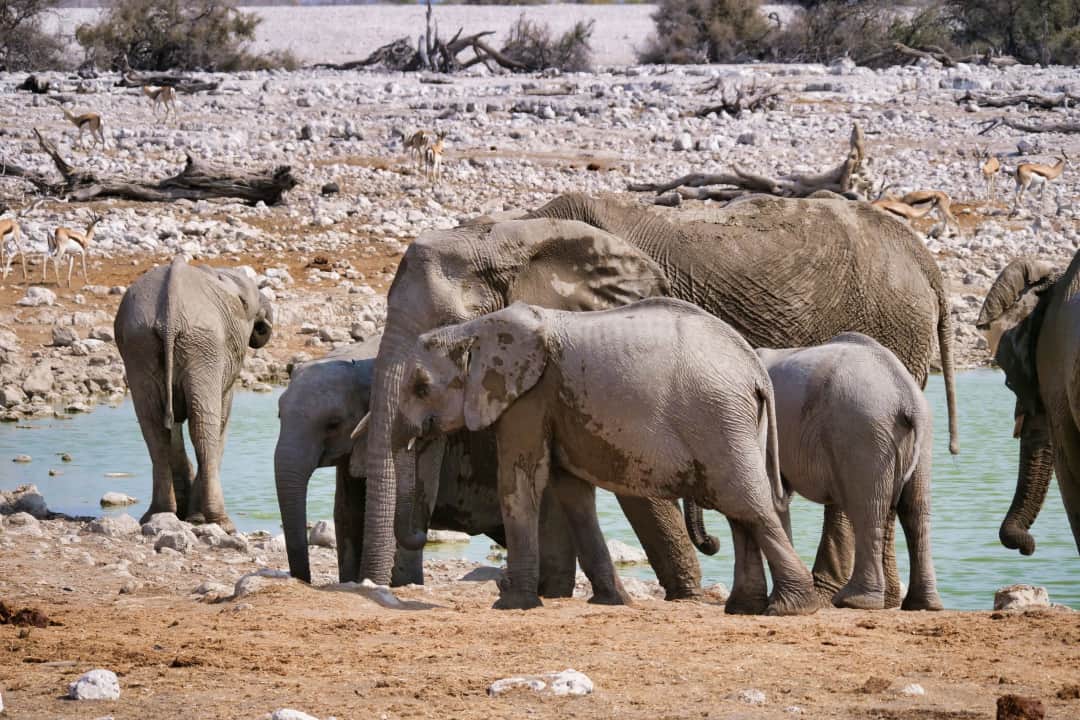
What catches people out is the physical reality. Climbing a dune is far harder than it looks, sand gives way beneath every step, there is no shade anywhere at all once you leave the car park, and Namibian distances mean the drive in from anywhere else is most of a day on gravel. This is a landscape trip rather than a wildlife trip. There are oryx and springbok and ostrich out on the gravel plains and they look magnificent against the sand, but nobody comes here for animals. They come to stand at the top of something enormous at six in the morning with the shadows still long, and that is worth arranging your entire route around.
Best time to visit
The practical seasons here are about heat and about light rather than about game or rainfall, because it barely rains at all. From roughly May to September, the Namibian winter, days are warm to hot and dry and the mornings are cold, which is exactly what you want when the plan is to climb a large dune at first light. June and July mornings before sunrise can be close to freezing and people are genuinely surprised by it: you want a fleece and a hat at the car park, and you will be down to a shirt within an hour of climbing. This is the most comfortable and by some distance the most popular time to come.
October through to about March is the hot half of the year, and summer here is severe. Daytime temperatures regularly go past forty degrees, the wind picks up sand, and the window in which climbing anything is sensible narrows to the first two or three hours after the gate opens. People do get into trouble on Big Daddy in summer, and the mistake is always the same: setting off late, carrying too little water, and underestimating a climb that has no shade and no shortcut. If you come in summer, be at the inner gate the moment it opens and treat ten in the morning as the end of the working day.
The short rainy season, roughly January to April, is a genuine trade. Rain in the Namib is rare and brief, but when it comes the gravel plains around the dunes turn a startling pale green for a few weeks, the sky fills with cloud that gives the dunes far more drama than a flat blue backdrop ever does, and in exceptional years the Tsauchab actually flows and puts water into Sossusvlei itself. That happens perhaps a handful of times in a generation and turns the pan into a shallow lake with dunes reflected in it, which is spectacular and completely unplannable. The risk is that thick cloud can flatten the sunrise light you came for, and access roads occasionally suffer.
For the sharpest dune photography, April, May and September are the sweet spots: cool enough to climb, clear enough for reliable sunrise, and not quite at the peak of the crowd. Avoid the middle of the day entirely in any month. Moon phase matters more here than season if stargazing is part of the plan, so if the night sky is important, look for dates near new moon.
High season
July to October is the peak, driven by European and southern African holidays and by the comfortable winter climate, and the small number of lodges within reach of Sesriem means accommodation gets tight several months out. The properties inside the park gate are the first to go and are worth booking well ahead of everything else in your Namibian itinerary. Sunrise at Dune 45 in August involves a queue of vehicles at the gate and a line of people on the crest. January and February are the quietest, largely because of the heat.
This is a landscape destination rather than a wildlife one, and any guide that promises otherwise is selling you something else. What lives here is thinly spread, brilliantly adapted and mostly small, and once you understand how it survives, the emptiness stops looking empty.
The defining feature of the Namib is fog. The cold Benguela current runs up the Atlantic coast and condenses moisture out of the air, which rolls inland overnight as a dense bank and burns off through the morning. In much of the desert that fog is the only reliable water there is, and an entire community of species lives off it. Darkling beetles climb a dune crest before dawn and stand on their heads so condensation runs down their bodies to their mouths. The Namib sand gecko, translucent and pink with webbed feet, hunts at night and licks dew from its own eyes. The sidewinding adder moves across loose sand at an angle to its own body, buries itself with only its eyes showing and lures with its tail tip. Golden moles swim through the sand without ever surfacing, and the white lady spider throws itself sideways down a dune face in a cartwheel to escape. Guided nature drives on the private reserves near Sesriem are built around finding these, and they are far more interesting than that description makes them sound.
The larger animals live out on the gravel plains and the dry riverbeds rather than in the dunes themselves. Gemsbok, the oryx that appears on Namibia's coat of arms, is the one you will remember: a heavy grey and black antelope with metre-long straight horns, standing on an orange dune slope at dawn in a place with no water at all. Springbok graze the flats, ostrich cross them at speed, and black-backed jackal patrol the roadsides. Brown hyena and Cape fox are present and largely nocturnal, and spotted eagle-owls and barn owls hunt around the camps. Along the Tsauchab watercourse, ancient camel thorn trees survive on deep groundwater and hold most of the area's bird life.
The plants are worth looking at properly rather than driving past. The nara melon, a leafless spiny bush anchored in dune sand by roots that can reach many metres down, feeds almost everything out here and has sustained people along this coast for a very long time. And the camel thorns of Deadvlei, dead for centuries, still standing, still hard as iron because there is not enough moisture for fungi or termites to break them down, are the clearest single statement this desert makes about itself.
Sunrise at Dune 45
Dune 45 sits forty five kilometres along the road in from Sesriem, which is where the unromantic name comes from, and it is the dune almost everyone climbs first. It is not the biggest, and that is precisely the point: the ridge is a manageable twenty to forty minutes at a slow plod, so you can reach a good height while the sun is still coming up rather than missing the light on the way. From the crest the dune sea runs away in ranks in both directions and the shadow line falls sharply down the face beside you. A lone camel thorn tree at the base gives the classic photograph its scale. It is also the busiest dune in Namibia at sunrise in high season, with a visible line of people on the ridge, so if solitude matters more than convenience, climb the unnamed dune opposite instead. Almost nobody does and the view is close to identical.
Deadvlei
Deadvlei is the reason most people came, even those who did not know its name before arriving. It is reached by a walk of roughly a kilometre over loose sand from the 4x4 car park at the end of the road, which sounds trivial and is not once the sun is up. What you arrive at is a flat white clay pan, hard and cracked underfoot, with perhaps a few dozen blackened camel thorns standing on it, dead for centuries and preserved rather than rotted. Behind them the dune known as Big Daddy rises as a solid orange wall. The colour separation is so absolute that photographs of it are routinely accused of being manipulated. Timing changes what you get: arrive at first light and the far wall is still in shadow with soft even light on the trees, wait until mid morning and the wall glows hard orange against white clay while the trees go almost black. Both work. The middle of the afternoon does not.
Climbing Big Daddy, and what that actually involves
Big Daddy is the tall dune standing over Deadvlei, well over three hundred metres from the pan floor, and climbing it is the physical challenge of a Sossusvlei trip. You go up the ridge rather than the face, because the ridge is compacted enough to hold your weight while the face is not, and it still takes most people between one and one and a half hours of genuine effort. Sand collapses under every step, so you lose a portion of each stride, and there is no shade and nowhere to sit that is not baking. Do it at first light or not at all. The reward at the top is a view down onto Deadvlei looking like a white postage stamp with black pins in it, and dune ranks in every direction. The descent is the best part: rather than retracing the ridge, you run straight down the steep face into Deadvlei, sinking to your shins at each stride, and it takes about five minutes. Take more water than you think you need, at least two litres a person, and a hat.
Sossusvlei itself and the last five kilometres
The road in from Sesriem is tarred for sixty kilometres, which surprises people expecting a desert track, and then it stops at a car park and the final five kilometres to Sossusvlei is deep, soft sand that a two wheel drive vehicle will not manage. You have three options: drive it yourself with a proper 4x4 and low range if you know how to handle sand, take the park shuttle that runs from the 2x4 car park, or walk, which is an hour each way and only sensible in the cool of early morning. Getting a hire car stuck in that stretch is a common and expensive mistake, and deflating your tyres is part of doing it properly. Sossusvlei is a larger, less dramatic pan than Deadvlei, ringed by dunes and holding a few living camel thorns, and in a rare wet year it holds standing water and reflects the dunes. Most people give it fifteen minutes and spend their time at Deadvlei instead, which is the right call.
Sesriem Canyon and Elim Dune in the afternoon
Once the light has gone flat, these are the two things worth doing near the gate. Sesriem Canyon is a narrow gorge the Tsauchab has cut about thirty metres down into cemented river gravel over a very long time, and it is a complete change of scale after the dunes: you walk down into it and along the floor between walls close enough to touch on both sides, in shade, with pools of water lingering in the deeper sections long after rain. The name comes from the six ox-hide thongs early travellers needed to tie together to lower a bucket to the water. Elim Dune, a few kilometres from the campsite, is the practical sunset dune when you cannot get out to the main dune field before the gate closes, with views back to the Naukluft mountains. Both are short, both are close, and both fill the dead hours between your morning at the dunes and dinner.
A balloon flight or a scenic flight over the dune sea
The dune field is far larger than the small corner you drive into, and the only way to grasp that is from the air. Hot air balloons launch before dawn from near Sesriem and drift for around an hour over dunes and dry riverbeds at whatever height the morning air allows, landing wherever the wind decides, usually for a breakfast set up in the open. It is expensive, weather dependent and books out in high season, and it is one of the few luxuries in Namibia that repeat visitors say was worth it. Light aircraft flights do something different: they run longer routes west over the sand sea to where the dunes meet the Atlantic, over shipwrecks on the Skeleton Coast, seal colonies and the Sandwich Harbour lagoon. If you have to choose, the balloon is the more intimate experience and the plane shows you far more country.
Stargazing
There is essentially no artificial light, no moisture in the air and no dust from industry for hundreds of kilometres in any direction, which combines into some of the finest night sky viewing accessible anywhere. The Milky Way is not a faint smudge here, it is a structured band bright enough to cast a suggestion of shadow, with the Magellanic Clouds clearly separate from it and the southern constellations high overhead. The NamibRand Nature Reserve, just south of the Sossusvlei area, was designated Africa's first International Dark Sky Reserve, and several lodges in the wider region have observatories, resident guides and proper telescopes. Even without any of that, walking away from the lights of a campsite for ten minutes with your eyes adapted is enough. Check the moon phase before you book: a full moon washes out everything and a few nights either side of new moon is a completely different sky.
Getting to know the small desert, with a guide
The one thing self-drive visitors consistently miss is the living desert, because it is invisible at forty kilometres an hour and much of it is nocturnal or fog dependent. Guided nature drives and walks run from lodges around Sesriem and the surrounding reserves, and they work at the opposite scale to everything else here: tracks in the sand read like a page, a beetle standing on its head to drink fog, a gecko dug out and put back, a sidewinder's looping trail, a nara bush whose roots go down further than the plant is tall. Guides who work these plains can also explain the fairy circles, the bare round patches that pattern the grassland north and south of here and remain genuinely unresolved among scientists. An hour or two of this changes how the rest of the desert looks for the remainder of your trip.
Site
Sossusvlei
Take it with you
Everything on this page in one document you can keep, print, or send to whoever you are travelling with. No email required.
It makes a real difference and it is the single most important booking decision here. There are two gates at Sesriem. The outer gate opens at sunrise. The inner gate, which leads to the dune road, opens about an hour earlier, but only guests staying inside the boundary at the Sesriem campsite or the lodges within it can use it. Since it is sixty kilometres from the gate to the end of the road, guests staying outside cannot physically reach Dune 45, let alone Deadvlei, until well after the sun is up, so they miss the shadow line that is the whole reason to be there at dawn. Accommodation inside is limited and books out early. If you cannot get it, the workable compromise is to stay as close to the gate as possible, be first in the queue at the outer gate, and settle for climbing Dune 45 in slightly later light rather than trying to make Deadvlei at sunrise.
Harder than any photograph suggests, and this is the most common misjudgement people make here. Sand collapses under each step, so you lose part of every stride, and the effort is closer to climbing stairs in soft snow than to walking up a hill. Dune 45 is the manageable one, twenty to forty minutes up the ridge at a steady pace with rests, and most reasonably mobile people get up it. Big Daddy is a different proposition: over three hundred metres of continuous climbing, one to one and a half hours, no shade, nowhere to stop that is not exposed. Fitness helps but so does technique. Walk the compacted ridge rather than the loose face, go barefoot if the sand is still cool, keep a slow steady rhythm rather than short bursts, and start at first light. In summer, do not begin a Big Daddy climb after about eight in the morning.
Not to reach Sesriem or to drive most of the way in. The approach roads are gravel and manageable in a two wheel drive with care, and the sixty kilometre road from the gate towards Sossusvlei is tarred. The final five kilometres to the Sossusvlei and Deadvlei car park is deep soft sand and genuinely requires a capable 4x4 driven by someone who knows to deflate the tyres and keep momentum. A shuttle service runs that last stretch from the 2x4 car park for everyone else, and it is a perfectly good solution. That said, a high clearance vehicle is worth having for Namibia generally: gravel road punctures are common enough that you should know where the spare and jack are before you set off, and many hire agreements include two spares for exactly that reason.
Two nights, which gives you one full sunrise at the dunes plus an afternoon and evening, is the practical minimum and is what most itineraries allow. A single night rarely works: you arrive in the late afternoon after a long drive, get up before dawn, and are back on the road by mid morning, which means one attempt at the light and no recovery if it is cloudy or you oversleep. Three nights is the comfortable version and lets you do Dune 45 one morning and Deadvlei with Big Daddy the next, in better light and without rushing either, with a balloon flight or Sesriem Canyon and stargazing filling the rest. Given how far you have driven to get there, a second morning is one of the better value additions to a Namibian route.
They are two separate clay pans a short distance apart at the end of the same dry riverbed, and the names get used interchangeably in a way that confuses people booking. Sossusvlei is the larger pan and lends its name to the whole area; it is ringed by dunes, has some living camel thorn trees and occasionally holds water after exceptional rain. Deadvlei is smaller, higher and whiter, cut off from water long ago, and it is the one with the blackened dead trees standing on cracked white clay beneath an orange dune wall. When someone shows you the famous photograph, it is Deadvlei. Both are reached from the same car park at the end of the road: Deadvlei is roughly a kilometre's walk over sand and is where you should spend your time.
Partly, and it depends on honest self-assessment. The drive in, the dune road, the views from the car and Sesriem Canyon are accessible to almost anyone, and Sesriem Canyon involves a short descent rather than a hike. The dune climbs are not: Big Daddy is a serious physical effort and even Dune 45 is hard work in soft sand. The walk to Deadvlei is roughly a kilometre over loose sand with no shade, which is manageable for many but not all, and is much easier before eight in the morning than after. Children generally love the dunes and love running down the faces even more, but they dehydrate faster than adults and need watching in the heat. There is no shelter anywhere out there and no water source, so everything you need has to come with you in the vehicle.
More water than feels necessary, at least two litres a person, because there is nowhere to buy any past the gate. A hat, sunglasses and sunscreen, and a windproof layer or fleece for the pre-dawn drive, which in winter can be near freezing while you will be down to a shirt two hours later. Closed shoes for the drive and the walk, although most people climb the dunes barefoot because sand fills shoes within a few steps. If you carry a camera, take something to keep fine sand out of it: this sand is exceptionally fine and gets into lens mounts and zoom barrels, and a change of lens on a windy dune crest is a decision you regret later. Something to eat, since you will be out for four or five hours before you see food.
Yes, though it helps to know what the experience actually is. This is not a place with things to do in the usual sense: there is no wildlife spectacle, no town, no cultural site, and the activity list is short. What it offers is the physical sensation of standing in a landscape at a scale that is difficult to process, in silence so complete that your own breathing becomes intrusive, at an hour of the day when the colour is doing something extraordinary. People with no interest in photography routinely describe the sunrise from a dune crest as the moment of their Namibian trip. What will disappoint you is arriving in the middle of the day, looking at a hazy orange hill and leaving. The place is entirely dependent on being there at the right hour, and that part is within your control.
It is usually the first major stop out of Windhoek and it anchors the southern half of a loop. A standard and well balanced two week route runs Windhoek to Sesriem for the dunes, west to Swakopmund and Walvis Bay for the coast and the cold Atlantic, north through Damaraland for rock art and desert-adapted elephant, then to Etosha for wildlife before returning to Windhoek. Done in that order the trip builds rather than repeats: emptiness, then coast, then rock, then animals. The drive from Windhoek to Sesriem takes most of a day on gravel with a stop at the tiny settlement of Solitaire, and the route over the Spreetshoogte Pass is far more scenic than the direct road if you have the time. Do not plan long drives and dune sunrises on consecutive days without a buffer: Namibian distances consistently take longer than the map implies.