
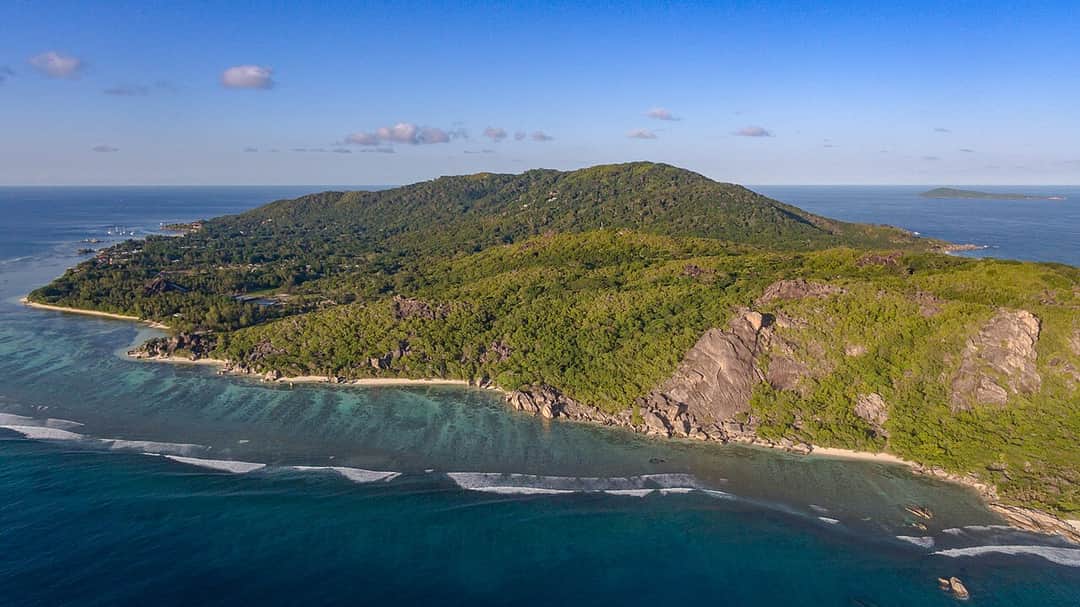
Island in Seychelles
Almost every tropical island you have ever seen is either a volcano or a pile of coral. The Seychelles is neither, and that single geological fact explains everything you recognise about the place. The inner islands, Mahe among them, are made of granite: a stray fragment of ancient continent that stayed behind in the middle of the Indian Ocean when India tore away and headed north. Granite weathers into rounded blocks rather than cliffs or black sand, so the beaches here come with boulders the size of houses lying in the shallows, smooth and grey and pink, worn into shapes that look deliberate. Nowhere else in the tropics looks like this, and knowing why makes the view better rather than worse.
Mahe is the main island and it carries almost everything: the international airport, the capital, the hospitals, and around nine in ten Seychellois. It is small, roughly twenty-seven kilometres long, and yet it takes far longer to drive around than the map suggests, because the middle of it is a mountain range. The interior rises steeply into forested granite ridges topped by Morne Seychellois at just over nine hundred metres, and the roads that cross it are narrow, hairpinned and slow. That vertical middle is the second thing people fail to anticipate. Mahe is not a flat island with a resort strip. It is a mountain in the sea with beaches around the edge, and the two halves of it feel like separate holidays.
Victoria, on the north east coast, is one of the smallest capital cities in the world and takes about an hour to walk around properly. It has a covered market that still smells of fish and cinnamon at eight in the morning, a small silver clock tower modelled on one in London, a Hindu temple painted in colours that stop traffic, a cathedral, and a botanical garden with giant tortoises in it. It is not a grand city and it does not pretend to be. What it does give you is a working Seychellois town, which is a useful corrective if you spend the rest of the week in places designed to be photographed.
The culture is Creole and it is genuinely its own thing: descended from French settlers who arrived in the eighteenth century, from enslaved Africans brought with them, from Africans freed by the Royal Navy and landed here, and from later Indian and Chinese traders. Kreol Seselwa is the everyday language, French and English are both official, and the food follows the same logic, with French technique applied to fish, coconut milk, chilli and whatever fruit is in season. Grilled job fish, octopus curry, breadfruit chips and a bottle of local beer at a beachside takeaway is the meal to plan your day around, and it costs a fraction of what the hotel will charge you.
Be clear about the money before you commit, because it is the one thing everyone underestimates. The Seychelles is expensive: not slightly, but consistently and across the board, from the hotel to the taxi to the tin of tomatoes in the shop. It is also more workable on a normal budget than its reputation suggests, because since the market opened up there has been a real network of small Seychellois-owned guesthouses and self-catering places, and there is a cheap and comprehensive public bus system that goes almost everywhere on Mahe. The honeymoon version of this island and the guesthouse version are the same beaches. Only the bill is different.
Best time to visit
Mahe sits close enough to the equator that the temperature barely moves through the year and there is no cold season, no dry season in the way East Africa understands it, and, importantly, no real cyclone season either. The islands lie outside the main tropical cyclone track, which is a genuine practical advantage over Mauritius or Reunion further south. What does change through the year is the wind, and on Mahe the wind decides which coast is calm, which is rough, which is clean and which collects seaweed.
From roughly May to September the south east trades blow, sometimes steadily and hard. This is the cooler, drier, fresher half of the year, good for walking in the hills and for anyone who finds humidity oppressive, and it is when the south and east coasts get swell, current and washed-up weed. Beaches on the sheltered north west, Beau Vallon in particular, are at their best in these months. From roughly November to March the north west monsoon takes over: hotter, more humid, more rain, generally lighter winds but with heavy squalls that pass through and clear. Now the pattern flips, the north west gets the choppier water and the weed, and the south and east settle down.
April and October are the changeover months and they are the quiet secret of the Seychelles calendar. The wind drops off between systems, the sea flattens, and underwater visibility is usually at its best of the year, which is why divers who know the islands book those two months specifically. They are also, being between the two obvious holiday peaks, slightly easier to book. If somebody asks for one recommendation without any other constraints, April and October are the answer.
Seasonal extras are worth building around if they matter to you. Whale sharks pass through around the end of the south east monsoon, broadly late August into October, and can be encountered on the west side of Mahe with licensed operators. Sea turtles nest on Seychelles beaches through the north west monsoon months. Rain, whenever it comes, is tropical rain: heavy, short and over, rather than a grey day. Very few Seychelles holidays are ruined by weather. Plenty are compromised by picking a coast that happens to be on the windward side that month, which is a planning error rather than bad luck, and one you can avoid entirely by asking your guesthouse which beach is sheltered in your dates.
High season
The busiest periods are the European winter holidays from mid-December into early January, Easter, and the northern summer months of July and August. Rates rise sharply and the better guesthouses and small hotels go months ahead. Mahe absorbs visitors more easily than Praslin or La Digue because it has the population and the road network to spread them out, so even in peak weeks the busy places are Beau Vallon and the Victoria ferry terminal rather than the island as a whole. May, June, September and early November are the quietest and best value.
Start with the rock, because on Mahe the geology is the scenery. The granite is a fragment of continental crust hundreds of millions of years old, and it weathers into rounded boulders and sheets rather than the cliffs and black sand of volcanic islands. Where a bare granite sheet is exposed on a ridge, the Seychellois call it a glacis, and these are miniature ecosystems in themselves: thin soil, extreme sun, and specialised plants including an endemic pitcher plant that grows on the rock and traps insects to get the nutrients the stone will not give it. The Copolia trail above Victoria takes you to one of these glacis in under an hour and is the single best way to understand how this island is put together.
The forest above the coast holds a set of species that exist nowhere else. Mahe is the only home of the jellyfish tree, one of the rarest trees in the world, thought extinct before it was rediscovered. Endemic birds are everywhere once you know them: the Seychelles bulbul calling from the canopy, the Seychelles blue pigeon with its red crown, the small and very fast Seychelles sunbird working through the flowers of a garden, and the Seychelles kestrel, a compact falcon that hunts lizards and is easily seen over Victoria itself. At dusk, large fruit bats cross overhead in numbers, which surprises people the first evening and becomes part of the rhythm of the place by the third.
Giant tortoises are the animal everybody wants and it is worth understanding the situation honestly. The great wild population lives on Aldabra, an atoll more than a thousand kilometres away and effectively closed to ordinary visitors. On Mahe you meet them in enclosures and gardens, most reliably at the botanical gardens in Victoria and at various hotels and smallholdings, where they are individually named and unhurried and perfectly happy to be scratched on the neck. It is not a wilderness encounter and nobody should pretend otherwise, but they are enormous, very old, and genuinely engaging animals to spend twenty minutes with.
In the water, the reefs around Mahe are shallow and accessible rather than dramatic. Marine parks at Sainte Anne off Victoria and at Port Launay and Baie Ternay in the north west offer the best snorkelling, with parrotfish, angelfish, wrasse, rays and green turtles over patch reef and seagrass. Some coral here has suffered badly from warming events over the last few decades and areas of it are recovering rather than pristine, which is worth knowing so you arrive with realistic expectations. Diving improves with distance from shore, around granite pinnacles and offshore rocks where the structure is better and larger fish gather, and the whale sharks that pass through at the turn of the season are the highlight of the marine calendar.
Beau Vallon and the sheltered north west
Beau Vallon is the long, gently curved bay on the north west coast, and it is the beach that does the most jobs. The water shelves gradually, the swimming is safe in most conditions, and unlike much of Mahe it has an actual scene along it: hotels, guesthouses, dive centres, watersports operators and a run of small restaurants and takeaways behind the sand. Evening food stalls set up along the beach at times, which is one of the better cheap meals on the island. It gets the most people of any beach on Mahe, which by Seychelles standards still means you can walk to a quiet section in ten minutes. The pattern to know is seasonal: Beau Vallon is at its calmest and cleanest during the south east trades from around May to September, and can be choppier and weedier during the north west monsoon at the turn of the year. If you are basing yourself in one place with easy access to boats, dives and buses, this is the practical choice.
Anse Intendance and the wild south
The south west coast is where Mahe stops being a postcard and becomes something more serious. Anse Intendance is a wide sweep of steep sand with no reef in front of it, so the ocean arrives unbroken, and on a big swell the shore break is loud enough to hear from the car park. It is one of the most striking beaches in the Indian Ocean and it is frequently not safe to swim, which is exactly the tension that makes it worth the drive. Nearby Anse Takamaka, Anse Soleil, Petite Anse and Baie Lazare give you the same coastline in gentler doses, and the road between them climbs and drops through forest and villages with almost no development on it. Take the warnings seriously here rather than treating them as legal boilerplate. Currents on this coast, and on Grand Anse and Police Bay further round, have caught out strong swimmers, and there are no lifeguards on most Seychelles beaches.
Walking in Morne Seychellois National Park
More than a fifth of Mahe is protected inside a national park that covers the mountainous spine, and walking it is the thing most beach visitors never do and later wish they had. Copolia is the easiest and the best introduction: an hour of stepped path through mist forest onto a bare granite dome with pitcher plants growing out of the rock and a view down over Victoria, the harbour and the Sainte Anne islands. Morne Blanc is short but steep and delivers a viewpoint straight down onto the west coast. The Anse Major trail runs along the coast from Bel Ombre over rock and scrub to a beach with no road to it, which is the closest thing on Mahe to arriving somewhere under your own steam. Go early, take far more water than feels necessary, and expect humidity rather than heat to be the difficulty. Trails are marked but can be slippery, and a guide is worth it for the longer routes.
Victoria
The capital deserves a morning and rewards one. Start at the Sir Selwyn Selwyn-Clarke Market before nine, when the fish is still coming in and the stalls are stacked with tuna, job fish, breadfruit, chilli and vanilla, and the upper floor sells the same souvenirs at a third of hotel prices. From there everything is walkable: the silver clock tower at the junction that Seychellois use as the centre of the world, the Hindu temple with its carved and painted tower, the cathedral, the natural history museum, and the national botanical gardens a short walk south where giant tortoises live under coco de mer palms brought over from Praslin. Add the Bicentennial monument on the waterfront and a bakery lunch and you have a proper half day. Victoria is not spectacular. It is the one place on the island where you see Seychellois going about ordinary life, and it puts the rest of the trip in proportion.
Snorkelling the marine parks
Two areas do most of the work. Sainte Anne Marine National Park sits just offshore from Victoria and is a cluster of small islands reached by boat, usually as a half or full day trip with snorkelling stops, a glass-bottom section for non-swimmers and lunch on an island. It is one of the older marine protected areas in the Indian Ocean and the shallow water is easy, which makes it a good choice for children and nervous swimmers. In the north west, Port Launay and Baie Ternay are quieter and, on their day, better: sheltered bays with seagrass and patch reef, green turtles, rays and good fish life, reached by road at Port Launay or by boat at Baie Ternay. Both are inside marine parks with an entry charge. Snorkelling here is about accessibility and calm water rather than wall-to-wall coral, and expectations calibrated to that will not be disappointed.
Creole food, markets and the rum distillery
Eating well here is the easiest way to make an expensive island affordable and the fastest way into the culture. The core dishes are grilled fish with lime and chilli, octopus curry cooked down in coconut milk, tuna steaks, rougaille-style tomato sauces, breadfruit fried as chips, and ladob, which is plantain or cassava simmered in coconut milk and eaten either sweet or savoury. The takeaways and small Creole restaurants along the coast roads serve this at a fraction of resort prices and portions are large. For a fixed half day, the Takamaka rum distillery occupies an eighteenth-century plantation house in the south east, and the tour covers cane, distillation and a tasting alongside the history of the estate itself. Add a stop at one of the craft studios and galleries scattered along the west coast, where several long-established artists work, and you have the non-beach afternoon that most itineraries are missing.
The colonial and Creole history in the hills
Above Victoria on the Sans Souci road, a viewpoint marks the site of Venn's Town, also called Mission Lodge, where a school was established in the nineteenth century for the children of Africans freed from slave ships by the Royal Navy and landed in the Seychelles. Little is left beyond low walls under enormous trees and a viewing platform over the west coast, and it is quiet enough that most visitors treat it purely as a photo stop. It repays five minutes of actually reading the boards. Seychellois society was assembled out of French settlement, slavery, emancipation and later migration within about two centuries, and this hillside is where that story is most directly visible. Combine it with the domaine and craft village sites elsewhere on the island and you get a version of Mahe that is about people rather than sand, which is what most beach itineraries leave out entirely.
Using Mahe as a base for Praslin and La Digue
The two other main inner islands are close enough to be part of any Mahe trip and different enough to be worth the effort. Praslin is about an hour by fast ferry or fifteen minutes by light aircraft, and holds the Vallee de Mai, a UNESCO-listed palm forest that is the natural home of the coco de mer, the largest seed in the plant kingdom, along with the rare Seychelles black parrot. Anse Lazio and Anse Georgette on Praslin are among the most photographed beaches anywhere. La Digue is a short second hop from Praslin, has almost no cars, is explored by bicycle, and contains Anse Source d'Argent, the beach of granite boulders and shallow pink-tinted water that appears in most images of the Seychelles. Day trips are possible but rushed. If you can spare the nights, one on Praslin and one on La Digue turns a Mahe holiday into a Seychelles one.
Island
Mahé
Take it with you
Everything on this page in one document you can keep, print, or send to whoever you are travelling with. No email required.
Because the inner islands are granite, and almost no other mid-ocean islands are. Most tropical islands are either volcanoes or coral formations built on top of them. The Seychelles inner group is a fragment of continental crust, hundreds of millions of years old, left stranded in the Indian Ocean when the landmasses around it moved apart. Granite erodes into rounded blocks rather than cliffs, so the shoreline ends up scattered with smooth grey and pink boulders, sometimes the size of a small building, standing in shallow water or leaning against each other at the top of the beach. It also produces a mountainous, forested interior rather than a flat coral plain, and a set of plants and animals that evolved in isolation on old rock rather than colonising new volcanic ground. Every visual cliche of the Seychelles traces back to that one fact.
Mahe alone is a good holiday. It has the widest range of beaches, the only real mountains and hiking, the capital, the best food scene and by far the most accommodation at every price level. If you have a week and want to stay put, staying put on Mahe is a defensible choice. That said, the three islands are genuinely different rather than variations on a theme. Praslin gives you the Vallee de Mai and the coco de mer, which is a botanical experience you cannot get on Mahe. La Digue gives you a near car-free island explored by bicycle and the most famous beach in the country. Day trips to either are possible on the fast ferry but involve a lot of the day spent travelling and arriving at the busiest hours. If your trip is ten days or more, split it. If it is a week, add one or two nights on La Digue and leave Praslin for another time.
It is expensive and there is no way to make it cheap, but the gap between the most and least expensive version of the same holiday here is enormous. The savings come from three decisions. Stay in a Seychellois-owned guesthouse or self-catering apartment rather than a resort: they are numerous, well run and often on the same beaches. Eat at Creole takeaways and small local restaurants rather than hotel dining rooms, and shop at the Victoria market. Use the public buses, which run across most of Mahe for a very small fare, instead of taxis, which are the single fastest way to spend money here. Domestic flights and boat excursions are where costs still bite, so book ferries rather than flights between the inner islands where you can. Done that way, the Seychelles is comparable to an expensive European holiday rather than an unreachable one.
This matters more here than at most beach destinations, because the beaches that photograph best are often the ones with the least protection. As a general rule, the sheltered bays on the north and north west, Beau Vallon above all, along with Anse Royale on the east and the marine park bays at Port Launay, are calm and safe in most conditions. The exposed south and west coast beaches, including Anse Intendance, Grand Anse, Anse Bazarca and Police Bay, can develop strong currents and heavy shore break, and people have drowned at them. Which coast is dangerous shifts with the monsoon, so a beach that is glassy in January can be unswimmable in July. There are no lifeguards at most beaches. Ask locally on the day, take posted warnings at face value, and if you are unsure and alone, walk it rather than swim it.
There is, and it is worth planning around rather than worrying about. Drifting seaweed accumulates on whichever coast is facing into the prevailing wind, so during the south east trades from about May to September it collects on the south and east beaches, and during the north west monsoon from about November to March it turns up on the north and west, including Beau Vallon. The quantity varies a lot year to year and week to week, and hotels clear their own frontage daily. The practical answer is not to avoid a season but to choose a coast: pick accommodation on the sheltered side for your dates, and keep a rental car or bus route in reserve so you can drive to the other side of the island on a bad week. Mahe is small enough that the leeward coast is never more than forty minutes away.
You do not need one, but it changes the trip. The public bus network covers almost the whole island, runs frequently on the main routes, costs very little and is used by everybody, which makes it one of the more pleasant ways to travel here. The limitations are that services thin out in the evening and the buses do not wait around for scenic stops. A hire car gives you the south west coast beaches at the hours when nobody is there, the interior viewpoints, and the ability to move to a sheltered beach when the wind changes. If you take one, know what you are getting: driving is on the left, the mountain roads are narrow with blind bends and sheer drops, parking at popular beaches is limited, and journey times are roughly double what the distance suggests. Confident drivers should hire. Everyone else can manage on buses and the occasional taxi.
Temperature is nearly constant year round, so the decision is about wind and sea state rather than climate. April and October are the two changeover months between monsoons, and they are the best all round choice: light winds, flat sea and the clearest underwater visibility of the year, which is why divers target them specifically. May to September is cooler, drier and breezier, good for hiking and for the north west beaches. November to March is hotter and wetter with heavier but short-lived rain, and suits the south and east coasts. Whale sharks generally pass through around the end of the south east monsoon, broadly late August to October. Unlike islands further south, the Seychelles is not in the main cyclone track, so there is no month that carries a serious risk of a storm wiping out your week.
It works well for both, and the reputation for honeymoons obscures how practical it is with children. The sheltered north west beaches shelve gently and stay calm for most of the year, the Sainte Anne marine park boat trips include glass-bottom viewing for children who will not snorkel, the botanical gardens and the tortoises reliably occupy a morning, and self-catering apartments with kitchens are widely available and far more forgiving than a resort room. The constraints are the ones you would expect: currents on the exposed beaches mean you have to be selective about where you swim, medical facilities are limited compared with a large country, and mountain roads with a car full of children are slow going. For honeymooners the appeal is obvious, and the quieter southern and western coasts deliver the privacy that the north west does not.
More than the marketing suggests, though less than on a larger island like Mauritius. Hiking in Morne Seychellois National Park is the standout and genuinely good, with routes from an hour to a full day through mist forest and onto bare granite domes. Diving and snorkelling run all year. Victoria gives you a market, museums, temples and gardens. There is a rum distillery in an old plantation house, craft and art studios along the coast, historical sites like the mission at Venn's Town, and boat trips to the marine parks and outlying islands. Add ferry hops to Praslin and La Digue and there is comfortably a fortnight of things to do. What Mahe does not have is a nightlife scene, extensive shopping or big-ticket attractions, and dinner options thin out early in the evening outside the main areas. Plan for early starts and quiet nights.
