
Site in Senegal
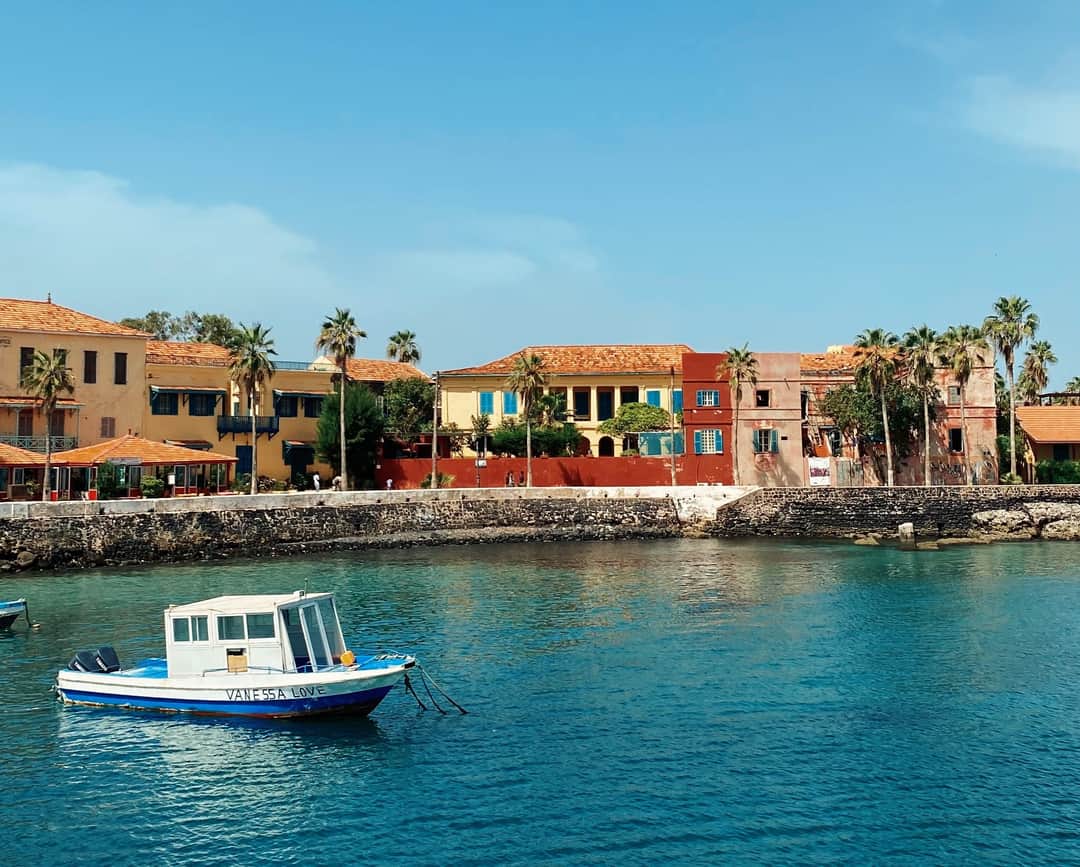
The crossing takes about twenty minutes and it does most of the work. You leave a terminal in the middle of Dakar's port, with cranes and container stacks and the noise of a capital city of several million people, and within a few minutes the mainland is a skyline behind you and there is an island ahead built of ochre, rust red and faded pink. You step off onto a stone jetty. There are no cars on Gorée and there never have been in any meaningful sense, so the first thing you notice is what you can hear: children, a radio, someone hammering, the sea. The House of Slaves is a four minute walk from where the boat ties up.
The island is small enough to walk around in half an hour without hurrying, under a kilometre long and a few hundred metres wide, a lump of basalt lying a couple of kilometres off the Dakar peninsula. Its whole history comes from that geography: the landward side is a sheltered anchorage in an otherwise exposed stretch of coast, and the seaward side is a cliff. The Portuguese used it from the middle of the fifteenth century, the Dutch took it and gave it the name that stuck, a corruption of their words for good harbour, and the English and the French took it in turn after that. Under France it became one of the Four Communes of Senegal, whose inhabitants held French citizenship rights long before the rest of the colony, which is why the island has the architecture of a small provincial French town dropped onto an African rock.
What brings almost everyone here is the Maison des Esclaves, the House of Slaves, and the doorway at the back of it that opens straight onto the ocean. It is the most photographed doorway in West Africa and one of the defining images of the memory of the Atlantic slave trade. It is also the subject of a real and long running argument among historians about how many people actually passed through this specific island, which is worth understanding before you go rather than discovering afterwards on the internet. The scale of departures from Gorée is genuinely contested. Its significance as a place of memory is not. Both of those statements are true at once and holding them together is the honest way to visit.
The other surprise is how alive it is. Around a thousand people live on Gorée, and it is not a preserved ruin or a site with a car park. Washing hangs across the lanes, bougainvillea comes over the walls in magenta and orange, cats sleep on the warm stone, and there is a substantial community of painters, sculptors and sand artists who work here because the light and the quiet are good. At weekends Dakar families come over for the small beach beside the jetty and the island feels like a village holiday rather than a monument. That contrast, between a beautiful place people are enjoying and what the buildings were used for, is the thing visitors find hardest to hold, and it is the truest thing about Gorée.
Practically it is one of the easiest significant sites in Africa to reach. It is a ferry ride from the middle of a capital city with an international airport. That ease is worth using properly: go on the first boats of the morning before the crowds and the heat, take longer than the two hours most day trips allow, and consider one of the small guesthouses so you are still there in the evening when the day visitors have gone and the island belongs to the people who live on it.
Best time to visit
Dakar sits far enough north on the West African coast to have a genuine cool season, and that is the single biggest variable in how a day on Gorée feels. From roughly November to May it is dry, with the alizé trade wind coming off the Atlantic, and from around December into February it can be pleasantly cool, breezy and clear, with mornings that need a light layer. This is the best window and it is no accident that it is also when most visitors come.
June to October is the hivernage, the rainy season, hottest and most humid from July into September. Rain here is not constant: it arrives as heavy storms, often at night or in the late afternoon, and between them the sun is fierce. Humidity is the real cost, because Gorée is walked rather than driven and the lanes hold heat. The compensation is a green island, dramatic skies over the water and far fewer visitors, and the cultural calendar in Dakar is quieter but the city is at its most ordinary and unguarded.
Within any day, the time you choose matters more than the month. The first boats of the morning put you on the island in cool air with the lanes almost empty, and if you go straight to the House of Slaves you may have the courtyard to yourself for a while, which changes the visit completely. Between about eleven and three the day trip crowds arrive, the heat sits in the alleys, and the House of Slaves can be shoulder to shoulder with tour groups. Late afternoon empties out again and the light on the ochre walls is the best of the day.
Weekends are Senegalese rather than touristic: the little beach fills with Dakar families, there is music, and it is busy in a completely different and rather good way. If you want a quiet, contemplative visit, come on a weekday morning. If you want to see the island as a living place, come on a Sunday afternoon and stay until the light goes. Whatever you do, do not book a two hour package that lands you at midday, walks you through the House of Slaves in twenty minutes and takes you back.
High season
The busiest stretch is November to March, when Dakar's dry cool season overlaps with European and North American winter travel and the island receives a steady flow of tour groups. Within any day the crush is mid morning to mid afternoon, when several ferries' worth of visitors are on a small island at once. Weekends are busy year round with Senegalese day trippers rather than foreign tourists. Early mornings, late afternoons and the rainy months from July to September are noticeably quieter.
Gorée is a site and a settlement rather than a wilderness, and what rewards attention here is the setting rather than any animal list. The island is a basalt outcrop with two distinct faces. The eastern, landward side is low, sheltered and built up, with the jetty, the little crescent of beach and the old town packed tightly behind it. The western side rises to the Castel, a rocky plateau of scrub and cactus with cliffs dropping to open Atlantic, where the wind is constant and the swell breaks white on black rock a long way below.
Colour is the thing people photograph. The old houses are washed in ochre, terracotta, rose and faded yellow, and the effect is not a heritage colour scheme but centuries of pigment from local earth, patched and repainted. Against it, bougainvillea in magenta and orange spills over garden walls, frangipani grows in courtyards, and a few large baobabs and old flame trees stand in the open spaces. In the strong midday light the island looks bleached. In the hour before sunset it turns the deep red that everyone remembers.
The animal life is essentially urban and coastal. Black kites turn constantly over the rooftops on the thermals coming off the rock, along with hooded vultures which are a normal part of the Dakar skyline rather than a sign of anything. Terns and gulls work the channel, egrets pick along the tide line, and the island's cat population is large, confident and thoroughly documented by every visitor with a camera. Offshore, pirogues work the water between here and the mainland all day.
The sea itself deserves a note. The beach by the jetty is shallow, sheltered and genuinely swimmable, which is why Dakar families come, and it is one of the more pleasant places to sit and let a hot afternoon pass. The Atlantic side is not swimmable and should not be attempted: it is cliff, rock and heavy swell, and the water below the Castel is deep and moving fast. Aside from that, the practical hazards of the island are sunburn and the cobbles.
The ferry from Dakar, which is part of the visit
The chaloupe leaves from a dedicated terminal on the Dakar waterfront near the port and takes around twenty minutes each way, running through the day with more sailings at weekends. Buy the return ticket at the terminal, note the time of the last boat back, and take the outside deck if you can get to it. The crossing does something no photograph of the island can: it puts a stretch of open water between you and the mainland, at exactly the point where the city drops away and the island comes up, and it makes the geography of the place immediately obvious. Foreign visitors pay a different fare from residents, which is normal and posted. The boats fill in both directions in the middle of the day, so travelling out early and back late avoids queueing on a hot quay.
The Maison des Esclaves and the Door of No Return
The House of Slaves is a two storey ochre building a short walk from the jetty, with a double curved staircase rising from a courtyard to the merchant's living quarters above and, below and behind, small dark cells opening off a ground floor passage. At the end of that passage is the doorway, framing nothing but sea. The house dates from the late eighteenth century and was restored and opened as a museum in the 1960s and 1970s, and for decades its curator narrated the visit himself in a delivery that people still describe as the reason the site is what it is today. Go early. It is a small building and thirty people in it changes everything. Read the FAQ below on the historical debate before you come, so that you can absorb what you are told without being ambushed by an argument you did not know existed.
The Historical Museum in Fort d'Estrées
At the northern tip of the island, Fort d'Estrées is a squat circular French fort from the middle of the nineteenth century, later used as a prison, and it now holds the Historical Museum of Senegal. The displays run chronologically through the casemates around the ring: prehistory and the early kingdoms of Senegambia, the arrival of Europeans on the coast, the Atlantic trade, the French colonial period, resistance figures, and independence. It is old fashioned museography, with a good deal of text and glass cases, and it is much the most useful single hour on the island for understanding what you are looking at everywhere else. Almost every day tripper skips it in order to be back on the boat. That is precisely why it is quiet and worth your time.
Walking the lanes, and the story of the signares
Gorée has no traffic, so walking it is the main activity and there is no route to follow. Sand and stone lanes run between two storey houses with shuttered windows, external staircases, courtyards you can see into, and walls in every shade between yellow and rust. Saint Charles Borromeo church, from the early nineteenth century, sits near the centre and is among the oldest in Senegal, and there is an old stone mosque as well. Look for the larger merchant houses and ask about the signares, the Franco African women of Gorée and Saint Louis who entered into recognised unions with European traders, held property and slaves in their own right, and formed a distinct and powerful local elite. Their story complicates any simple account of who did what here, which is one of the reasons the island repays a slow walk rather than a checklist.
The Castel and the view from the top
The Castel is the basalt plateau that forms the southern high point of the island, reached by a path that climbs past a small cluster of houses and craft stalls. On top there are gun emplacements and tunnels from the colonial period, including enormous coastal artillery installed to cover the approaches to Dakar, now rusting in the scrub. There is also a memorial to the victims of the slave trade and, on a clear day, the best view you will get: the whole island laid out below with its red roofs, the channel, and Dakar stacked up on the far shore. Go up in the last hour of light or early, because there is very little shade on the climb and it is exposed to the sun the whole way. Allow forty minutes for the round trip, more if you want to sit.
Artists, sand paintings and buying something well
A real community of artists lives and works on Gorée and a good number of them will invite you into their studios. The signature local craft is sand painting, in which coloured sands from different parts of Senegal are laid onto board to build up an image, and watching one made explains why they are not all the same price. There is also painting, woodwork, jewellery and a great deal of imported mass produced material sold alongside the genuine work, so it pays to look at several places before buying. Prices are negotiated, politely and without drama, and the sellers here are far less pushy than in Dakar's markets. Bring cash in small notes, because card payment is limited and change is a recurring problem.
Lunch, the beach and staying the night
Several small restaurants sit along the waterfront near the jetty, with tables out under the trees and a straightforward Senegalese menu of grilled fish, thieboudienne, yassa and chicken. Service runs at island pace, so order before you are hungry. The little crescent beach next to the landing is shallow, protected and used constantly by Senegalese families at weekends, and swimming there is a good way to spend the middle of a hot day. A handful of guesthouses take overnight guests, and staying is the single best decision available to you here. After the last ferry the tour groups are gone, the lanes empty, the light goes red and then blue, and you get a version of the island that day visitors never see.
Pairing Gorée with Dakar
Gorée is half a day, so the trip around it matters. On the mainland, the Museum of Black Civilisations in central Dakar is the serious complement to the island and covers the continent and its diaspora on a scale the small island museums cannot. The African Renaissance Monument on the western heights is worth the climb for the view over the peninsula whatever you make of the statue itself. Beyond that, Dakar rewards ordinary wandering: the Medina, the corniche, the fish landing at Soumbedioune in the late afternoon, and a live music night, since this is one of the great music cities of the continent. Two full days in Dakar with Gorée as one morning inside them is a much better shaped trip than a Gorée day trip on its own.
Site
Gorée Island
Take it with you
Everything on this page in one document you can keep, print, or send to whoever you are travelling with. No email required.
Ferries leave from a dedicated terminal on the Dakar waterfront, close to the port and within easy reach of the city centre by taxi. The crossing takes roughly twenty minutes and boats run through the day, with a heavier schedule at weekends when Senegalese families go over. Buy a return ticket at the terminal, take a photograph of the timetable, and know the time of the last sailing back, because missing it means finding a guesthouse. Foreign visitors and Senegalese residents pay different fares, which is posted and normal. There is no other way across for ordinary visitors, no bridge and no scheduled alternative, so the ferry schedule is the frame your whole day sits inside.
Most packaged trips allow about two hours, which is enough for the House of Slaves and a walk to the jetty and nothing else. Half a day is the sensible minimum: the House of Slaves, the Historical Museum in Fort d'Estrées, an unhurried walk through the lanes, the climb to the Castel and lunch by the water. A full day lets you swim, sit, and go back to the House of Slaves a second time when it is empty, which is a very different experience from the first visit in a group. Overnight is better still. A handful of small guesthouses take visitors, and once the last ferry has gone the island is quiet, the lanes are lit and lived in, and you are among residents rather than day trippers.
Yes, and it is better to know this before you go. For decades the site has been presented, including by guides on the island, with very large figures for the number of people shipped from Gorée. Historians of the Atlantic trade have argued for a long time that those figures are far too high, that the Senegambian coast as a whole accounted for a comparatively small share of total Atlantic departures, that the great volumes left from the Gold Coast, the Bight of Benin, the Bight of Biafra and West Central Africa, and that the House of Slaves itself was primarily a wealthy merchant's residence rather than a large holding warehouse. The doorway framing the sea, on this reading, is a symbol rather than a literal loading point. What that argument does not do is empty the place out. Gorée was a European trading post for more than three centuries, held in turn by the Portuguese, Dutch, English and French, and enslaved people were held, bought and shipped from here. The disagreement is about scale, not about whether it happened. It is also worth being clear that the numbers argument is sometimes picked up by people whose real interest is in minimising the slave trade in general, which is a separate and dishonest project. The reasonable position, and the one most Senegalese and most historians would recognise, is that Gorée's importance today is memorial: it is the place where this history is remembered on the West African coast, visited by heads of state and by descendants, and inscribed by UNESCO for exactly that reason. Go, take it seriously, and hold both facts at once.
It is short and it is physically small, which surprises people who know the photograph. You enter a courtyard with a curved double staircase, you look into low cells off the ground floor passage, you read the signs describing who was held where, and you reach the doorway at the back that opens directly onto rock and sea. There is usually a guide, and the delivery is dramatic and unhurried in a tradition established by the curator who ran the house for decades. In a group of forty in the middle of the day, the room by the door becomes a queue for photographs and the atmosphere goes. Alone or nearly alone, early in the morning, it is completely different and people come out of it quiet. That difference is entirely within your control and it depends only on which ferry you take.
You do not need one to find your way, because the island is tiny and unmissable. A guide is worth it for context, particularly on the merchant houses, the signares and the fort, and the better ones speak good French and often English and know the family histories of the buildings. Agree the price and the length of the tour before you set off, in words, and pay at the end. You will be approached at the jetty by several people offering, and by sellers and by children asking for money or sweets. A clear, friendly refusal repeated once works, and giving money to children on the street is discouraged locally because it keeps them out of school. Nothing about this is aggressive by the standards of major tourist sites and it stops once you are up in the lanes.
November to May is the dry season and December to February is the most comfortable, with cool Atlantic wind, clear light and mornings that need a layer. July to September is the rainy season, hot and humid, with heavy storms that mostly pass quickly, and it is much quieter. Within a day, timing matters more than the month. The first boats put you on the island in cool air with empty lanes, and if you go straight to the House of Slaves you may get it almost to yourself. Between late morning and mid afternoon the island holds several ferries' worth of visitors at once and it feels crowded, because it is small. Late afternoon clears again and the low sun on the ochre walls is the best photography of the day.
The island itself is excellent for children: no cars at all, a safe shallow beach, cats everywhere, and lanes they can run down without you worrying about traffic. Senegalese families treat it as a weekend outing for exactly those reasons. The House of Slaves is the part that needs judgement. It is not graphic in the way a museum exhibit can be, but the subject is what it is and the guides describe it directly, including the separation of families and the treatment of women. Older children who have been told beforehand what they are going to see generally handle it well and often ask better questions than adults. With very young children, consider taking turns so that one adult goes through the house properly while the other stays on the beach.
Cash in small notes, because card acceptance on the island is limited and change is scarce. Water, because it is hot and you will be walking. Sun protection and a hat, since shade is patchy and the climb to the Castel is fully exposed. Shoes you can walk cobbles and sand in, not sandals that fill with grit. Senegal is a predominantly Muslim country and Dakar is relaxed about dress, but modest clothing that covers shoulders and knees is respectful, particularly around the church and the mosque and when photographing people. Always ask before photographing residents, and be aware that some will ask for a small payment, which you can accept or decline politely. Take swimming things if you plan to use the beach, as there is nowhere convenient to buy them.
Yes, but expect a different kind of visit rather than a repeat of the same one. The Ghanaian castles are enormous military structures with dungeons that hold hundreds of people, and the tour there is a sustained hour of confinement and description that leaves most visitors flattened. Gorée is a small merchant's house on a beautiful island where people live, and its power is symbolic and quiet rather than overwhelming. If you approach it expecting the physical scale of Elmina you will find it slight. If you approach it as a memorial and as a place with its own long and complicated history, of Portuguese, Dutch, English and French occupation, of the signares, of the Four Communes and of Senegalese independence, it earns the day easily. Doing both, in either order, gives you a far fuller picture of the trade than either one alone.