
City in Ghana
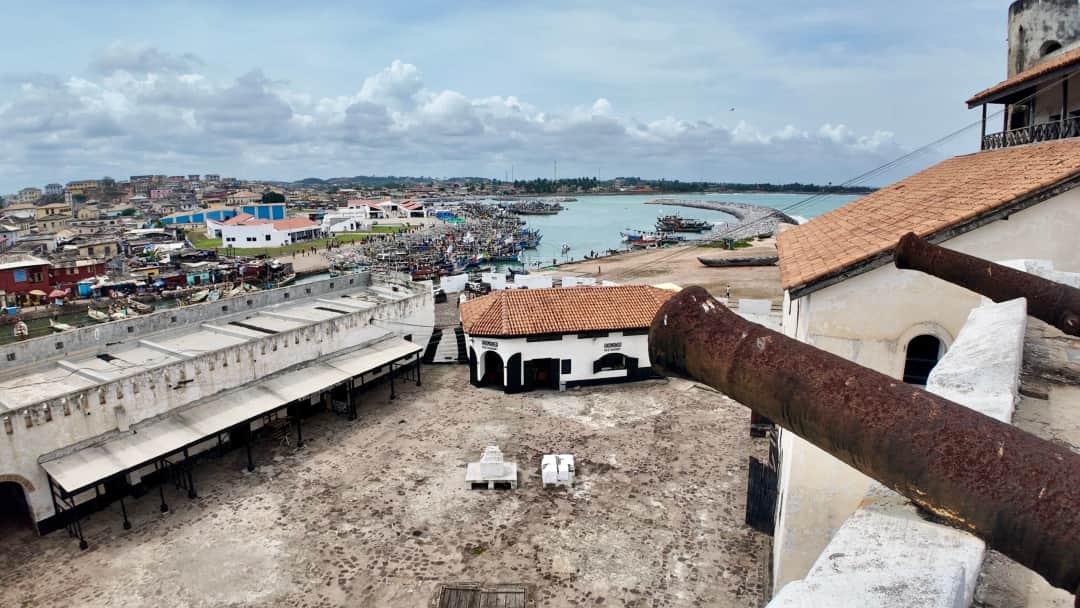
The first difficulty with Cape Coast Castle is that it is beautiful. It stands white and low on a black rock shelf above the Atlantic, surf breaking against the seaward wall, and drawn up on the sand beneath it are several hundred fishing canoes painted in every colour anyone had to hand. Children play football in front of the gate. Women sell oranges in the shade of the ramparts. Then a guide leads you down a short ramp into a stone room with no window, stops talking, and turns off the light, and the beauty is no longer available to you. People arrive prepared for the history. Very few arrive prepared for that contrast, and it is the thing they tend to remember.
The town is Oguaa in Fante and Cape Coast in English, a name the Portuguese left behind as Cabo Corso. The castle began in 1653 as a Swedish trading post and was taken and retaken by Danes, Dutch and English until the British held it and made it the headquarters of their administration on the Gold Coast. That pattern repeats the whole way along this shore. Within an hour's drive there is a greater density of European forts and castles than anywhere else in Africa, most of them built first for gold and timber and then converted, room by room, to the trade in human beings. Cape Coast Castle and Elmina Castle stand twenty minutes apart and are inscribed together on the UNESCO World Heritage list.
For a large share of the people who come here, this is not sightseeing. Visitors of African descent arrive at Cape Coast and Elmina the way other people travel to a family grave, and the language used on the ground reflects that: return, homecoming, ancestors. Ghana has leaned into it deliberately, through Emancipation Day, through Panafest, and through the Year of Return campaign that brought very large numbers of diaspora visitors to this coast. If that is why you are coming, plan the trip as a pilgrimage and not as a stop on an itinerary, because that is what it will turn out to be whether you planned it that way or not.
Geographically it is straightforward. Cape Coast sits on the coast road roughly three hours west of Accra, longer if you leave the city late in the morning. Elmina is a short hop further west. Kakum National Park and its canopy walkway are about forty minutes inland. Assin Manso, where enslaved people were washed in a river before the final march to the coast, lies off the road on the way down from Accra, and taking it in that order, river first, then castle, follows the route people were actually forced along.
The most common mistake is compression. Operators will sell you a single day out of Accra taking in Kakum, Elmina and Cape Coast, and it is physically possible. It is also a poor idea. Two castle tours in one day blunts both, a canopy walk before or after a dungeon is a strange emotional gear change, and the drive back into Accra traffic at the end of it gives you nowhere to put what you are carrying. Two nights on the coast is the difference between having seen this place and having been here.
Best time to visit
Ghana's southern coast is warm and humid every month of the year, so the seasons here are about rain and haze rather than temperature. The decision is mostly between the dry months, when everything is easy and the light is flat and hazy, and the wet months, when the country is green and the forest is at its best and you plan around afternoon downpours.
The main rains run from roughly May into July, with June usually the wettest month. Rain on this coast is heavy and short rather than constant, so it rarely wrecks a day outright, but the Kakum forest floor turns slick and the canopy walkway is closed in electrical storms. A second, lighter rainy spell comes around September to November. Between them, roughly late July and August, the coast gets a cooler and drier interlude that catches visitors by surprise: overcast, breezy, noticeably less hot, and the busiest cultural weeks of the year fall inside it.
December to March is the reliable dry stretch and the most popular time to travel. From December into February the harmattan blows down off the Sahara, and although it is far weaker here than in northern Ghana it still puts a dry dust haze in the air that softens the horizon and dulls photographs. Mornings are the answer to that: the light off the sea before nine is clean, the fishing harbour is at full noise, and the castle is quiet before the coaches come down from Accra. December is also when a great many Ghanaians abroad come home, so Accra and the coast road are lively and hotels fill.
If you want to choose by what is happening rather than by weather, aim at the last week of July and the first week of August. Emancipation Day falls on 1 August, and in alternate years Panafest brings performances, wreath laying and a night vigil at the castles. It is the most charged and most crowded time to be here. If you would rather have the dungeons close to empty and your own time in them, come in a quiet month and get to the gate when it opens.
High season
December and early January are the busiest weeks, driven by the Ghanaian diaspora coming home for Christmas and by the events built around that. The other peak is late July into August for Emancipation Day and, in alternate years, Panafest, when Cape Coast and Elmina fill with visitors from across the Americas, the Caribbean and Europe. Outside those windows the castles are steadily but not heavily visited, with mid morning to mid afternoon on weekdays the crowded part of any day.
This is a coast and a rainforest rather than a game destination, and the landscape has its own logic. The shoreline is rock and long surf beaches, with a heavy Atlantic swell that looks inviting and carries rip currents strong enough to be dangerous. Behind Cape Coast lies the Fosu lagoon, a shallow brackish water body that pulls in herons, egrets, kingfishers and waders, and beyond it the land climbs quickly into the last significant block of closed canopy rainforest left in southern Ghana.
That forest is Kakum, and it is genuinely rich even though it is stingy about showing you anything. Forest elephants live here and are seen rarely, usually as tracks, dung and pushed over saplings rather than as animals. Bongo, yellow backed duiker, giant forest hog and several monkey species including Diana monkeys are present, and the bird list runs well over two hundred species with hornbills, parrots and greenbuls among the ones you are most likely to hear. Butterflies are the reliable pleasure, especially after rain when they gather on damp ground in drifts.
What you actually experience on a day visit is the forest itself: enormous buttressed emergent trees, a canopy that closes above you and takes the sky away, cicada noise that rises and falls like machinery, and a temperature drop the moment you leave the car park. Wildlife viewing here is a matter of early starts and quiet feet. The walkway at eight in the morning with mist still lying in the valleys is a completely different place from the walkway at noon with three school groups on it.
On the coast itself, the fishing fleet is the wildlife story most visitors end up caught by. Watching a crew bring a canoe in through the surf, and the beach organise itself around the catch within minutes, tells you more about how this town lives than any museum panel. Several stretches of Ghana's coast east and west of here see marine turtles nesting in the cooler months, olive ridley and occasionally leatherback, and a few community projects run guided night walks in season. Ask locally rather than assuming, because the nesting beaches move and the projects come and go.
Cape Coast Castle: the dungeons and the Door of No Return
The guided tour is the point and it should not be skipped in favour of wandering alone. It runs roughly an hour and a quarter and it is structured deliberately: the courtyard and the cannon first, then the governor's apartments with their sea view and their light, then down into the male dungeon, a set of low stone chambers where hundreds of people were held at a time on a floor that still carries a compacted layer of what was left there. Guides usually turn out the lights for a moment. Above the dungeons sits the church, which is not an accident of layout and is pointed out as such. Then the condemned cell, then the passage to the Door of No Return, a low doorway opening straight onto the sea and the boats. The other side of the same door now carries the words Door of Return, put there for the descendants who come back through it. Go early. A tour shared with eight people is a different experience from one shared with fifty.
Elmina Castle and Fort St Jago on the hill
Elmina is twenty minutes west and it is the older building: raised by the Portuguese in 1482, later held by the Dutch and finally the British, and generally described as the oldest surviving European structure in sub-Saharan Africa. It is bigger, whiter and more labyrinthine than Cape Coast, and the tour lands differently. Guides here show you the women's dungeon, the small courtyard where women were brought out for the governor to choose from, the punishment cell with its skull marked door, and memorial plaques left by returning descendants. On the hill directly opposite stands Fort St Jago, built by the Dutch to command the castle they had just taken, and the twenty minute walk up to it gives you the best overview in the region: castle, lagoon, bridge and the packed harbour below. Doing both castles is worth it. Doing both in one day is not, and if you only have one day, most people find Cape Coast the stronger tour and Elmina the more atmospheric building.
Assin Manso and the ancestral river
About an hour inland, on the road down from Accra, Assin Manso was one of the last major slave markets before the coast, and captives were washed in the river here before the final march to the forts. It is a quiet, green, shaded place with a path down to the water, and it works powerfully as a first stop precisely because it is so unlike the castles: no walls, no cannon, just a stream under trees. There is a memorial garden where the remains of two people of African descent were brought back from the Americas and reburied, and a wall where returning visitors leave names. Taken in the right order, river then castle then the door onto the sea, the three sites become one journey in the direction it was actually walked. Most Accra day trips skip it entirely, which is a good reason to build your own itinerary rather than buy the standard one.
Kakum National Park and the canopy walkway
Kakum protects one of the last substantial blocks of rainforest in southern Ghana, and its famous walkway is a chain of seven rope and plank bridges strung between platforms built into emergent trees, roughly 350 metres end to end and tens of metres above the forest floor at the highest point. It sways. It is safer than it feels and quite a lot of people turn back at the second bridge anyway. The walk in from the visitor centre is a steady twenty minute climb through the forest and the guides are good on medicinal plants and on the birds you can hear but will not see. Go at opening time or pay for early access if it is offered: mist in the valleys, no groups, and a real chance of hornbills. Guided ground trails are the better option for anyone who wants to look for wildlife rather than look at forest from above, and a night or dawn walk is the only serious way to try for the shy species.
The fishing harbour and the town
Cape Coast is a working town and the harbour below the castle is its engine. Canoes come in through the surf mid morning and again in the afternoon, and the beach reorganises itself around each landing: boys hauling, women buying at the waterline, fish carried up on heads to the smokers, nets spread and mended along the sand. It is loud, wet, crowded and completely unstaged. Ask before photographing people and expect a conversation rather than a refusal. Uphill from the shore, Cape Coast has the frayed grandeur of a place that used to be the capital: colonial era shopfronts with first floor balconies, a small lighthouse on the point, and a set of long established secondary schools that made this town Ghana's education centre for a century. Walking the streets between the castle and the market for an hour is time better spent than most museum visits.
Panafest, Emancipation Day and Fetu Afahye
Three separate things happen here that are worth planning around. Emancipation Day on 1 August is marked annually with ceremonies at Assin Manso and the castles, including wreath laying and a night vigil in the dungeons that is among the most affecting things you can attend anywhere on this coast. Panafest, the Pan-African Historical Theatre Festival, runs in alternate years around the same period and brings performance, drumming, lectures and a large diaspora crowd to Cape Coast and Elmina. Separately, Fetu Afahye is the town's own festival, held by the people of Oguaa in early September, and it is a Ghanaian civic occasion rather than a diaspora one: chiefs in palanquins, asafo companies, drumming and a town that stops working for the day. Accommodation is tight for all three and needs booking well ahead.
The smaller forts along the coast
The two great castles overshadow a string of smaller forts that are often empty of visitors and give you a much clearer sense of how ordinary this infrastructure was. Fort William at Anomabo, east of Cape Coast, is a compact British fort in a busy fishing town that was itself a significant departure point. Fort Amsterdam at Abandze and Fort Good Hope at Senya Beraku are further along the same road in varying states of repair. Some are locked and need someone found to open them, several are ruinous, and the guiding is informal and uneven. What you get in return is the thing the big castles cannot give you: standing alone in a small dark room with no group and no script, working out for yourself what it was for.
Somewhere to sit afterwards
This belongs on the list as much as anything else does. The stretch of coast west of Elmina has quiet beaches at Brenu Akyinim and small clifftop places around Biriwa where you can do nothing for an afternoon, and the better hotels in Cape Coast itself face the sea. The reason to build this in is practical rather than indulgent. People come out of the dungeons flattened, and the standard itinerary sends them straight back into a minibus for three hours to Accra, which is when the day turns into something they never quite processed. Book the night. Eat grilled fish somewhere with the sea in front of you, talk about it or do not, and travel on in the morning.
City
Cape Coast
Take it with you
Everything on this page in one document you can keep, print, or send to whoever you are travelling with. No email required.
Both, on separate days if you can. They are not duplicates. Cape Coast usually delivers the stronger guided tour, with a clearer narrative arc from courtyard to dungeon to the Door of No Return, and it is the site most closely tied to the modern diaspora return movement. Elmina is the older and architecturally more extraordinary building, a Portuguese fortress from 1482 that rambles across several levels, and its tour puts more weight on the treatment of enslaved women. If you genuinely only have one day, take Cape Coast in the morning and climb Fort St Jago at Elmina in the afternoon for the view and the context without sitting through a second dungeon tour. Two full castle tours inside six hours leaves most people numb rather than moved, which is the opposite of what you came for.
You can, and a large proportion of visitors do, but it is the weakest way to see it. The drive is around three hours each way in good conditions and considerably more if you leave Accra after the morning rush has set in. That leaves you a tight window that operators typically fill with Kakum in the morning and a castle in the afternoon, or both castles back to back. The result is a day of watching the clock and a three hour drive home at the end of it, immediately after the most emotionally demanding hour of your trip. Stay at least one night in Cape Coast or Elmina. It costs you very little, it lets you reach the castle gate when it opens and the dungeons are quiet, and it gives you somewhere to be afterwards that is not a minibus.
It is difficult, and it is designed to be. You walk down into windowless stone chambers where people were held in numbers that make no sense until you are standing in the space, you are told plainly what happened in each room, and the lights are usually turned off for a moment so that you experience the dark. Guides describe conditions directly, including the treatment of women, and do not soften it. People cry, sit down on the floor, leave the group, pray aloud. All of that is completely normal here and nobody will be surprised by it. If you need to step out, step out. Give yourself the rest of the day afterwards with nothing scheduled, and if you are travelling with people you are close to, expect to want either silence or a long conversation, and not to know which until you are out.
Photography is generally permitted, but the question is more about judgement than about rules. Many visitors choose not to photograph inside the dungeons at all, and there is a clear difference between quietly recording a place and posing in it. Smiling group portraits in a holding cell, or anything staged in the Door of No Return, reads badly to Ghanaian staff and to other visitors, some of whom are there for their family rather than their itinerary. Wait until the guide has finished speaking, keep flash off, and photograph people only after asking. If your instinct in a given room is that the camera is intrusive, that instinct is right. The photographs you will value later are mostly of the courtyard, the sea and the town anyway.
Yes, and the sites are explicitly open to everyone. Ghanaian guides are used to mixed groups and will not treat you as an intruder. The behaviour that matters is simple: listen more than you talk, do not turn the tour into a debate about historical detail, and do not make it about your own discomfort in front of people for whom this is ancestral. Be aware that in a mixed group some people around you are having an entirely different experience from yours, and give them room. European visitors in particular sometimes feel a strong urge to explain or apologise on the spot. It is generally better received to be quiet, pay attention, and take it seriously.
There is no minimum age and Ghanaian school groups visit constantly, so children are a normal sight at both castles. Whether your own child should go depends on the child and on preparation rather than on a number. The material is unflinching, including the treatment of women and the punishment cell, and the darkened dungeon frightens some younger children. Older children and teenagers often get a great deal out of it, especially if they know beforehand what they are going to see and why the family is going. Talk it through in advance rather than letting the guide be the first source. Kakum's canopy walkway is a good pairing for a family trip, though the height and movement genuinely put some children off, and there is no shame in turning back at the first platform.
Emancipation Day is marked in Ghana on 1 August with ceremonies at Assin Manso and the coastal castles, including wreath laying and a night vigil held in the dungeons. Panafest, the Pan-African Historical Theatre Festival, runs in alternate years around the same period and adds performance, drumming, lectures and a large gathering of diaspora visitors to Cape Coast and Elmina. Together they are the most powerful time to be here and also the most crowded, with accommodation booked out well in advance and castle tours running at capacity. If communal ceremony and being among thousands of people who came for the same reason is what you want, plan for it and book early. If you want to stand in the dungeon almost alone, deliberately avoid these weeks.
It is worth adding, provided you treat it as its own outing rather than as filler on a castle day. The walkway is a series of seven suspended bridges linked by platforms in the crowns of large trees, and it moves under you as you walk, which is what most people find unsettling rather than the height itself. It is engineered and inspected, and the guides move small groups across steadily. Anyone with a serious fear of heights should still expect to find it hard, and the first bridge is where you find out. Beyond the walkway, Kakum is best experienced on foot with a guide, early in the morning, when the forest is cool and loud with birds. Do not go expecting elephants. They are present and very rarely seen.
Cape Coast is a relaxed and welcoming town and the usual precautions of any small city apply and no more: watch your bag in the market, avoid deserted beaches after dark, and take a taxi rather than walking back to an out of town hotel at night. Swimming is a bigger risk than crime, because the Atlantic surf here carries strong rip currents and there are no lifeguards on most beaches. At the castle gates and in the car parks you will be approached by sellers of carvings, beads and bracelets, and by people offering to guide you. Buy the official ticket and take the official guide at the desk. Decline the rest clearly and pleasantly, once, and keep walking. If somebody presses a bracelet onto your wrist as a gift, hand it straight back rather than accepting it.