
Site in Madagascar
Nobody should plan a Madagascar trip around the Avenue of the Baobabs on its own. The site is a short stretch of red dirt road a few hundred metres long, lined with roughly two dozen towering trees, and a visitor who parks, walks the road and takes photographs is done inside twenty minutes. Say that plainly before anything else, because the images that circulate online suggest a place you wander through for an afternoon. What actually earns the long drive out here is the tree itself, and the fact that the Avenue sits at the centre of one of the more rewarding corners of western Madagascar, provided you build a proper trip around it rather than treating it as a single stop.
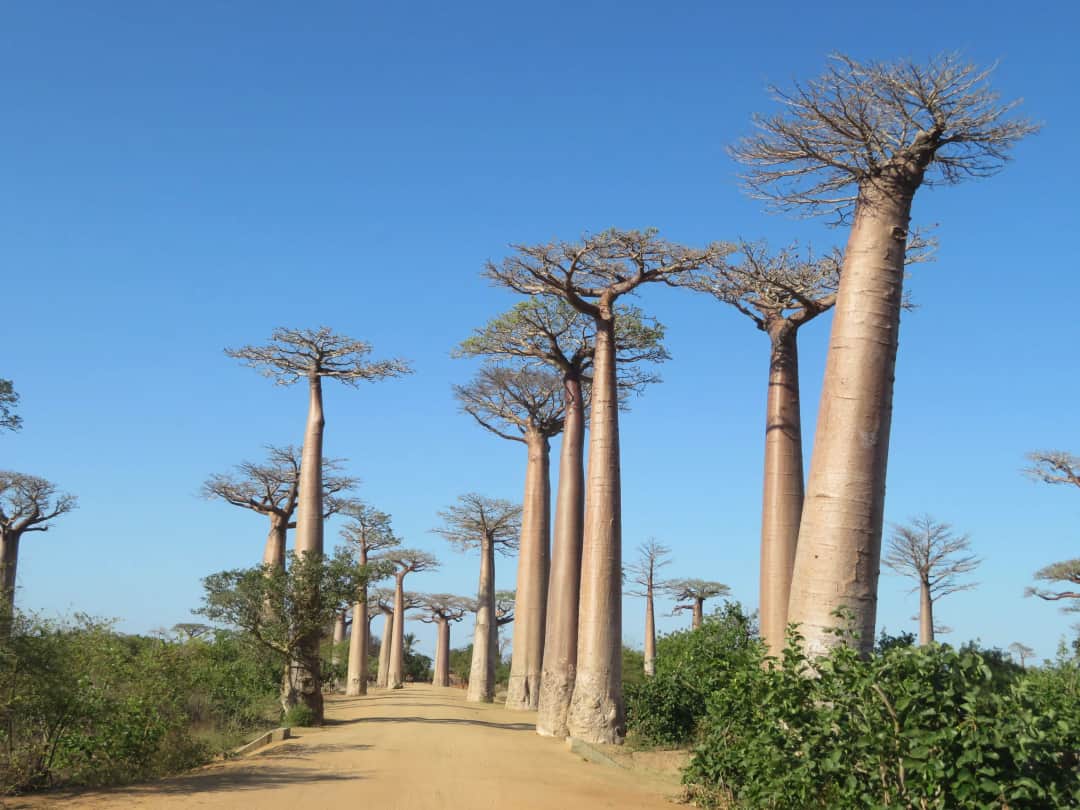
The trees are Adansonia grandidieri, Grandidier's baobab, the tallest and most photogenic of the six baobab species endemic to Madagascar. It grows a smooth, almost perfectly cylindrical grey trunk that can run thirty metres up before it opens into a flat, sparse crown of branches, a shape that looks less like a tree than a monument someone built on purpose. It is native to a narrow band of dry forest and farmland in the Menabe region of western Madagascar, between Morondava and Belo-sur-Tsiribihina, and this stretch of road happens to run straight through a dense stand of them, spared by farmers clearing the surrounding forest for rice and maize, generations ago.
Locally the tree is called reniala, mother of the forest, and the Sakalava people who farm this land regard individual baobabs as ancestral and sometimes sacred, tied to spirits and to the dead. That reverence is part of why these particular trees survived while the forest that once surrounded them on every side was cleared. They were left standing in the middle of paddies and fields, which is the reason the Avenue looks the way it does: not a forest, but a line of giants rising straight out of open farmland, with nothing else nearby to compete with them for scale.
Almost everyone who comes here is based in Morondava, the small coastal town about three quarters of an hour away by road, reached by a short flight from Antananarivo or a very long overland drive. From Morondava the Avenue is a routine excursion, usually paired with the Kissing Baobabs a short distance further on, where two trunks have grown wound around each other. The more rewarding version of this trip pushes further: Kirindy Forest for fossa and several lemur species after dark, and for the committed, Tsingy de Bemaraha, a limestone pinnacle landscape several rough hours to the north. None of this is a well paved, easy corner of Madagascar. It rewards people who arrive with time and a tolerance for bad roads.
One honest note before you go. The Avenue has no formal protected status. It sits on private and communal farmland, not inside a national park or strict reserve, and the trees you see today are what survived decades of clearing rather than a preserved forest. Cultivation still comes right up to the base of some trunks, and there is real concern among conservationists about erosion and long term root stress as agriculture presses closer. See it as it is now rather than assuming it will look the same in twenty years, and treat the fact that it still exists at all as the more remarkable part of the story.
Best time to visit
There are only two times of day worth being at the Avenue: the hour around sunrise and the hour around sunset. Through the middle of the day the light is flat and hard overhead, the trunks lose their shape and go a dull grey, and the photographs everyone has seen of this place, the trees as black silhouettes against an orange sky, are entirely a function of low sun. Most visitors go for sunset because it fits naturally at the end of a day out from Morondava, and it is also when local guides and vendors gather, so it is not a quiet experience. Sunrise gets you the same light with almost nobody else there, at the cost of leaving Morondava in the dark.
Season matters here for the roads more than for the trees, which do not change dramatically with the calendar. The dry season, roughly April through November, is when the unpaved road out from Morondava and onward toward Kirindy and Belo-sur-Tsiribihina is at its most passable, still corrugated and slow but not treacherous. June through September is also the coolest and most comfortable stretch of the year for driving and walking, and the clearest for the colours photographers chase at sunset.
December through March is the rainy season, and it changes the calculation substantially. Heavy rain turns the laterite roads into a genuinely difficult surface, river levels rise, and some routes north toward Tsingy de Bemaraha can become impassable or require detours by boat. The Avenue itself usually stays reachable from Morondava through most of the wet season since it is close to town, but the wider trip that makes the detour worthwhile, Kirindy and Tsingy, gets considerably harder and sometimes shuts down entirely at the height of the rains around January and February. Humidity is also at its highest through this period.
April to June and September to November are the sensible shoulder windows: the rains have eased or not yet begun, the heat of the dry season peak has not built up, and the wider Menabe circuit is fully open. If your trip depends on reaching Tsingy de Bemaraha as well as the Avenue, treat the rainy season as effectively closed and plan around it rather than hoping the roads hold.
High season
Madagascar's broader high season, July through September, is also the busiest stretch at the Avenue, driven by European and North American school holidays and by the dry, cooler weather that makes the whole west coast easiest to travel. Sunset at the Avenue during these months draws a real crowd of vehicles and vendors rather than a quiet moment alone with the trees. Christmas and the New Year add a shorter second peak despite falling inside the rainy season.
The Avenue itself is farmland rather than habitat, and wildlife directly on the road is thin: a scattering of birds using the huge hollow trunks as roosts, the occasional Madagascar hoopoe or vasa parrot overhead, chameleons in the surrounding scrub if you know where to look. This is not the reason to build a wildlife day around the Avenue. That reason is under an hour away.
Kirindy Forest, a patch of dry deciduous forest under community and research management north of Morondava, holds the best realistic chance most visitors will get to see a fossa in the wild. It is Madagascar's largest carnivore, a lean, long tailed, cat like predator more closely related to the mongoose family than to any cat, and it hunts lemurs through the canopy and undergrowth with a speed and confidence that looks nothing like its usual comparison. Sightings are never guaranteed, but Kirindy is the single best place in the country to try, and guides who work there daily know which individuals are currently holding territory nearby.
By day Kirindy holds Verreaux's sifaka, moving sideways across open ground between trees in a hopping gait that gets a laugh from almost everyone who sees it for the first time, and red fronted brown lemurs travelling in noisy troops through the canopy. After dark the forest changes character entirely: guided night walks turn up several species of mouse lemur, among the smallest primates on earth, along with sportive lemurs, giant jumping rats found nowhere else, and with real luck a fossa crossing a track in torchlight.
All of this belongs to the Menabe dry deciduous forest, one of Madagascar's most threatened habitats and now reduced to scattered blocks like Kirindy, hemmed in by the same agricultural expansion that has thinned the Avenue's own surroundings. Coming for the baobabs and adding a night near Kirindy is the difference between a photo stop and an actual look at what this part of Madagascar still holds.
Sunset at the Avenue
The standard visit times itself for the last hour before the sun goes down, when the low light turns the trunks into black silhouettes against an orange sky and the road briefly fills with visitors, guides and local vendors selling carvings and drinks. It is a genuinely dramatic twenty minutes and the reason most people come. Arrive with time to walk the full length of the avenue before the light drops rather than parking at the first tree you reach, because the best angles change as the sun moves and the crowd tends to cluster around only the two or three most photographed trunks.
Sunrise, without the crowd
The same light, the same silhouettes, and almost nobody else on the road, at the cost of leaving Morondava while it is still dark. Sunrise draws a fraction of the sunset crowd because it demands an early start on a rough road, which is exactly why serious photographers prefer it. The trees face a slightly different angle to the rising sun than to the setting one, so it is worth walking the avenue in both directions rather than assuming yesterday's sunset spot will work again this morning.
The Baobab Amoureux, the Kissing Baobabs
A short drive from the main avenue, two individual baobabs have grown with their trunks wound tightly around each other, a natural graft that local guides will tell you a longer story about, usually involving two lovers forbidden to marry. Whatever the truth of the legend, the trees themselves are a striking, unusual sight distinct from the straight rows of the main avenue, and the stop takes only a few minutes. Most itineraries combine it with the Avenue on the same afternoon since both sit on the same road out of Morondava.
A night walk in Kirindy Forest
Kirindy's dry forest is at its most interesting after dark, when a local guide with a torch leads small groups along quiet tracks looking for whatever is active that night. Mouse lemurs, among the smallest primates alive, are the most reliable find, alongside sportive lemurs sitting motionless in low branches and, with genuine luck rather than a guarantee, a fossa crossing the path. It is slow, quiet walking rather than a wildlife drive, and patience matters more than covering ground. Bring a torch of your own as backup and expect an early start the following morning if you are combining it with a day walk.
Fossa and sifaka by day in Kirindy
Daytime in Kirindy belongs to Verreaux's sifaka, which travel through the forest in family groups and cross open ground with a sideways hopping gait that looks like nothing else in the animal kingdom. Red fronted brown lemurs move noisily through the canopy in troops, and guides based at the forest's long running research camps are usually the best source of up to date information on where a fossa has recently been active. Morning is markedly cooler and more comfortable for walking than the middle of the day, and a guide who works here regularly is worth the extra cost over a generic driver-guide.
Tsingy de Bemaraha
Several rough hours north of Morondava, Tsingy de Bemaraha is a UNESCO World Heritage landscape of karst limestone eroded into a maze of razor sharp pinnacles, the word tsingy meaning roughly where one cannot walk barefoot. Ladders, via ferrata style cables and suspension bridges thread through the Grand Tsingy for those who want the full exposed route, while the Petit Tsingy offers a gentler version of the same formations. Decken's sifaka and a distinct set of forest birds live in the pockets of forest between the pinnacles. This is not a day trip from Morondava: reaching it typically means a full day of difficult road and often a river crossing, so it needs two or three nights added to a baobab itinerary, not an afternoon.
Belo-sur-Tsiribihina and the river
The small town of Belo-sur-Tsiribihina sits on the route north toward Tsingy, on the bank of the Tsiribihina river, and functions as the practical staging point for that onward journey, including the ferry crossing the road itself depends on. It is a modest, unhurried place rather than a destination in its own right, with a slower pace and a real sense of how remote this part of Madagascar still is once you are a few hours past the Avenue. Travellers doing the Tsingy route by road usually break the journey here rather than attempting it in a single push.
Morondava and Nosy Kely beach
Most trips are based in Morondava, a relaxed coastal town with a French colonial and Sakalava character, a working fishing harbour, and Nosy Kely, a spit of beach at the town's edge good for an evening walk rather than a swimming holiday. It is not a beach destination in the way Nosy Be or the east coast can be, and most visitors treat it purely as the gateway to the baobabs and Kirindy, flying in from Antananarivo, spending a night or two, and moving on. Worth a slow evening walk through town for the market and the boat builders working on traditional lakana canoes on the sand.
Site
Avenue of the Baobabs
Take it with you
Everything on this page in one document you can keep, print, or send to whoever you are travelling with. No email required.
Walking the road itself, even slowly with plenty of photographs, takes twenty to thirty minutes. Most visitors build a half day around it rather than the site alone: driving out from Morondava, stopping at the Kissing Baobabs a short distance further on, arriving with time to walk before sunset, then driving back after dark. Treat the Avenue as the anchor for an afternoon or evening rather than an outing that needs a full day on its own, and use the extra time to add Kirindy Forest either before or after.
Both give you the same low, warm light and the same black silhouettes against the sky, so the difference comes down to crowds and convenience. Sunset is the default because it fits naturally at the end of a day trip from Morondava and it is when local guides and vendors are present, but that also means the road fills with other visitors and vehicles in high season. Sunrise gives you close to the same photograph with almost nobody else there, at the cost of a very early, dark start. If photography matters more to you than convenience, choose sunrise.
It works as a genuinely quick stop: fly into Morondava from Antananarivo, spend one night, do the Avenue at sunset or sunrise and the Kissing Baobabs alongside it, and fly out. That is a real, worthwhile trip on its own. It becomes a much better one with two or three additional nights for Kirindy Forest, and a longer one still, four to five days beyond Morondava, for Tsingy de Bemaraha. Decide which version you are booking before you go, because a one night stop and a full Menabe circuit are very different trips sold under the same name.
Morondava has an airport with flights from Antananarivo, which is how almost everyone arrives, since the overland drive across central Madagascar is extremely long. From Morondava the Avenue itself is a short drive on a partly paved, partly laterite road, manageable in an ordinary vehicle in good weather. Onward travel toward Kirindy and especially Tsingy de Bemaraha requires a 4x4 and a driver who knows the route, and during the rains some of that onward road becomes difficult or impassable regardless of the vehicle.
Grandidier's baobab, the species that lines the Avenue, is considered threatened, and the pressure is visible on the ground rather than abstract: the dry forest that once surrounded these trees on every side has been cleared for rice and maize over generations, leaving the Avenue's trees standing alone in open farmland. The Avenue has no formal protected status, and cultivation still comes right up to the base of some trunks, which conservationists link to soil compaction and root stress over time. The trees you see are survivors of that clearing rather than a preserved forest, and their long term future depends on land use decisions being made around them now.
Yes, and for most visitors it is the single best addition to a baobab trip. Kirindy is roughly an hour north of Morondava, holds Madagascar's best realistic chance of seeing a fossa, and offers both day walks for sifaka and lemurs and guided night walks for the smaller nocturnal species. A night at a camp near Kirindy turns a baobab photo stop into an actual look at the dry forest ecosystem the Avenue's trees originally belonged to, and the extra driving is modest compared to what a Tsingy extension demands.
For travellers with the days and the appetite for rough travel, yes, it is one of the more remarkable landscapes in Madagascar. For anyone tight on time or averse to long stretches on difficult roads, it is a harder call. The journey north typically takes a full day of driving on laterite roads that can be exhausting even in the dry season, often including a river crossing, and the site itself rewards a proper visit of a night or two rather than a rushed single afternoon. Treat it as a separate, deliberate extension to the trip rather than something you decide on the day.
Weather and access move together here, so the practical answer is the dry season, roughly April through November, and especially June to September for the most comfortable travel and the clearest skies for sunset photography. The rainy season, December through March, makes the roads considerably harder and can shut down the route toward Tsingy de Bemaraha altogether at its peak around January and February. The Avenue itself, being close to Morondava, usually stays reachable through the rains, but the wider trip that makes the detour worthwhile becomes much harder to complete.
Local guides and vendors selling wood carvings, drinks and snacks are a normal and expected part of the sunset scene, and hiring a local guide for even a short walk supports the community that lives on and farms the land the Avenue stands on. Bargaining is normal but keep it good natured. Because this is living farmland and, for the Sakalava community, trees carrying ancestral significance, avoid climbing on roots or trunks and ask before photographing people directly. A small amount of courtesy goes a long way in a place that receives a great many cameras and comparatively little of the benefit.